
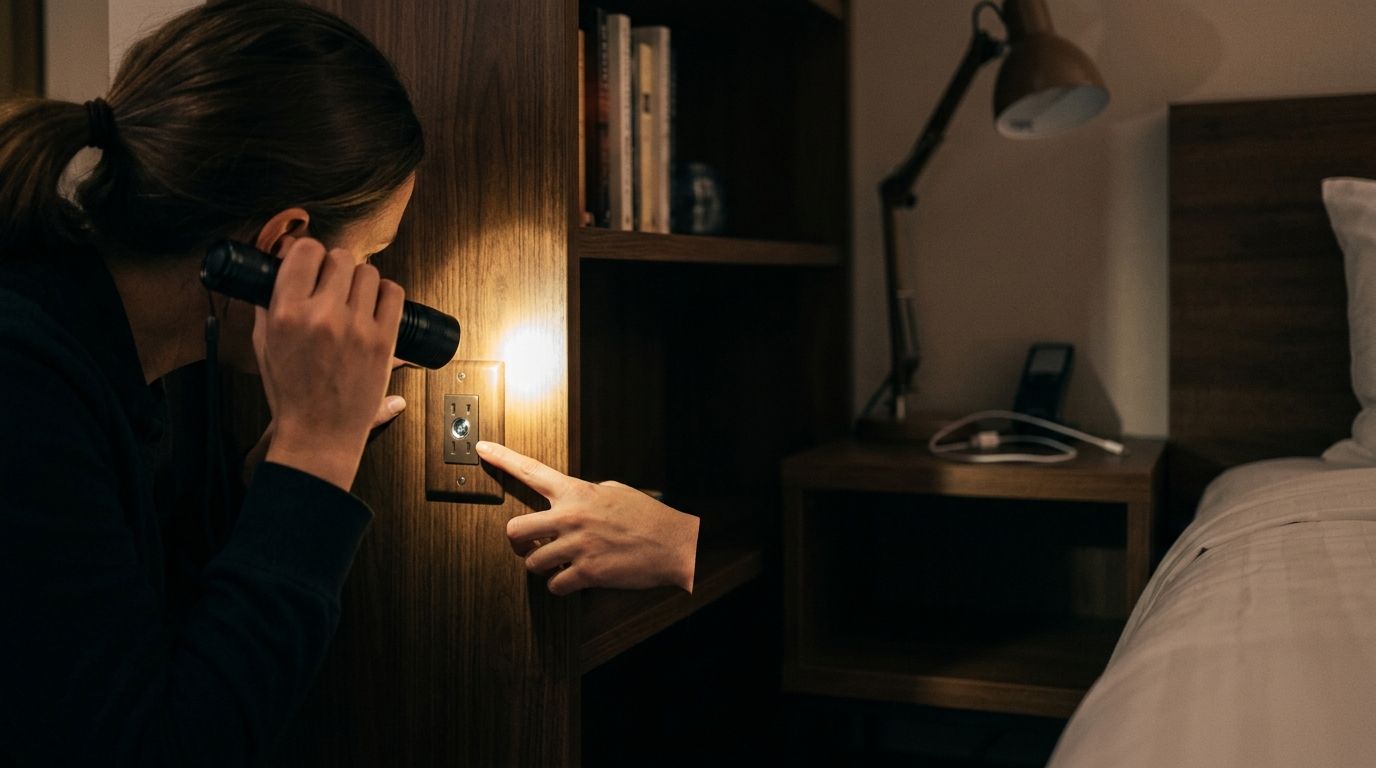
A flashlight reveals a hidden camera lens in under two minutes by bouncing light off the glass and catching the reflected glint, but it only works once the room is fully dark and you know how to hold the beam. The method catches lensed cameras hiding in clocks, smoke detectors, and wall outlets within about 3 to 10 feet — it does not catch cameras behind two-way mirrors, anti-glare coated lenses, or units wired without visible glass.
- Detecting a hidden camera using a flashlight works by spotting the lens glint in a fully darkened room.
- The flashlight scan catches most pinhole lenses within 3 to 10 feet but misses coated or mirror-hidden lenses.
- Pair the flashlight scan with a phone camera check or an RF detector for wireless and infrared cameras.
- A confirmed glint or ongoing suspicion in 2026 calls for a professional TSCM sweep, not more DIY scanning.
Why this matters
Hidden cameras keep showing up in short-term rentals, gym locker rooms, and office break rooms because pinhole lenses now cost very little and fit inside everyday objects — smoke detectors, phone chargers, alarm clocks. A flashlight scan is the fastest zero-cost check anyone can run before unpacking a suitcase or getting undressed in an unfamiliar space. It is not a substitute for equipment-grade detection, but it catches a real share of consumer-grade cameras that rely on an exposed lens.
USA Bugsweeps runs full TSCM sweeps nationwide for homeowners and business owners who need certainty beyond a flashlight, but the technique below is worth knowing before you ever make that call.
How to detect a hidden camera using a flashlight
The flashlight trick works on the same principle as eyeshine in a photograph — a camera lens reflects light back toward its source at a very narrow angle, which makes it flare when your eye and the beam are aligned.
- Kill every light source in the room. Turn off lamps, close blinds, and cover any glowing electronics — even a phone screen left face-up will wash out the glint.
- Use a small flashlight rated at 100 lumens or higher. Anything dimmer struggles to produce a visible reflection past a few feet.
- Hold the flashlight next to your eye, not out at arm's length. The beam and your line of sight need to be nearly parallel for the glint to bounce back to you.
- Sweep the beam slowly across the room — walls, shelves, smoke detectors, alarm clocks, picture frames, and electrical outlets first, since these hide the most cameras.
- Watch for a small pinprick of colored light — usually blue, green, or white — flashing back at you. Pinhole camera lenses typically measure just 1 to 2mm wide, smaller than a pencil eraser.
- Move to a second position and repeat. A lens only glints when the beam hits it dead-on, so a single sweep from one spot will miss cameras angled away from you.
| Method | Range | Catches | Misses |
|---|---|---|---|
| Flashlight glint scan | 3-10 ft | Exposed pinhole lenses | Coated/mirrored lenses, no-lens wired units |
| Phone camera scan | 2-5 ft | Infrared LEDs on night-vision cameras | Cameras without IR illuminators |
| RF detector | Room-wide | Wireless transmitters actively broadcasting | Wired cameras, cameras on local storage |
Verdict: the flashlight method is a legitimate first pass, best for a quick check in a hotel room or rental — not a replacement for an RF sweep when the stakes are higher than a weekend stay.
Why the flashlight method misses some cameras
- Anti-reflective lens coatings on newer covert cameras cut the glint down to almost nothing, even at the right angle.
- Cameras behind two-way mirrors or mesh fabric scatter the light before it reaches the lens.
- Ambient light contamination — a charging LED, a phone screen, or a sliver of daylight under a door — washes out the faint reflection you're looking for.
- Wrong angle or distance — the glint only appears within a narrow cone, so a camera three feet to your left won't flare if you're scanning straight ahead.
- Wired cameras hidden inside objects like outlet covers or USB chargers sometimes route the lens behind a pinhole so small the reflection is nearly invisible to the naked eye.
- Cameras that record to local storage rather than broadcasting won't show up on an RF detector scan either, which is why a layered check matters.
Running a phone camera method for hidden cameras alongside the flashlight scan catches infrared illuminators that a visible-light flashlight can't see, since most phone camera sensors pick up near-infrared light the human eye misses entirely.
Not sure what that glint was?
Get a professional TSCM sweep to confirm or rule out hidden cameras.
Does a flashlight work on all hidden cameras?
No — a flashlight only works on cameras with an exposed, uncoated lens within roughly 3 to 10 feet of your position in a fully darkened room. Cameras hidden behind two-way mirrors, mesh speaker grilles, or fitted with anti-glare coatings won't produce a visible glint no matter how carefully you scan.
What flashlight is best for finding hidden cameras?
A flashlight rated at 100 lumens or higher works best for finding hidden cameras, held directly next to your eye rather than out in front of your body. Tactical flashlights and most modern phone flashlights meet that brightness threshold, but weak keychain lights under 20 lumens rarely produce a strong enough reflection to see.
Can I find a hidden camera with my phone flashlight?
Yes, a phone flashlight can find a hidden camera using the same glint technique, though most phone flashlights sit closer to 20-50 lumens, which shortens the reliable range to about 3 feet. Holding the phone flush against your cheek, screen dark, gets you closest to the alignment a dedicated flashlight provides.
FAQ
How to detect a hidden camera using a flashlight in a hotel room?
Turn off every light, hold a flashlight of at least 100 lumens next to your eye, and sweep slowly across smoke detectors, clocks, and outlets looking for a small reflective glint. Check from at least two positions since the lens only flares when the beam hits it head-on.
Is the flashlight method reliable for finding hidden cameras?
It's reliable for exposed pinhole lenses within 3 to 10 feet but not for coated lenses, mirror-hidden cameras, or units without visible glass. Treat a clean flashlight scan as a good sign, not a guarantee.
What does a hidden camera lens look like under a flashlight?
A hidden camera lens shows up as a tiny pinprick of reflected light, usually blue, green, or white, flashing back toward the beam. The lens itself is often just 1 to 2mm wide, smaller than a pencil eraser.
Should I use a flashlight or an RF detector to find a hidden camera?
Use both — a flashlight catches exposed lenses on wired or offline cameras, while an RF detector catches wireless transmitters a flashlight scan can miss entirely. Neither method alone covers every camera type sold in 2026.
Can hidden cameras be detected without any equipment?
A flashlight and a smartphone camera cover the two most common consumer detection methods without buying anything extra. Both rely on light reflection or infrared, and both miss coated or professionally concealed cameras that a TSCM sweep would catch.
Where do hidden cameras usually hide in a room?
Smoke detectors, alarm clocks, wall outlets, picture frames, and USB chargers are the most common hiding spots. Start the flashlight sweep at these objects before scanning the rest of the room.
How far away can a flashlight detect a hidden camera lens?
A 100-lumen flashlight typically detects a hidden camera lens within 3 to 10 feet, depending on room darkness and the angle of the beam. Weaker phone flashlights usually top out around 3 feet.
One last thing
The glint you're chasing with a flashlight is the exact same physics behind eyeshine in flash photography — light hitting a reflective surface at a near-zero angle and bouncing straight back to its source. That's why a lens the size of a pencil eraser, tucked inside a smoke detector, can still give itself away in a pitch-black room if you hold the beam right. If the scan turns up something suspicious, or you just want certainty in a space you don't fully control — a rental, a new office, a hotel room — a hidden camera detector built for home use or a full professional sweep closes the gap a flashlight can't.


