
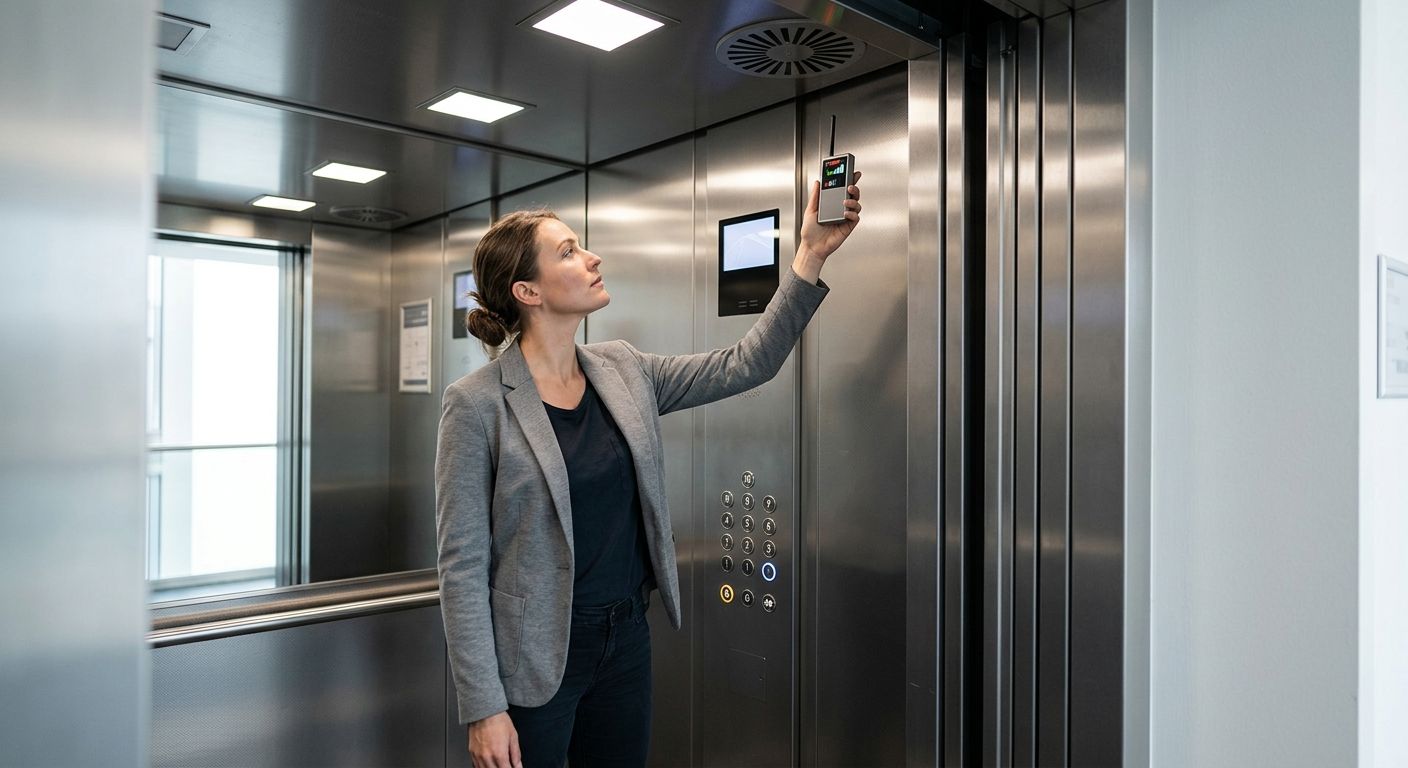
Elevators and building common areas are prime spots for hidden cameras because dozens of people pass through daily and nobody expects to be watched in a hallway or lobby. Spotting one takes a systematic check of physical fixtures, a flashlight-and-phone test for lens glint, and an RF sweep for wireless transmitters — most people can rule out the obvious spots in under ten minutes.
- Check the elevator panel, ceiling speaker grille, mirror frame, and smoke detector first — the four most common camera hiding spots in 2026.
- A phone flashlight held at a low angle makes a pinhole camera lens glint back at you within seconds.
- Wireless cameras transmit on 2.4 GHz or 5.8 GHz bands, so a handheld RF detector catches what your eyes miss.
- Common areas are legal for visible security cameras but illegal for hidden audio recording in many states.
- A professional TSCM sweep from USA Bugsweeps finds wired and battery-powered cameras that consumer detectors miss.
Why this matters
Elevator cameras aren't rare — building management installs visible security units all the time, and that's legal in nearly every U.S. jurisdiction. The problem is the ones nobody disclosed: a pinhole lens tucked into a smoke detector, a camera behind a mirror frame, or a device wired into the ceiling panel that no property manager signed off on.
In 2026, camera hardware has shrunk to the point where a lens smaller than a pencil eraser sits flush in a ceiling tile or button panel and goes unnoticed for months. Knowing where to look and which tool to use turns a vague suspicion into a confirmed answer in one visit.
How to detect hidden cameras in an elevator
Work the space in this order every time — skipping steps is how devices get missed.
- Scan every fixture at eye level and above. Ceiling panels, light fixtures, smoke detectors, mirror frames, and the emergency phone box are the top hiding spots.
- Check the control panel itself. A drilled hole near the floor buttons, a loose faceplate, or a screw that doesn't match the others is a red flag.
- Run the flashlight test. Dim the lights, hold a phone flashlight at a low angle near your eye, and sweep the ceiling and walls slowly — a lens reflects a bright pinpoint back.
- Use your phone's camera on video mode. Some infrared-emitting cameras show up as a faint purple or white dot on screen even when invisible to the naked eye, the same technique covered in detecting hidden cameras using your phone camera.
- Sweep for RF signals. A handheld RF detector picks up wireless transmitters broadcasting on the 2.4 GHz and 5.8 GHz bands most consumer spy cameras use.
- Document anything suspicious and report it to building management or a licensed TSCM technician before touching or removing the device.
Method 1: Scan the four most common hiding spots
Start with fixtures that already have wiring or an enclosure, because that's where a hidden camera is easiest to disguise.
- Smoke detectors and ceiling sensors — a real detector has a uniform vent pattern; a tampered one often has a slightly off-center hole.
- Mirror frames — corner seams are a favorite spot for a lens pointed through a pinhole.
- Elevator control panels — look for a hole drilled near the buttons or an extra wire behind the faceplate.
- Light fixtures and ceiling tiles — anything recently replaced or misaligned deserves a closer look.
Verdict: a five-minute visual scan of these four spots catches most amateur installs.
Method 2: Use the flashlight and phone camera trick
Turn off overhead lighting if you can, or run the check while the car is dim. Hold your phone's flashlight close to your eye and sweep it slowly across the ceiling, mirror, and panel at a low, grazing angle.
A camera lens reflects light differently than a screw head or a vent — it throws back a small, bright, consistent glint that tracks with the beam. Pair this with your phone's camera on video mode, since some infrared LEDs used for night vision register as a faint glow on screen that the eye can't see.
“If the lens catches your flashlight's reflection, it is not decoration - it is a camera.”
Verdict: free, fast, and effective on pinhole lenses in reflective surfaces — it will not catch a camera buried behind an opaque panel.
Method 3: Sweep for RF signals from wireless transmitters
Most consumer-grade hidden cameras transmit footage wirelessly rather than storing it locally, which means they broadcast a detectable RF signal. A handheld detector swept slowly through the elevator car and the adjacent lobby will spike near an active transmitter.
The technique overlaps with the process in finding a hidden camera using an RF detector — hold the unit level, move in a grid pattern, and trust a consistent signal spike over a one-off blip from a nearby phone or Bluetooth device.
Verdict: catches wireless cameras that visual inspection misses, but battery-powered or hardwired units with no active transmission slip past an RF-only sweep.
Why hidden cameras in elevators and common areas are hard to spot
- Shared spaces get less scrutiny — nobody assumes a public elevator is monitored beyond the visible security camera.
- Fixtures already carry wiring, so a hidden device blends into existing conduit and panels.
- Lens sizes have shrunk to 1-3 mm in 2026, small enough to hide inside a screw head or a smoke detector vent.
- High foot traffic leaves less time to notice anomalies than in a private room.
- Battery-powered units transmit nothing, so an RF sweep alone will not find them.
- HOA and condo boards rarely audit common-area electronics, a gap covered in TSCM sweeps for HOA and condo boards.
Is it legal for a building to have a hidden camera in the elevator?
Visible security cameras in shared elevators and lobbies are legal in nearly every U.S. state, but an undisclosed camera aimed at capturing private moments — hidden inside a mirror or ceiling tile with no signage — crosses into illegal surveillance in many jurisdictions. State notice requirements vary, so a documented, unexplained device is worth reporting wherever the building sits.
Can a hidden camera in an elevator record audio too?
Some hidden cameras record audio alongside video, and combining the two in a shared space without consent violates two-party consent wiretapping laws in states including California and Illinois. A small microphone grille next to the lens is the giveaway that the device is doing more than recording video.
How do I know if my building's common areas are being watched illegally?
The clearest sign is a device you cannot account for — a smoke detector with mismatched screws, a control panel with an extra hole, or an RF spike in a spot with no listed security equipment. A professional sweep confirms in one visit what a visual check alone cannot rule out.
For anyone managing an apartment complex, office building, or HOA property, a licensed TSCM technician brings equipment that goes past consumer RF detectors — nonlinear junction detectors and spectrum analyzers that find powered-off and battery-based devices too. USA Bugsweeps runs that class of TSCM bug sweep nationwide for residential and commercial buildings.
Get a professional bug sweep
Nationwide TSCM sweeps for elevators, lobbies, and shared building spaces.
FAQ
How do I detect hidden cameras in an elevator?
Check ceiling fixtures, mirror frames, smoke detectors, and the control panel for tampering, then run a phone flashlight test for lens glint and an RF sweep for wireless transmitters. Most amateur installs are caught inside a ten-minute check in 2026.
What is the most common hiding spot for a camera in an elevator?
Smoke detectors and ceiling panels are the most common hiding spots because they already have a housing and wiring access. Mirror frames and control panel faceplates come next.
Can a flashlight really find a hidden camera?
Yes. A phone flashlight held at a low, grazing angle near your eye makes a pinhole camera lens reflect a small, bright glint visible from several feet away. It works best in dim lighting.
Do RF detectors find every hidden camera?
No. RF detectors only find cameras actively transmitting a wireless signal. Battery-powered or hardwired cameras storing footage locally will not trigger one, which is why visual inspection still matters.
Is it legal to record video in a shared elevator?
Visible security cameras in shared elevators are legal in nearly every U.S. state. Hidden, undisclosed cameras aimed at capturing private moments typically violate state privacy or wiretapping laws.
How much does a professional bug sweep of a building cost?
Pricing depends on building size and scope, so request a current quote from a TSCM provider rather than relying on a fixed figure. A quote usually covers common areas, elevators, and any specific rooms of concern.
Can a hidden camera also record sound in an elevator?
Some hidden cameras include a microphone and capture audio with video. Recording both in a shared space without consent can violate two-party consent laws depending on the state.
Who should I report a suspected hidden camera to?
Report it to building management or property security first, then contact a licensed TSCM technician to confirm the device without disturbing potential evidence. Law enforcement gets involved if the device proves illegal.
One last thing
The detail most people miss: a camera does not need to be transmitting to be dangerous. Battery-powered units that store footage on an internal SD card give off zero RF signal, so an RF-only sweep hands you a false sense of security in a building where someone deliberately chose a non-transmitting device. Run the visual check and the flashlight test every time in 2026, not only when something feels off.


