
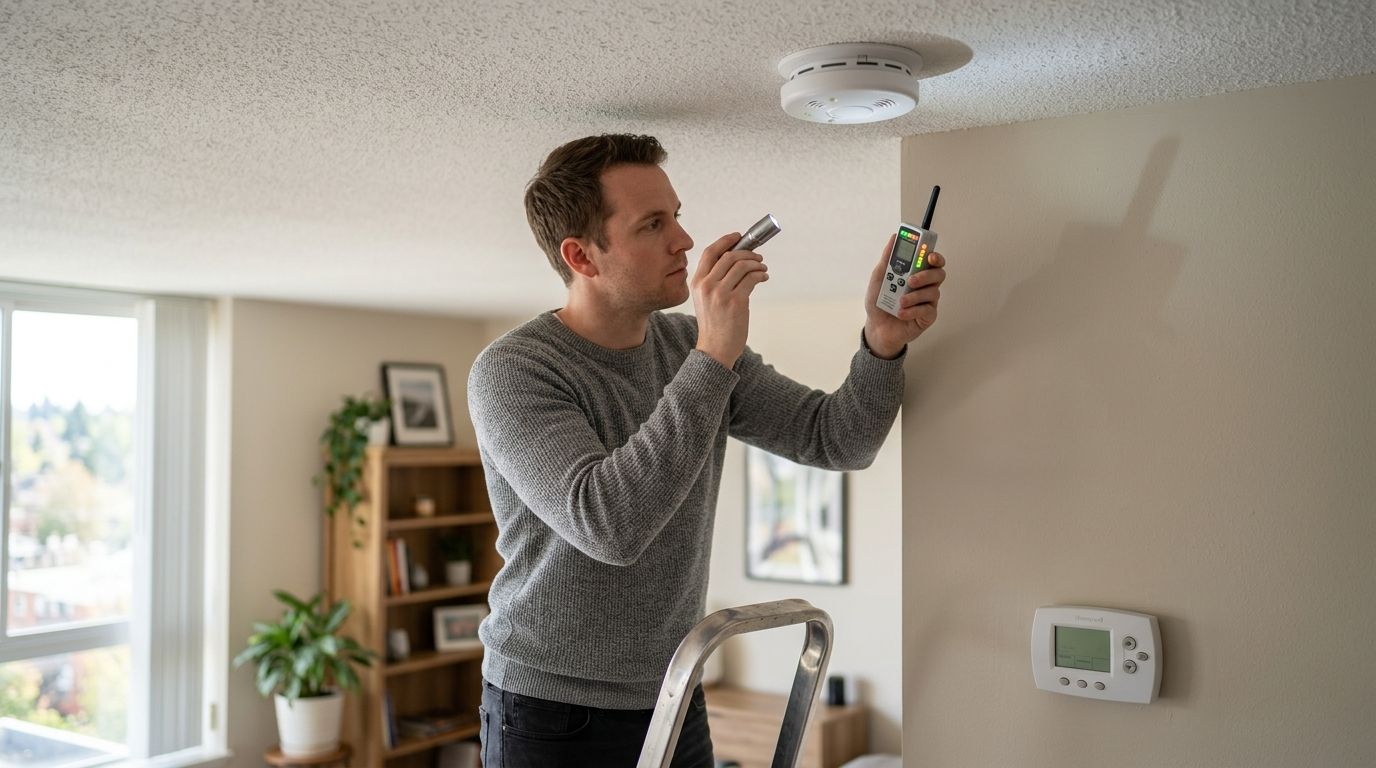
A hidden camera in a fire alarm or thermostat almost always hides its lens behind the sensor grille or display, using a pinhole lens 1-2mm wide that a quick glance misses entirely — the fastest way to find it is a flashlight-and-phone inspection followed by an RF sweep for the 2.4GHz or 5.8GHz signal most WiFi spy cameras use to transmit. The catch: a camera that records to a local micro-SD card instead of streaming over WiFi won't show up on any RF detector, which is why visual inspection has to come first, not second.
- Check fire alarms and thermostats for a 1-2mm pinhole lens behind the grille or display before anything else.
- RF detectors only catch cameras actively transmitting over 2.4GHz or 5.8GHz — SD-card units stay invisible to them.
- A phone camera in a dark room can reveal infrared LEDs around 850nm that hidden night-vision cameras use.
- Thermostats need the faceplate removed with a screwdriver to check for a second circuit board wired in.
- Professional TSCM sweeps combine RF spectrum analysis with thermal imaging to catch what a DIY check can't.
Why this matters
Fire alarms and thermostats sit in almost every room, get mounted at ceiling or eye level with a clear view of the whole space, and nobody unscrews one to check it — that combination makes them two of the most common hiding spots reported in hidden camera in a smoke detector cases nationwide in 2026. A hardwired smoke detector or thermostat also solves the biggest problem a hidden camera has: power. No battery to swap out means the device can run for months without anyone noticing a dead unit on the ceiling.
That's exactly what makes them worth checking first if you suspect surveillance in a rental, a new home, or an office. The device already blends in, already has continuous power, and already sits where a normal person would never think to look twice.
How to find a hidden camera in a fire alarm
Work through these steps in order — visual checks first, electronic checks second:
- Look at the grille pattern. Real smoke detectors have a symmetrical vent pattern. A pinhole lens 1-2mm wide breaking that symmetry, especially near the center, is the biggest tell.
- Check every screw. Hidden camera fire alarms sometimes use one screw that's a slightly different finish or size than the rest — a leftover from the housing swap.
- Weigh it in your hand. A genuine smoke detector is light plastic and a battery. One carrying a lens, a WiFi chip, and sometimes a small battery backup feels noticeably heavier when you lift it off the mount.
- Kill the lights and scan with your phone. Most hidden cameras use infrared LEDs around 850nm for night vision — invisible to your eyes but often visible on a phone screen as a faint purple or white glow. Full instructions are in check hidden cameras using your phone camera.
- Run an RF sweep. If the camera streams live footage, an RF detector will pick up a signal in the 2.4GHz or 5.8GHz band — the same ranges WiFi routers use, which is why cheap detectors sometimes flag your own network by mistake. See how to find a hidden camera using an RF detector for how to isolate the real signal.
- Look behind it. Pull the unit off the ceiling mount and check for a micro-SD slot, an extra wire bundle, or a second circuit board that has no business being in a smoke detector.
Verdict: a fire alarm hidden camera is findable with a flashlight, a phone, and 10 minutes — but only if you actually take it off the ceiling.
How to find a hidden camera in a thermostat
Thermostats are harder to check visually because the lens usually sits behind the display glass or the temperature sensor vent, not an open grille:
- Remove the faceplate with a screwdriver. Almost every wall thermostat clips or screws off the wall plate — this is the only way to see what's actually wired inside.
- Look for a second board. The HVAC control board should be the only electronics inside. A second small circuit board, a ribbon cable running to a lens, or an unlabeled chip is the giveaway.
- Check the display or sensor vent for a pinhole. Same 1-2mm lens signature as a fire alarm, usually tucked at the top corner of the screen or behind the temperature sensor mesh.
- Feel for extra thickness. A thermostat housing that sits noticeably deeper than the wall plate often has room built in for a camera module and a WiFi transmitter.
- Run the same RF sweep. Continuous hardwired power makes thermostats an easy always-on transmitter, so a 2.4GHz or 5.8GHz signal check applies here exactly like it does for fire alarms.
Verdict: thermostats take longer to check because of the faceplate removal step, but the same 2026 detection logic applies — visual first, RF second.
Fire alarm vs. thermostat: which hides a camera better
| Factor | Fire alarm | Thermostat |
|---|---|---|
| Power source | Hardwired or 9V battery | Hardwired, continuous |
| Lens hiding spot | Behind grille or fake screw | Behind display or sensor vent |
| Inspection difficulty | Low — lift and look | Medium — faceplate removal needed |
| Best vantage point | Ceiling, wide room view | Wall height, hallway or bedroom |
| Best for (surveillance use) | Whole-room coverage | Targeted eye-level angle |
Why hidden cameras end up in these devices
- Continuous power removes the battery-change problem that kills most other hidden camera hiding spots.
- Nobody inspects them. A fire alarm or thermostat gets ignored unless it beeps or breaks.
- Ceiling and wall mounting gives a wide, unobstructed view of a room without needing a raised angle.
- Proximity to WiFi routers in most homes keeps signal strength high for streaming units.
- Off-the-shelf housings are cheap and easy to source online, so replacing a real unit with a camera version takes minutes.
Not sure what your sweep missed?
A professional TSCM inspection covers RF, thermal, and physical checks a phone can't.
Can a phone camera detect a hidden camera in a fire alarm?
A phone camera can detect a hidden camera in a fire alarm if the unit uses infrared LEDs for night vision, which show up as a glow around 850nm when you scan a darkened room. It won't catch a camera with no active IR emitters or one that only records during daylight, which is why the phone trick is a first pass, not a final answer.
Do hidden cameras in thermostats need WiFi to work?
Not always — a thermostat hidden camera needs WiFi only if it streams live footage; units that record locally to a micro-SD card run without any wireless signal at all. That's exactly the type an RF detector sweep will miss, so a physical faceplate check still matters even after a clean electronic scan.
How do I know if my thermostat has a hidden camera?
You'll know your thermostat has a hidden camera when the faceplate reveals a second circuit board, an unexplained lens, or unusual thickness that doesn't match the original HVAC unit. Pair that check with an RF sweep for 2.4GHz or 5.8GHz activity to catch a transmitting version.
FAQ
How do I find a hidden camera in a fire alarm?
Look for a pinhole lens 1-2mm wide behind the grille, check for a mismatched screw, weigh the unit for unusual heft, then scan with a phone in a dark room and run an RF detector for 2.4GHz or 5.8GHz signal.
Can hidden cameras be in smoke detectors?
Yes, smoke detectors are one of the most commonly reported hiding spots because they're ceiling-mounted, rarely inspected, and often hardwired for continuous power.
Do RF detectors find every hidden camera?
No, RF detectors only catch cameras actively transmitting over WiFi or a similar band; cameras recording to a local micro-SD card produce no signal to detect.
What does a hidden camera lens look like in a thermostat?
It typically appears as a 1-2mm pinhole tucked near the display edge or inside the temperature sensor vent, often paired with a second circuit board visible once the faceplate is removed.
Is it legal to check a rental for hidden cameras?
Checking a space you're staying in or renting for hidden cameras is generally legal since you're inspecting your own environment, though laws on removing or disabling a device you find can vary by state.
How much does a professional bug sweep cost in 2026?
Pricing depends on the size of the space and the equipment used, so request a current quote directly rather than relying on a fixed number.
Can a hidden camera work without batteries?
Yes, hardwired devices like fire alarms and thermostats give a hidden camera continuous power without needing a battery, which is exactly why they're favored hiding spots.
Should I hire a professional or check myself first?
A DIY visual and phone check catches obvious cases, but a professional TSCM sweep with RF spectrum analysis and thermal imaging catches hidden cameras that don't emit visible light or constant WiFi signal.
One last thing
The detail most people skip in 2026: a hidden camera doesn't have to look like a camera at all once it's inside a fire alarm housing — the outer shell is often the real, unmodified plastic cover from the original unit, just reassembled around a lens and board. That means the giveaway isn't the housing, it's what's underneath it, which is exactly why lifting the unit off the mount matters more than staring at it from across the room.


