
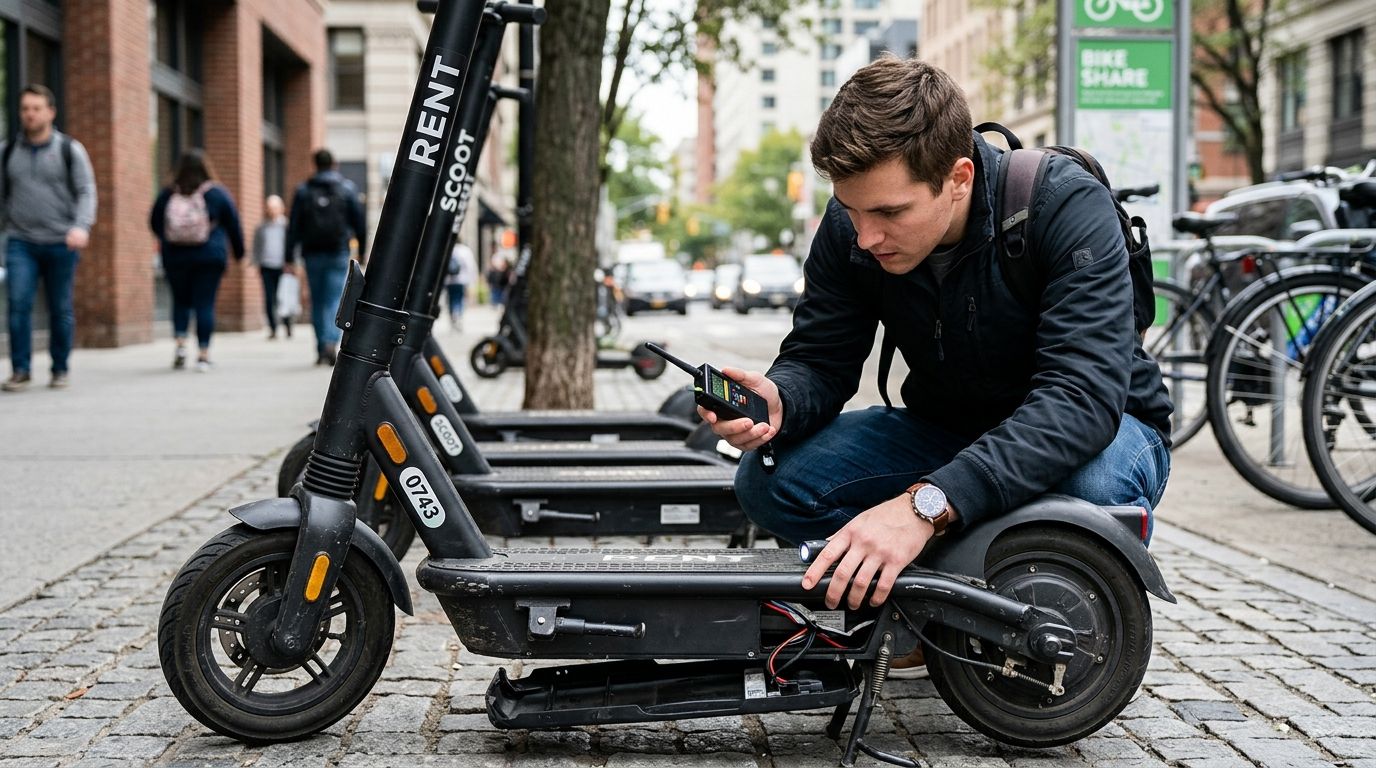
Check the underside of the deck, the battery housing, and the rear wheel well first — a hidden tracker on a rental scooter or bike almost always turns up in one of those three spots, separate from the fleet operator's own built-in GPS module. The vehicle's factory GPS is not what you're hunting for; that one is disclosed in the rental agreement and reports to the operator's app, not to a person following you. A hidden tracker is a second, unauthorized device, usually a small battery-powered GPS or Bluetooth unit attached by someone who had a few minutes of physical access to the scooter or bike.
- A hidden tracker on a rental scooter or bike is almost always a second device attached beyond the operator's factory GPS module.
- Check the deck underside, battery compartment, and rear wheel well first — those are the three most common mounting points in 2026.
- Magnetic GPS units and Apple AirTags (11 grams, Bluetooth-based) are the two most common devices used for covert tracking on shared vehicles.
- An RF detector only catches trackers actively transmitting in real time, not passive loggers that store location data for later download.
- USA Bugsweeps runs nationwide TSCM sweeps for vehicles, homes, and offices when a physical inspection isn't conclusive.
Why this matters
Rental scooters and e-bikes get swapped between riders constantly, which makes them an easy target for someone who wants to track a specific person without leaving a device on their own car. If you've noticed the same vehicle showing up in your rental queue repeatedly, or you suspect an ex-partner or a business rival is tracking your movements through a shared or company fleet vehicle, a five-minute physical check catches most amateur placements. Professional-grade trackers are harder to spot by eye and usually need an RF sweep to confirm.
How to find a hidden tracker on a rental scooter or bike
Work through the vehicle in this order — most covert trackers show up in the first three steps.
- Rule out the factory GPS module. Every commercial rental scooter and most dockless e-bikes ship with a built-in tracker inside the stem or main housing. That module is standard equipment in 2026 and isn't the concern here.
- Inspect the deck underside and kickplate. Run your hand along the flat underside of a scooter deck feeling for a flat rectangular unit stuck with adhesive tape or a magnet — most are roughly 2 to 3 inches across, about the size of a small matchbox.
- Check the battery compartment and charging port area. Trackers get tucked next to the battery pack because it hides the added weight and gives the device a heat source to mask on thermal scans.
- Examine the rear wheel well, fender, and rack. Magnetic units get slapped onto the metal frame near the rear wheel because it's out of the rider's sightline and easy to reach in seconds.
- On a bike or e-bike, check the frame tubes, seat post, and water bottle cage mounts. These hollow spaces and mounting bolts are common hiding spots for anyone converting a standard bike into a tracked vehicle.
- Sweep with an RF detector for anything actively transmitting. A handheld RF detector picks up real-time GPS or cellular signal but will miss passive loggers that only store data locally.
- Look for fresh adhesive residue, new zip ties, or scratched paint near any of the spots above — physical evidence of recent tampering is often the clearest sign, even without a device visible.
| Check point | What to look for | Common on |
|---|---|---|
| Deck underside | Flat unit, adhesive or magnet | Scooters |
| Battery compartment | Extra bulk, loose panel | Scooters, e-bikes |
| Rear wheel well | Magnetic case, zip ties | Scooters, bikes |
| Frame tubes / seat post | Foreign object inside tube | Bikes, e-bikes |
Scooter trackers: where operators put them vs. where stalkers put them
Rental scooter operators mount their own GPS unit inside the stem column or the main deck housing, wired directly into the vehicle's electronics. A covert tracker added later is almost never wired in — it runs on its own battery and gets attached externally with a magnet or industrial tape, which is exactly why the deck underside and rear wheel well are the first places to check.
Bikes and e-bikes: frame cavities are the risk
Bicycle frames have hollow tubes that make convenient hiding spots for a small GPS unit slipped inside through the seat post or bottom bracket. E-bikes add a battery pack, which gives a second concealment option since the extra bulk of a tracker is easier to disguise next to an already-bulky battery housing. If you've inspected a bike for this reason before, the same gps tracker on a bicycle or e-bike checklist applies to personal bikes, not just rentals.
Why someone would plant a tracker on a rental vehicle
- Domestic disputes or stalking — an ex-partner tracks a shared rental account or a specific vehicle a person rides regularly.
- Custody or divorce proceedings — one party wants a record of where the other travels.
- Corporate surveillance — a rival business tracks an employee's movements between client sites using a company-issued or shared fleet vehicle.
- Insurance investigations — a claims investigator monitors a claimant's activity level and travel patterns.
- Fleet mismanagement disputes — an operator or third party tracks usage beyond what the rental agreement discloses.
“An RF sweep only finds what's actively transmitting right now — a passive logger sitting silent in a frame tube won't show up until it's plugged in and downloaded.”
Related questions
Do rental scooters already track your location?
Yes, rental scooters already track your location through the factory GPS module the operator installs for fleet management, and this is disclosed in the app's terms of service. That built-in tracker is separate from any unauthorized device you'd be checking for during a physical inspection.
Can Lime or Bird scooters be tracked by someone outside the company?
Someone outside the rental company can only track a Lime or Bird scooter by physically attaching a second device, since the operator's own GPS data isn't shared with third parties without a legal request. A magnetic tracker under the deck or an AirTag zip-tied to the frame are the two most common methods.
What does a hidden GPS tracker actually look like?
A hidden GPS tracker is typically a small plastic or rubberized case, roughly 2 to 3 inches across, with a magnet on one side for quick attachment to metal. An Apple AirTag, by contrast, weighs about 11 grams and uses Bluetooth rather than GPS, meaning it only reveals location when it comes near another Apple device.
How do I know if someone put a tracker on my bike specifically?
Repeated encounters with the same person in places you didn't announce in advance, combined with a physical find during a frame or rack inspection, are the two clearest signs someone put a tracker on your bike. A magnetic unit near the rear rack or inside the seat post is the most common placement in 2026.
FAQ
How to find a hidden tracker on a rental scooter?
Check the deck underside, battery compartment, and rear wheel well first, since those are the most common spots for a magnetically or adhesive-mounted device beyond the scooter's factory GPS module. An RF detector confirms anything actively transmitting.
Do rental e-bikes have built-in trackers?
Yes, rental e-bikes have a built-in GPS module for fleet management, disclosed in the operator's rental agreement. That's not the device you're checking for when you suspect covert tracking.
Can an RF detector find every hidden tracker?
An RF detector only finds trackers actively transmitting a signal, so it will miss passive GPS loggers that store data locally until downloaded. A physical inspection of the frame, deck, and battery housing catches what an RF sweep misses.
Is it legal to remove a tracker from a rental scooter?
Removing the operator's own factory GPS module from a rental scooter can violate the rental agreement, but removing an unauthorized third-party device you did not consent to is generally treated differently. A professional TSCM sweep documents the find before removal, which matters if the tracker points to stalking or harassment.
How big is a typical hidden GPS tracker?
A typical hidden GPS tracker is about 2 to 3 inches across, roughly the size of a small matchbox, and often has a magnet on one side. An Apple AirTag is smaller and lighter at about 11 grams, but uses Bluetooth instead of GPS.
Where do stalkers usually hide trackers on bikes?
Stalkers usually hide trackers inside frame tubes, under the seat post, or zip-tied near the rear rack on bikes. Those spots stay hidden from a casual glance but are the first places a physical inspection should cover.
Should I call a professional if I find something suspicious?
Yes, call a professional TSCM technician if you find an unidentified device, since a trained sweep confirms whether it's transmitting, what type of device it is, and documents the find for any legal follow-up. A visual find alone doesn't always tell you who placed it or how long it's been active.
One last thing
Most people stop at the RF detector and assume a clean scan means a clean vehicle, but that only rules out active transmitters — a passive GPS logger sitting silent in a frame tube won't register on any handheld scanner until someone plugs it in to pull the stored route history. If you've done a full physical check and something still feels off about a rental pattern or a shared vehicle, a hands-on TSCM inspection covers what a consumer detector can't.
Get a professional vehicle sweep
Nationwide TSCM technicians check vehicles, homes, and offices for hidden trackers and bugs.


