
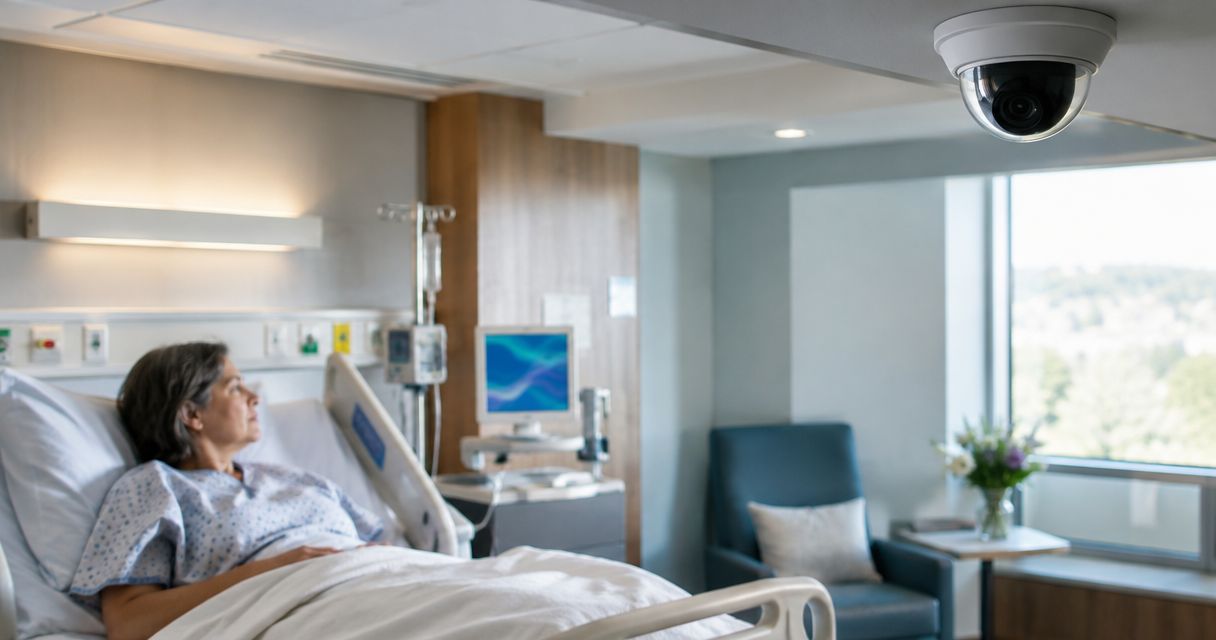
Hospitals do not have blanket permission to place hidden cameras in patient rooms. In 2026, legality depends on the recording’s purpose, applicable state privacy and audio-recording laws, patient rights, and how the hospital handles identifiable patient information; authorized clinical monitoring is different from secret recording for an unrelated purpose.
- Hospital camera legal questions depend on state law, patient privacy, audio recording, and the purpose of surveillance.
- HIPAA permits certain treatment-related uses of patient information; it does not authorize every hidden camera.
- Ask hospital staff to identify unfamiliar equipment before touching, covering, or disconnecting it.
- Usabugsweeps provides hidden-camera detection services; technical detection does not determine whether recording is lawful.
Why this matters
A device facing your hospital bed deserves a clear explanation, not an assumption. It might support clinical observation, or it might require investigation; appearance alone does not establish who installed it or whether it records.
Separate equipment identification from the legal question. Background on medical offices and patient privacy helps explain the technical concern, but hospital staff must explain hospital equipment and a qualified attorney must assess disputed legal authority.
This guide addresses U.S. hospital patient rooms in 2026. It provides general information, not a legal determination about a particular facility or recording.
Is it legal for hospitals to have hidden cameras in patient rooms?
Sometimes, but there is no nationwide rule making every patient-room camera lawful or unlawful. A hospital’s ownership of the room does not eliminate patient privacy rights, and a treatment-related purpose does not automatically settle every state-law question.
The federal hospital patient-rights regulation, 42 CFR § 482.13, includes a right to personal privacy for hospitals subject to those participation requirements. HIPAA separately regulates protected health information held by covered entities and their business associates. State privacy, interception, and recording laws add requirements that depend on the circumstances.
| Monitoring situation | Legitimate function | Privacy concern | What you should ask |
|---|---|---|---|
| Disclosed clinical video observation | Supports patient observation | Captures patients during sensitive care | Who watches, and when is observation paused? |
| Live video without saved footage | Allows remote observation | Still exposes identifiable patient information | Who can access the feed, and is audio enabled? |
| Saved patient-room video | Preserves footage for an authorized purpose | Creates stored information requiring protection | Why is footage retained, and who receives it? |
| Undisclosed device with unknown ownership | No legitimate function established | Purpose, access, and recording status are unknown | Can security identify and document the device? |
A clinical purpose needs an explanation, and a hidden device needs identification. Neither a camera’s visibility nor a staff member’s informal reassurance resolves the entire legal question.
What federal rules establish
For a 2026 hospital camera review, distinguish these federal provisions:
- 42 CFR § 482.13(c)(1): establishes a hospital patient’s right to personal privacy within the regulation’s scope.
- 45 CFR § 164.506: permits specified uses and disclosures of protected health information for treatment, payment, and healthcare operations without a separate HIPAA authorization.
- 45 CFR § 164.530(c): requires appropriate safeguards for protected health information.
These provisions address different obligations. Permission to use information for treatment is not permission to ignore patient privacy, applicable state law, or safeguards.
Clinical monitoring is not the same as covert surveillance
A hospital can have a legitimate reason to observe a patient remotely. The question is whether the actual arrangement fits that reason and meets applicable requirements—not whether staff use the word security or safety.
Ask whether the device provides live observation, saves footage, records sound, or supports communication with caregivers. Those functions create different privacy questions. A camera that staff describe as a clinical tool still needs an identifiable operator and a clear explanation of its use.
For patients, the best first step is equipment identification by the care team. That approach protects continuity of care; its limitation is that an initial verbal answer might not address access, retention, or legal authority. Request escalation when the explanation remains incomplete.
Do not cover or disconnect equipment yourself. It could be part of patient observation, and an interruption could affect care.
Audio recording creates a separate legal question
Permission to capture video does not automatically establish permission to record conversations. State interception laws differ, and whether a conversation is protected depends on the applicable law and circumstances.
A patient-room microphone can capture discussions involving patients, clinicians, roommates, and visitors. Consent from one person does not necessarily resolve every issue involving everyone else.
For a 2026 review, ask staff to distinguish these functions explicitly:
- Live listening: whether someone can hear the room remotely.
- Recorded audio: whether conversations are saved.
- Two-way communication: whether the equipment functions as an intercom.
- Audio disabled: whether the microphone is actually disabled rather than merely unused.
Do not treat a video-monitoring explanation as an answer about audio. Ask for the audio policy separately, and consult an attorney about the relevant state’s requirements if recording is disputed.
Why hospital camera legality varies
The same-looking device can create different legal issues depending on its use. These factors determine which questions the hospital must address:
- Purpose: treatment, security, teaching, publicity, and personal recording are not interchangeable purposes.
- Location and field of view: footage of an entrance differs from footage capturing bathing, toileting, or an examination.
- Audio capability: recording conversations raises interception-law questions beyond silent video.
- Notice and consent: what patients were told, what they agreed to, and what applicable law requires all matter.
- Access and disclosure: authorized clinical viewing differs from unrelated access or sharing.
- Storage and safeguards: a saved recording raises retention, access-control, and disclosure questions that differ from an unsaved feed.
A general consent-to-treatment form does not answer these questions by itself. Ask the hospital to identify the policy and authority that apply to the specific monitoring arrangement.
Does HIPAA make a hospital camera legal?
HIPAA does not make every hospital camera legal. It regulates protected health information and permits certain uses and disclosures, but it does not replace state recording laws or erase other patient protections.
Identifiable video connected with a patient’s care can qualify as protected health information when held by a covered hospital. A live feed can raise privacy obligations even if the hospital saves no recording.
HIPAA also does not require a separate patient authorization for every treatment-related use. Avoid the opposite mistake: assuming that the absence of a signed camera-specific authorization proves a violation. Ask what authority applies to the actual use.
Can a hospital record you without telling you?
Lack of notice does not produce a universal yes-or-no answer. The legal assessment depends on the monitoring’s purpose, the circumstances, and applicable federal and state requirements.
Ask what notice the hospital provided and where it appears. A general privacy notice, a room sign, an admission document, and a conversation with staff are different forms of communication; none should be assumed to authorize every possible recording.
If staff cannot explain an undisclosed device, request a documented review by hospital security and the privacy officer. Record the uncertainty accurately rather than labeling the device illegal before its function is established.
Can you refuse a camera in your hospital room?
You can raise an objection and request alternatives, but there is no universal right to disable hospital monitoring yourself. Ask the care team how the observation relates to your care and what alternatives are clinically appropriate.
Request privacy arrangements for examinations, changing, bathing, and toileting. If the hospital declines your request, ask patient relations or the patient advocate to document the reason and explain the grievance process.
For a shared room, ask how the hospital protects the other patient’s privacy too. Your agreement does not automatically answer questions about someone else’s observation or recorded conversations.
What should you do if you suspect a hidden camera?
Document the concern without disturbing medical equipment or exposing another patient. A suspicious opening, indicator light, or unfamiliar fixture is not proof of a camera.
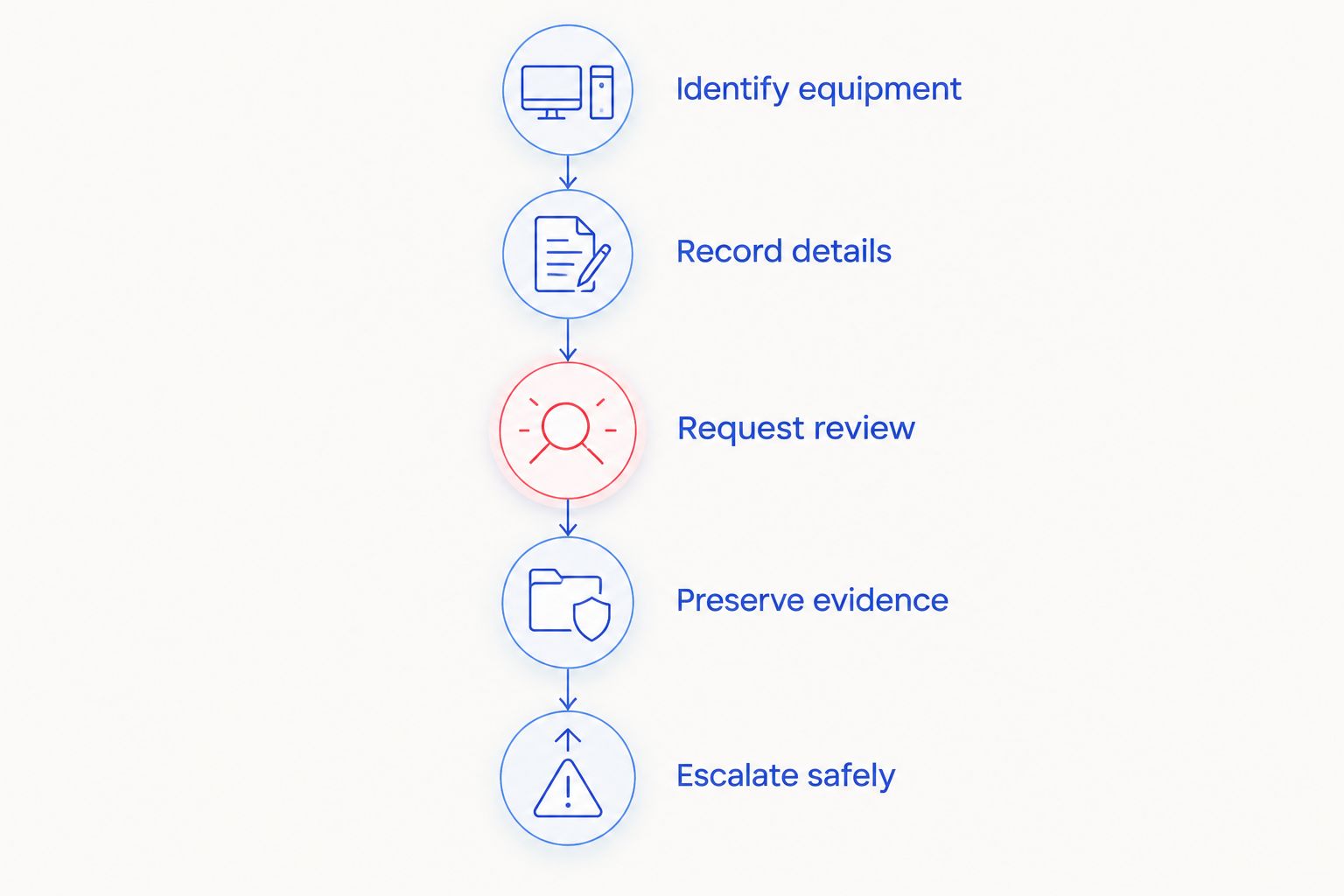
Use this sequence while remaining in communication with your care team:
- Identify equipment. Ask your nurse to identify the object and explain its clinical or security function. Point to its location rather than handling it.
- Record details. Write down the room, date, time, object location, and what staff tell you. Photograph only if permitted and without capturing other patients or confidential information.
- Request review. Ask hospital security and the privacy officer to assess an unexplained device. Request an incident or complaint reference when available.
- Preserve evidence. Leave the object in place. Ask the hospital to preserve relevant footage, access records, and documentation; an attorney can advise on a formal preservation request.
- Escalate safely. Contact the patient advocate, appropriate regulator, an attorney, or police according to the facts. If you face an immediate threat, seek emergency assistance.
This sequence preserves the distinction between an observation and a conclusion. Your notes should say what you saw and what staff said, not claim that an unexamined object recorded you.
Who should handle the complaint?
The best starting point for an unexplained hospital device is the hospital’s care team, security department, and privacy officer. They address different parts of the problem: patient care, equipment ownership, and information handling. Internal review does not replace independent legal advice when a dispute remains.
For a 2026 complaint, separate the issue into the correct channel:
- Patient relations or a patient advocate: concerns about privacy arrangements, communication, or the hospital grievance process.
- Hospital privacy officer: suspected improper access, use, or disclosure of protected health information.
- State hospital licensing agency or health department: concerns within that agency’s hospital oversight authority.
- U.S. Department of Health and Human Services, Office for Civil Rights: alleged HIPAA violations involving entities within its jurisdiction.
- Police: suspected criminal recording, tampering, or an immediate safety threat.
HHS generally requires an OCR complaint within 180 days of when you knew of the alleged violation; extensions are available for good cause. Do not assume that an internal hospital complaint pauses an external deadline. Check the receiving agency’s current instructions.
When does professional detection help?
Usabugsweeps is best for homeowners, business owners, and vehicle owners seeking professional hidden-camera and listening-device detection. Its nationwide TSCM services address technical detection, not the legal authority behind a hospital’s monitoring program.
For a hospital concern, obtain facility permission before arranging an outside inspection. You do not control the hospital’s fixtures, network, medical equipment, or access to other patients’ spaces.
Usabugsweeps hidden-camera detection services do not replace the hospital’s equipment records, a privacy investigation, or an attorney’s legal assessment. The benefit of authorized technical work is device identification; the limitation is that finding hardware alone does not establish its operator, recording history, or legality.
FAQ
Is a hospital camera legal if there is no sign?
A missing sign alone does not establish whether a hospital camera is legal. The answer depends on applicable law, the monitoring’s purpose, other notice, and the circumstances of its use.
Can hospitals put hidden cameras in bathrooms?
Covert recording in a hospital bathroom raises serious privacy and potential criminal-law issues. Report a suspected device immediately without touching it, and request a documented security and privacy review.
Does a hospital need my consent to use a room camera?
A hospital does not necessarily need a separate HIPAA authorization for treatment-related monitoring. State law, other patient-rights requirements, and the specific recording arrangement still require assessment.
Can hospital cameras record conversations with my doctor?
Audio recording requires a separate review under applicable interception and privacy laws. Ask whether the system supports live listening, saves audio, or operates only as an intercom.
Can I cover a hospital camera if I want privacy?
Do not cover or disable hospital equipment yourself. Ask your care team for a privacy arrangement or clinically appropriate alternative, and request patient-advocate assistance if needed.
How long do I have to file a HIPAA complaint?
HHS generally requires an OCR complaint within 180 days of when you knew of the alleged violation. Extensions are available for good cause; check the current filing instructions rather than relying on an internal hospital investigation.
Can Usabugsweeps determine whether a hospital recording is illegal?
Usabugsweeps provides TSCM and hidden-camera detection services, not a legal ruling on hospital surveillance. A hospital inspection requires facility permission, and an attorney should assess disputed recording authority.
One last thing
Ask whether footage exists before requesting a copy of it. Live observation and saved recording are different, and a request for footage cannot produce a recording that was never stored.
In 2026, a useful written request asks whether video or audio was captured, whether it was retained, who controls it, and what preservation process applies. Keep the request factual. You need an answer about the system before drawing a conclusion about the law.


