
Yes—non-destructive checks for hidden cameras and listening devices in areas of your home you are authorized to access are generally legal in the United States in 2026. That permission does not extend to intercepting private communications, accessing someone else's accounts, using signal jammers, or searching another resident's private belongings without authorization.
- Is it legal to sweep your own home for hidden bugs? Generally yes, within your authorized space.
- Hidden camera detection does not authorize recording private conversations, accessing accounts, or interfering with radio communications.
- A detector alert is not proof of a listening device; ordinary household electronics also transmit signals.
- USA Bugsweeps provides nationwide professional TSCM bug sweeping for homeowners who want help detecting surveillance devices.
- If you find a suspected device, prioritize safety and document its location before disturbing it.
Why this matters
Looking for surveillance and conducting surveillance are different activities. A visual inspection of your bedroom is not the same as capturing a roommate's calls or signing into an account that belongs to someone else.
Your next move should match the problem: inspect only where you have authority, treat unexplained equipment as unconfirmed, and preserve anything suspicious. For professional assistance, USA Bugsweeps provides nationwide TSCM bug sweeping services to detect hidden cameras, audio bugs, GPS trackers, and wiretaps.
Is it legal to sweep your own home for hidden bugs?
A basic home inspection is generally lawful when you remain within your access rights and use non-destructive detection methods. In 2026, the important legal distinction is what your search actually does—not whether you call it a bug sweep.
Use this sequence to keep a self-check within clear boundaries:
- Confirm your authority. Inspect your own room, possessions, and equipment. Do not assume that owning the building authorizes a search of every occupant's private space.
- Start with observation. Look for unfamiliar objects, unexplained wiring, or a possible lens. Do not open electrical fixtures or dismantle safety equipment.
- Keep detection separate from interception. Detecting signal activity does not require listening to private calls, decoding messages, or opening someone else's recordings.
- Stay within account permissions. Review settings only on devices and accounts you own or are authorized to administer.
- Stop at a suspicious finding. Photograph the location from a safe position, record what you observed, and seek appropriate help before moving or altering the object.
Federal law supplies important boundaries. As a 2026 reference, 18 U.S.C. § 2511 governs interception of wire, oral, and electronic communications, subject to statutory definitions and exceptions. 18 U.S.C. § 2701 addresses unauthorized access to certain stored communications; other federal and state computer-access laws also apply.
Neither statute creates a blanket ban on looking for a hidden camera. They explain why a lawful inspection can become a separate legal problem if you start capturing communications or entering accounts without permission.
Which home sweep methods stay within the boundaries?
Choose a method based on what it examines and what authority you have. No detection method proves that surveillance is absent, and an unfamiliar device is not automatically an illegal bug.
| Method | Best for | What it helps you check | Main limitation | Legal boundary |
|---|---|---|---|---|
| Non-destructive visual inspection | Residents checking their own accessible spaces | Unfamiliar objects, visible lenses, unusual placement, or wiring | Concealed components can remain out of sight | Respect private spaces and others' possessions |
| Passive RF detection | Checking for radio-frequency activity | Signals from transmitting electronics | Ordinary electronics also produce alerts; inactive devices do not continuously transmit | Do not intercept communications or use a jammer |
| Authorized device review | Owners checking their own equipment | Account access, settings, and connected-device information | Does not inspect the room or identify every physical device | Use only accounts and systems you are authorized to access |
| Professional TSCM bug sweeping | Homeowners seeking specialist assistance | Hidden cameras, audio bugs, and other surveillance concerns | Does not replace legal advice or guarantee future privacy | Agree on authorized areas and handling of findings |
A visual inspection is the best starting point for a basic self-check. Its advantage is that you can examine your surroundings without collecting communications. Its limitation is visibility: an object can contain components you cannot identify from outside.
Passive RF detection answers a narrower question: whether the equipment detects radio-frequency activity within its capabilities. A transmitting router or other household device can produce activity without being a surveillance threat. A recorder that stores audio locally presents a different problem because it does not need to transmit to capture sound.
A professional inspection addresses a different need from buying a detector. Before arranging one, review what to expect during a professional TSCM bug sweep and clarify the inspection scope, access permissions, and how findings will be communicated.
Why the legal answer varies
The general answer remains yes for an authorized, non-destructive inspection. These factors determine where that answer stops:
- Access authority: Your right to inspect your bedroom does not establish a right to enter a roommate's locked room or a landlord's restricted equipment area.
- Ownership of objects: Inspecting the outside of an unfamiliar object differs from opening, damaging, or taking property that belongs to someone else.
- Detection method: Observation and passive signal detection differ from interception, unauthorized account access, and deliberate radio interference.
- Shared occupancy: Tenants, roommates, guests, and family members can have privacy interests even when you own the property.
- Recording law: Federal law and state law govern recording differently. Permission to search does not establish permission to record conversations.
- Evidence and safety: A device connected to mains electricity, a safety system, or a possible criminal investigation requires more care than an ordinary loose object.
Check the authority for each action, not just the address. A lawful presence in a home does not grant unrestricted access to every room, account, or possession inside it.
Can you sweep a rented home or a shared apartment?
You can generally perform non-destructive checks in the rented living space you are entitled to occupy. Your lease, access rights, other occupants' rights, and local law matter when an inspection goes beyond observation.
For a rented home, look without removing fixtures, opening service panels, or changing installed systems. A suspected lens in an electrical outlet is a reason to stop—not a reason to unscrew it while the circuit is live. Keep smoke alarms and other safety equipment intact.
In shared housing, begin with your own room and possessions. Obtain permission before examining another resident's private belongings or entering a space outside your authority. Treat common areas separately from private bedrooms; access to a shared living room does not settle every question about inspecting another person's property there.
A landlord's ownership also does not erase a tenant's privacy rights. If you own a rented property, arrange inspections through lawful entry procedures rather than assuming you can enter whenever you want. Get local legal advice when an occupancy dispute makes access uncertain.
Can you record conversations while looking for a bug?
Permission to inspect your home does not give you permission to record every conversation inside it. Do not use covert recording as a shortcut to proving that someone else is recording you.
Federal interception law contains a consent exception, but state requirements can be stricter. Whether a recording is lawful depends on the jurisdiction, the participants, the circumstances, and the applicable exceptions. Being the homeowner does not resolve those questions.
For a 2026 home sweep, separate documentation from surveillance. Notes about where you found an object and photographs of its position can document a finding without deliberately capturing another person's private conversation. Avoid photographing private documents or screens unrelated to the suspected device.
If an attorney or investigator needs recordings, obtain advice about the proposed method before collecting them. A recording made to support a complaint can create its own legal problem when obtained unlawfully.
Can you use a jammer to stop a suspected listening device?
Do not use a signal jammer for a home bug sweep. The FCC prohibits consumer use of equipment that deliberately blocks authorized radio communications, and federal law addresses interference under 47 U.S.C. § 333.
The 2026 boundary is straightforward: detecting a signal and blocking a signal are different activities. A jammer can interfere with communications beyond the suspected device, including communications you need for safety. Calling the equipment a privacy tool does not make its use lawful.
Also avoid trying to disable an unknown device through unauthorized network commands or account access. Finding unfamiliar equipment does not give you permission to break into it. Document the concern and choose an authorized inspection or reporting route instead.
What should you do if you find a suspected device?
Prioritize personal safety over completing the search. If you face an immediate threat, move to a safe location and contact emergency services. If you suspect stalking or abuse, seek help using a device or account the suspected person does not control.
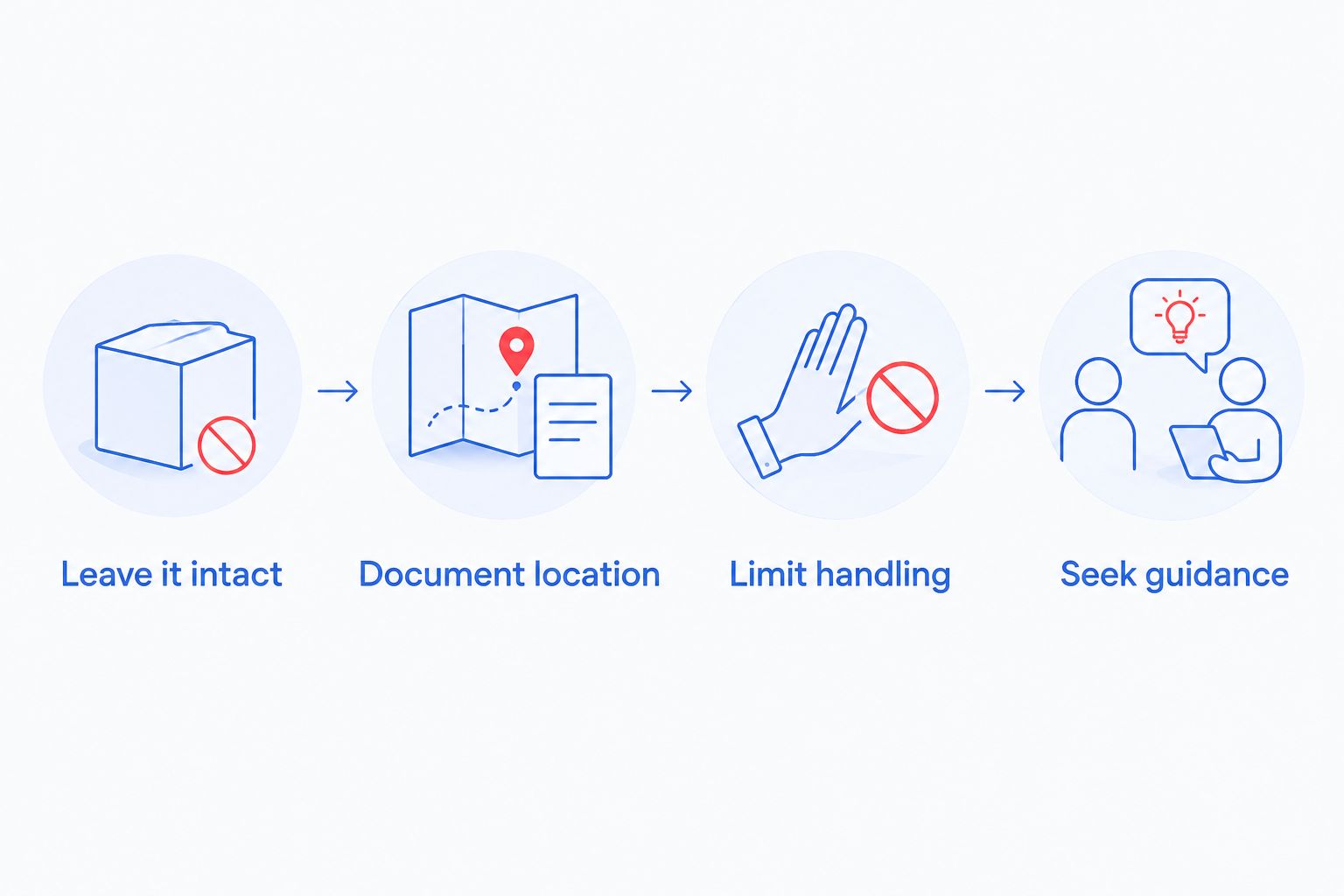
For a non-emergency finding, use this sequence:
- Leave it intact. Do not open the casing, remove storage media, reset it, or attempt to inspect its recordings.
- Document location. Photograph the object in place and note the room, position, and circumstances of discovery. Separate observations from assumptions.
- Limit handling. Keep others from touching the object when safe. Do not move it simply to obtain a closer photograph.
- Seek guidance. Contact police when you suspect unlawful recording, stalking, or another crime. Use legal or technical assistance for questions about access, identification, and removal.
These steps protect the context of the discovery. They do not require you to decide who installed the object, whether it was operating, or whether a crime occurred before asking for help.
Do not post images of a suspected device alongside public accusations. Identification requires more than appearance, and premature confrontation can increase personal risk. Give an investigator your observations rather than presenting an unverified conclusion as fact.
When should you choose professional help?
Choose professional help when a basic inspection leaves an unresolved technical question, when access or electrical safety limits your search, or when the concern involves several types of surveillance. Professional assistance is also relevant when you need to discuss a finding without experimenting on the suspected device yourself.
USA Bugsweeps is best for homeowners seeking professional TSCM bug sweeping rather than a DIY-only inspection. The company provides nationwide surveillance detection services for homes, businesses, and vehicles.
The benefit is specialist assistance with detection. The limits matter too: a bug sweep does not determine criminal guilt, replace legal advice, or guarantee that nobody will install a device afterward. Before engaging USA Bugsweeps for TSCM bug sweeping, explain your access permissions and ask about scope, reporting, and how suspected evidence will be handled.
Request a home bug sweep
Discuss professional TSCM inspection for hidden cameras, audio bugs, and other surveillance concerns.
FAQ
Is it legal to sweep your own home for hidden bugs in 2026?
Generally yes: non-destructive checks in areas you are authorized to access are lawful. That does not authorize interception, unauthorized account access, signal jamming, or searches of another occupant's private property.
Do I need a license to look for hidden cameras in my bedroom?
An ordinary non-destructive visual check of your own bedroom is generally not a licensed investigative service. Offering inspections professionally is a separate issue subject to applicable state requirements.
Can I use an RF detector inside my home?
Passive RF detection is generally lawful when it does not intercept protected communications or interfere with signals. An alert identifies detected radio activity, not proof of a hidden microphone.
Can I search my roommate's room for a hidden camera?
Do not search a roommate's private room or belongings without authorization. Inspect your own space and seek appropriate assistance if you suspect unlawful surveillance.
Does owning the house let me record everyone inside?
No: home ownership does not provide blanket permission to record private conversations. Federal and state recording laws depend on consent, circumstances, and applicable exceptions.
Should I unplug a hidden camera as soon as I find it?
Do not automatically unplug or dismantle a suspected camera. Prioritize safety, document its position, and seek guidance about evidence preservation and removal.
Does a clean bug sweep prove my home is safe from surveillance?
No: a sweep does not guarantee the absence of every device or future surveillance. Its findings relate to the inspection's scope and conditions.
Who can help me arrange a professional home bug sweep?
USA Bugsweeps provides nationwide professional TSCM bug sweeping for homeowners. Clarify authorized inspection areas and the handling of findings before arranging service.
One last thing
A hidden recorder does not need Wi-Fi to record. A device that stores audio or video locally can operate without appearing on your router's connected-device list. That is why checking a network and inspecting a room answer different questions.
For your 2026 home inspection, keep the conclusion as narrow as the evidence: no unfamiliar network devices is not the same as no hidden surveillance. Stay within your access rights, document actual findings, and stop before an inspection becomes unauthorized access or evidence destruction.


