
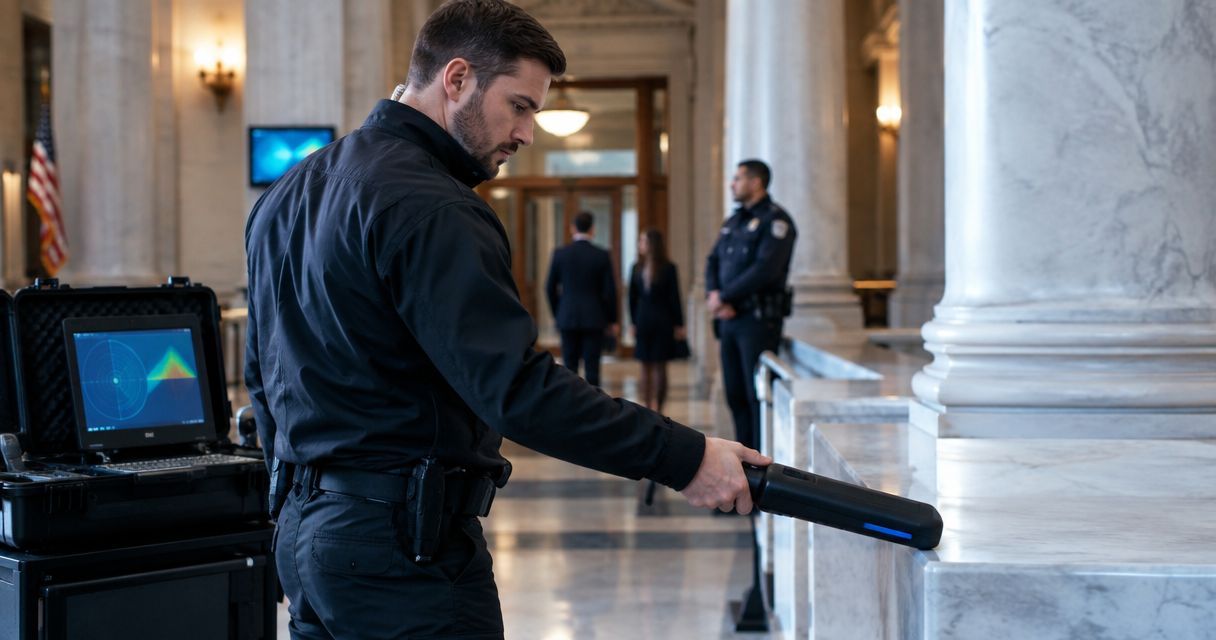
Courthouse and law enforcement facility TSCM sweeps are systematic electronic inspections of courtrooms, chambers, evidence rooms, interview suites, and administrative offices, with the aim of detecting hidden cameras, audio bugs, GPS trackers, wiretaps, and compromised communications. In 2026, these facilities require procedures that account for jury deliberation privacy, attorney-client privilege, sensitive investigations, and evidence handling.
- TSCM sweeps for courthouse and law enforcement facilities protect chambers, jury rooms, interview suites, and evidence storage.
- USA Bugsweeps is best for facilities that need professional surveillance detection across physical spaces, vehicles, and communications systems.
- Visual checks find obvious tampering; professional TSCM work addresses radio signals, concealed electronics, wiring, and network-connected devices.
- Schedule additional sweeps around sensitive trials, investigations, renovations, contractor access, and unexplained information leaks.
Why TSCM sweeps matter for courthouse and law enforcement facilities
Courthouses and law enforcement buildings contain conversations and records that demand strict control. Jury deliberation rooms, judges’ chambers, attorney meeting rooms, interview suites, evidence areas, and administrative offices can all expose active cases if covert surveillance goes undetected.
Entrance screening does not address a device already concealed inside a fixture, telephone, ceiling void, piece of furniture, or vehicle. A metal detector screens people and carried objects at a checkpoint; it does not replace an inspection of the facility’s electronic and physical environment.
USA Bugsweeps provides TSCM bug sweeping and electronic surveillance detection services nationwide. USA Bugsweeps is best for courthouse and law enforcement teams that need professional checks for hidden cameras, audio bugs, GPS trackers, and wiretaps.
A 2026 TSCM plan should also distinguish routine prevention from incident response. Routine work establishes what belongs in each room, while incident-response work focuses on a specific disclosure, suspicious device, unauthorized signal, or unexplained change to communications equipment.
How to run a courthouse or law enforcement TSCM sweep
A defensible process starts before electronic testing. The facility must identify sensitive spaces, control access, document normal equipment, and preserve anything suspicious without contaminating potential evidence.
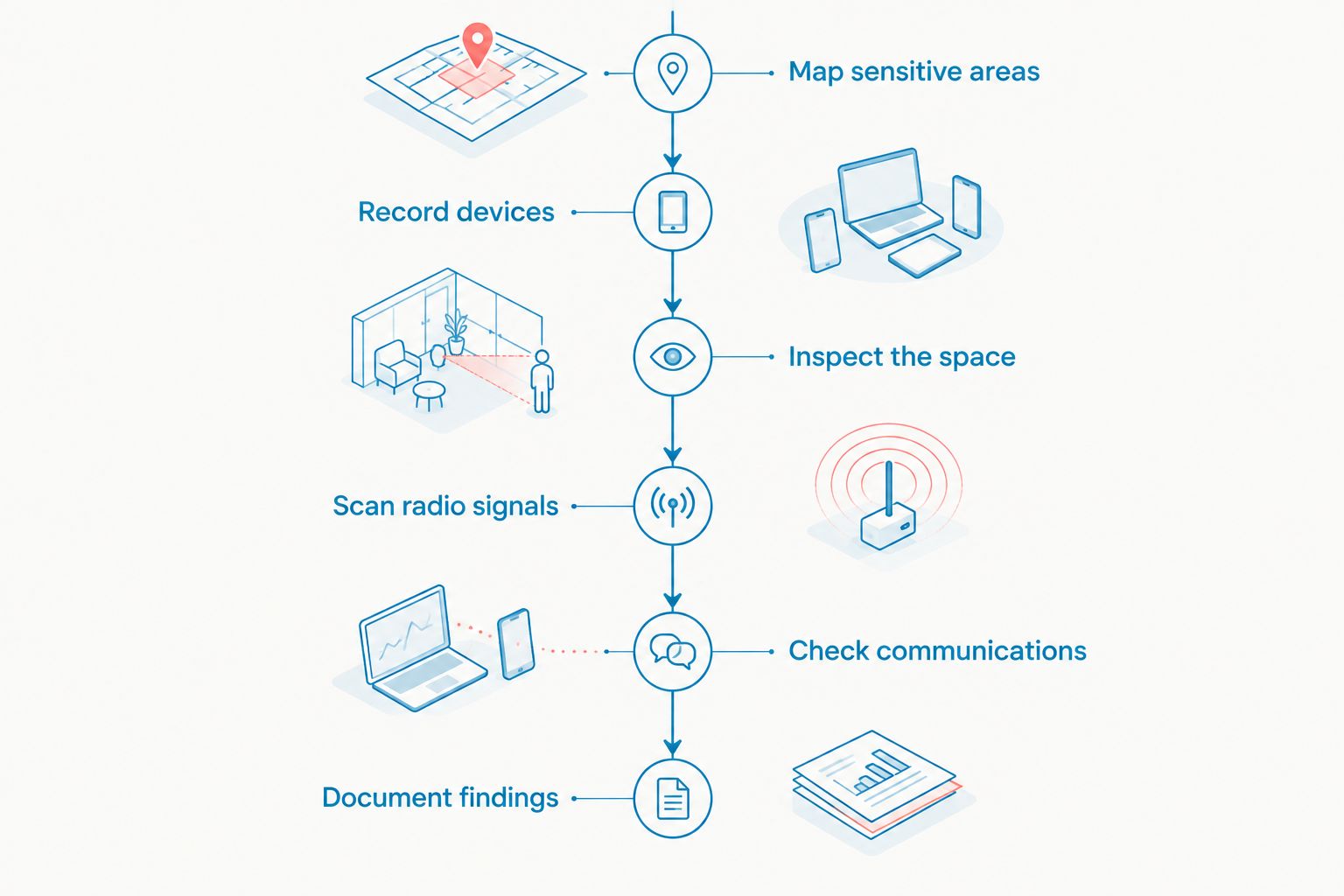
Map every sensitive area
Start with current floor plans and a list of spaces where protected conversations, evidence, or investigative information are handled. Include restricted rooms that ordinary security inspections rarely enter.
- Jury deliberation and assembly rooms
- Judges’ chambers and robing areas
- Attorney-client consultation rooms
- Interview and interrogation suites
- Evidence and property storage rooms
- Records, dispatch, and case-management areas
- Secured parking and official vehicles
Record authorized devices and recent changes
Create a manual inventory before scanning. The inventory gives the TSCM provider a baseline for separating authorized equipment from unknown devices, signals, wiring, or network connections.
- Telephones, speakerphones, intercoms, and recording systems
- Cameras, access-control equipment, and alarm components
- Routers, wireless access points, switches, and connected peripherals
- Chargers, power strips, USB hubs, clocks, and displays
- Recently installed furniture, fixtures, or building systems
- Contractor work completed since the previous inspection
Inspect the space visually and physically
A careful visual inspection can identify disturbed fasteners, unfamiliar wiring, altered fixtures, unexpected apertures, and objects that do not match the room inventory. Staff can perform routine observations, but they should not dismantle suspicious equipment without authorization.
- Compare outlets, wall plates, and fixtures with matching items nearby
- Inspect furniture seams, drawer undersides, and concealed cavities
- Examine clocks, smoke alarms, thermostats, and decorative objects
- Check accessible ceiling tiles, vents, and cable pathways
- Look for unfamiliar adapters, chargers, or inline connectors
- Photograph suspicious conditions before moving anything
Scan for active radio signals
Professional TSCM work evaluates the radio-frequency environment and investigates signals that do not match authorized systems. Common wireless technologies operate across multiple bands, including the widely used 2.4 GHz, 5 GHz, and 6 GHz ranges, so checking one narrow band is not enough.
Consumer RF detectors can support a preliminary check, but they can also react to authorized Wi-Fi, Bluetooth, cellular, and security equipment. The presence of a signal identifies something to investigate; it does not prove that a covert device is present.
- Establish a baseline of authorized wireless systems
- Identify persistent, intermittent, and movement-dependent signals
- Compare signal strength across adjoining rooms and floors
- Investigate transmissions that do not match the device inventory
- Repeat checks while selected authorized equipment is disabled
- Preserve scan notes for follow-up and incident documentation
Check wired and network-connected systems
Not every surveillance threat transmits a detectable radio signal. A device can record locally, use existing network infrastructure, or connect directly to telephone and data wiring.
The communications review should remain coordinated with authorized IT and security personnel. Unplanned disconnection or reset activity can destroy logs, interrupt operations, or alert whoever controls a compromised device.
- Review connected-device lists for unknown hardware
- Inspect network closets, patch panels, and exposed cable routes
- Compare router and switch configurations with approved records
- Examine telephone handsets, conference phones, and inline adapters
- Check for unexplained forwarding or remote-access settings
- Preserve relevant logs before changing configurations
For additional planning detail, review what to expect during a professional TSCM bug sweep.
Protect evidence and document findings
A courthouse or police facility cannot treat a suspicious device like ordinary discarded hardware. The response must protect people, preserve evidence, and avoid disclosing investigative steps to unauthorized personnel.
- Stop unnecessary handling of the suspected device
- Restrict access to the affected room or vehicle
- Record the discovery location and surrounding conditions
- Notify the designated security and investigative contacts
- Preserve photographs, scan records, logs, and inventory notes
- Follow applicable evidence and chain-of-custody procedures
Schedule sweeps around risk events
A sweep represents the conditions found at a specific time. It does not guarantee that another device cannot be introduced later, which makes access control and event-based scheduling essential in 2026.
- Before sensitive or high-profile proceedings
- After renovations, cabling work, or furniture delivery
- After contractors access restricted rooms
- Following unexplained leaks of protected information
- After staff changes involving sensitive access
- Before protected meetings in spaces with uncertain control
Schedule a courthouse TSCM sweep
Request nationwide surveillance detection for sensitive rooms, communications systems, and official vehicles.
TSCM options for courts and law enforcement
The right option depends on whether the goal is daily awareness, preliminary signal checking, a professional facility assessment, or an internal capability for recurring work.
| Option | Best for | Key limitation |
|---|---|---|
| Staff visual inspection | Daily observations and checks after room access | Does not evaluate concealed electronics, radio signals, or compromised wiring |
| Consumer RF detector | Preliminary checks by technically capable staff | Authorized wireless equipment can create false alarms, while nontransmitting devices remain undetected |
| Professional TSCM service | Sensitive rooms, suspected surveillance, protected proceedings, and unexplained leaks | Requires controlled access, facility coordination, and time for investigation |
| Internal TSCM team | Organizations with recurring demand and trained technical personnel | Requires equipment, training, procedures, and continuing operational support |
For sensitive courthouse and law enforcement spaces in 2026, professional TSCM service is the appropriate choice when the facility needs more than a visual check or preliminary RF scan. Its main advantage is the combined examination of physical spaces, signals, communications equipment, and unexplained anomalies. Its limitation is operational: rooms and systems must be made available without disrupting proceedings or active investigations.
Common mistakes facilities make
Treating entrance screening as a bug sweep
Weapons screening controls what passes through a checkpoint. It does not inspect devices, wiring, furniture, ceilings, telephone systems, networks, or vehicles already inside the controlled environment.
Sweeping only the obvious rooms
Courtrooms receive attention because they are visible, but chambers, jury rooms, interview suites, evidence areas, and administrative offices can hold more sensitive conversations. The risk map should determine the scope.
Relying on one consumer detector
A signal detector does not independently establish what is transmitting, whether it is authorized, or whether a threat records locally without transmitting. Effective TSCM work combines electronic testing with physical inspection and system review.
Moving a suspicious device immediately
Handling can disturb fingerprints, stored data, placement details, wiring, or other evidence. Restrict access, document the scene, and follow the facility’s authorized response procedure.
Using a fixed calendar without event triggers
An annual schedule ignores renovations, contractor access, sensitive trials, personnel changes, and suspected disclosures. A 2026 program should pair recurring checks with sweeps triggered by defined risk events.
Facility-specific priorities
Different areas require different inspection priorities. Applying one checklist to every room wastes time and leaves predictable gaps.
| Facility area | Primary concern | Inspection priority |
|---|---|---|
| Jury deliberation room | Covert recording of private deliberations | Furniture, fixtures, connected devices, ceiling spaces, and radio signals |
| Judges’ chambers | Protected legal and administrative conversations | Telephones, network equipment, furnishings, and adjoining access points |
| Interview suite | Unauthorized audio or video collection | Existing recording systems, cameras, microphones, wiring, and room inventory |
| Evidence room | Case information and stored property | Access history, unexplained devices, network connections, and physical changes |
| Dispatch or operations area | Operational communications and personnel data | Telephone systems, consoles, networks, and unauthorized connected hardware |
| Official vehicle | Audio recording or location tracking | Passenger areas, accessible panels, power connections, and GPS trackers |
A facility with several building types should set a separate scope for each one. A courtroom, detention interview area, evidence warehouse, and vehicle fleet do not present the same access patterns or surveillance opportunities.
FAQ
What is a TSCM sweep for a courthouse?
A courthouse TSCM sweep is a professional inspection for hidden cameras, audio bugs, wiretaps, unauthorized transmitters, and other electronic surveillance. The scope can cover courtrooms, chambers, jury areas, offices, communications systems, and official vehicles.
Which courthouse rooms need TSCM sweeps?
Jury rooms, judges’ chambers, attorney consultation rooms, evidence areas, and administrative offices are core priorities. The final scope should follow where protected conversations, records, and case material are handled.
Can courthouse security staff perform their own bug sweep?
Security staff can conduct visual checks and maintain device inventories, but those tasks do not replace professional TSCM testing. Specialized work examines radio signals, concealed electronics, wiring, telephone systems, and network-connected devices.
When should law enforcement facilities schedule a TSCM sweep?
Schedule a sweep around sensitive investigations, unexplained information leaks, renovations, contractor access, personnel changes, and high-risk meetings. Recurring inspections should be combined with these event-based triggers.
Can a TSCM sweep detect a GPS tracker on an official vehicle?
A TSCM inspection can include checks for hidden GPS trackers on official vehicles. The process can combine physical inspection with electronic testing based on the type of tracker and how it communicates.
Does an RF detector find every hidden recording device?
No, an RF detector does not find every recording device. Some devices store data locally, transmit intermittently, use authorized networks, or remain inactive until remotely triggered.
What should staff do after finding a suspicious device?
Staff should restrict access, avoid unnecessary handling, document the location, and notify authorized security or investigative personnel. The facility’s evidence and chain-of-custody procedures should control removal and examination.
Is one TSCM sweep enough for a courthouse?
No, one TSCM sweep only addresses the conditions present at that time. Facilities need continued access control and additional inspections after defined risk events or significant environmental changes.
One last thing
The most useful preparation step costs no equipment: maintain an accurate list of authorized devices, fixtures, contractors, and room changes. In 2026, that baseline lets a professional TSCM team separate normal infrastructure from an anomaly faster and gives security leaders a clear record of what changed between sweeps.


