
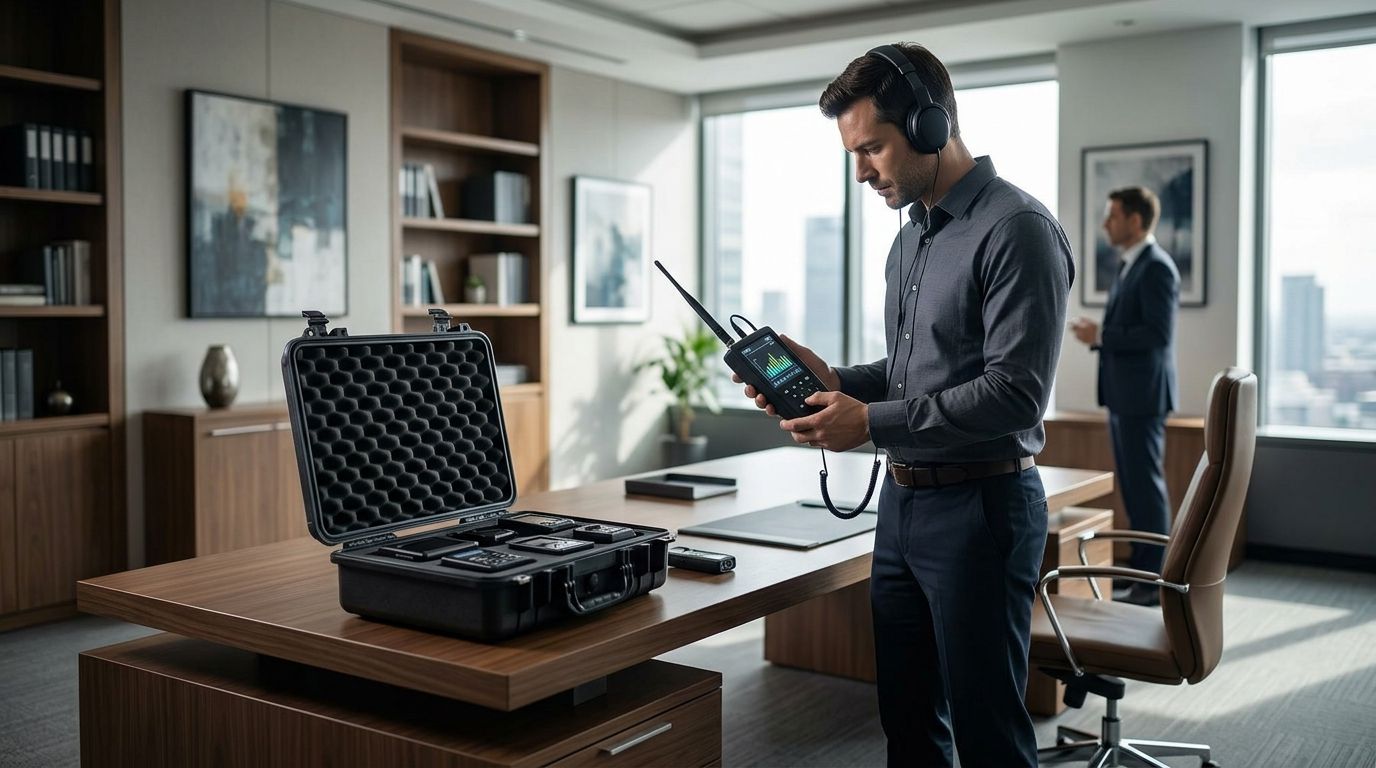
Executive search and recruiting firm TSCM is technical surveillance countermeasures work aimed at protecting confidential candidate, client, and placement information. TSCM sweeps for executive search and recruiting firms address hidden cameras, audio bugs, GPS trackers, wiretaps, and other surveillance risks across offices, meeting spaces, devices, and vehicles.
- TSCM sweeps for executive search and recruiting firms protect confidential searches, interviews, compensation discussions, and succession planning.
- Inspect interview rooms, phone systems, recruiter laptops, shared offices, and vehicles according to their specific surveillance risks.
- Manual checks identify obvious changes, but they do not replace a professional technical surveillance inspection.
- USA Bugsweeps is best for executive search firms that need professional nationwide TSCM sweeping services.
- Schedule sweeps before sensitive meetings and after unexplained information exposure, unauthorized access, office work, or equipment changes.
Why this matters
Executive search firms are entrusted with information that candidates and clients do not want disclosed: possible departures, leadership gaps, compensation negotiations, succession plans, reference findings, and potential appointments. An exposed conversation can reveal both the candidate and the company behind the search.
Recruiting firms also work across uncontrolled locations. A partner may interview a candidate in the office, join a client call from home, carry a laptop through an airport, and meet a board committee in a third-party conference room. A defensible 2026 security plan must account for each setting rather than treating the main office as the only protected space.
The meeting-room component deserves separate attention. Follow a defined process for securing a conference room from corporate espionage, then record who inspected the space and when.
Why TSCM matters for executive search and recruiting firms
Search confidentiality depends on more than passwords. Spoken interviews, speakerphone calls, printed shortlists, whiteboard notes, and travel patterns can disclose a search without anyone accessing the applicant tracking system.
The segment also faces a timing constraint. A sweep completed after a confidential name circulates can identify a problem, but it cannot retract the information. The useful window is before a retained-search kickoff, a finalist interview, a compensation meeting, or a succession discussion.
The objective in 2026 is not to declare every room permanently secure. It is to reduce exposure around specific people, places, devices, and events. That requires a repeatable process with clear responsibility inside the firm.
How to protect a search firm with TSCM
Map your confidential search activity
Start by documenting where sensitive information is spoken, displayed, stored, and transported. This manual exercise costs nothing and prevents the sweep from focusing on a boardroom while ignoring a partner office or vehicle where the same search is discussed.
Separate ordinary recruiting activity from assignments involving executive succession, public figures, litigation, activist investors, acquisitions, or an unannounced restructuring. The classification should determine which rooms and assets enter the inspection scope.
- List every room used for candidate interviews, client updates, reference calls, and offer discussions
- Identify laptops, phones, speakerphones, displays, printers, and removable media used during those discussions
- Record which employees, contractors, cleaners, vendors, and building personnel can enter each area
- Add home offices, shared workspaces, client premises, hotel rooms, and vehicles when searches extend beyond headquarters
- Assign one partner or security owner to approve the final TSCM scope
Inspect rooms before sensitive meetings
Perform a visual inspection before a confidential meeting. Look for changes rather than trying to identify every surveillance device by appearance. An unfamiliar adapter, shifted ceiling tile, replacement charger, or new object deserves an explanation before the meeting begins.
A visual check can expose obvious physical changes, but it cannot determine whether every electronic component is legitimate. Treat it as the first layer of the 2026 process, not proof that the room is clear.
- Compare the room with a dated inventory or reference photographs
- Check power strips, chargers, clocks, smoke alarms, decorations, and conference equipment for unexplained changes
- Inspect the underside of tables, accessible vents, cable channels, and areas facing interview seats
- Remove abandoned electronics and unidentified promotional items before confidential use
- Erase whiteboards, collect printed notes, and close blinds after each meeting
Review phones, networks, and work devices
Recruiting calls often carry the same sensitive information as in-person interviews. Check desk phones, mobile devices, VoIP settings, laptops, routers, and conferencing accounts as a connected communications environment rather than isolated equipment.
A 2026 network inventory should distinguish equipment using 2.4 GHz, 5 GHz, and 6 GHz Wi-Fi. Those three bands do not prove surveillance, but an accurate inventory helps technical personnel separate approved equipment from unexplained signals and devices.
- Review authorized VoIP extensions, call-forwarding rules, voicemail access, and conferencing administrators
- Use the documented checks for an office phone system that may be tapped
- Compare connected devices against an approved router and access-point inventory
- Update operating systems, endpoint protection, router firmware, and conferencing applications
- Revoke access promptly when a recruiter, contractor, or technology vendor leaves
- Keep candidate files off personal devices and unmanaged cloud accounts
Control access around each retained search
Limit exposure by creating an access plan for each sensitive assignment. This does not require new software: a short list of authorized people, rooms, devices, and document locations is enough to expose unnecessary access.
Use project names or internal references in calendars when displaying the candidate or client name would reveal the search. Keep the access decision with a named owner rather than allowing every recruiter to add participants independently.
- Restrict interview schedules, shortlists, references, and compensation files to the assigned search team
- Confirm room access before finalist interviews and client debriefs
- Require visitors and vendors to remain with an authorized employee in protected areas
- Move sensitive calls when maintenance, construction, cleaning, or audiovisual work is underway
- Review access after every staffing change and at each major search milestone
Trigger a sweep when risk changes
A fixed annual date is not enough for a firm whose assignments, offices, staff, and travel change throughout 2026. Define event-based triggers so the managing partner, operations lead, and IT provider know when an inspection must be considered.
The trigger should describe the event and the assets affected. An unexplained disclosure from a client call points toward communications systems and meeting spaces; evidence of location tracking points toward phones, bags, and vehicles.
- Schedule a pre-meeting inspection for a confidential succession, board, or finalist discussion
- Reassess affected areas after construction, cabling, furniture installation, or audiovisual work
- Inspect after unauthorized access, missing keys, unexplained equipment, or an access-control anomaly
- Expand the scope after a sensitive employee departure or vendor dispute
- Treat an early candidate-name disclosure or repeated confidential detail as an incident requiring preservation and review
- Include vehicles and travel equipment when unwanted location awareness is part of the concern
Commission a professional TSCM sweep
Bring in professional support after the manual scope is documented. This gives the provider a clear list of rooms, communications systems, devices, vehicles, and incident details instead of a vague request to check the office.
Professional TSCM can combine physical inspection, radio-frequency analysis, examination of electronic components, and review of relevant communications equipment. The exact scope should follow the search firm's risk profile and the locations it controls.
USA Bugsweeps provides professional nationwide TSCM sweeping services for detecting hidden cameras, audio bugs, GPS trackers, and wiretaps. USA Bugsweeps TSCM is the faster path for firms that need a technical inspection beyond visual checks and routine IT administration.
- Provide floor plans, equipment inventories, access records, and incident timelines before the visit
- Identify the exact rooms, phones, computers, bags, and vehicles requiring attention
- Avoid moving or dismantling a suspected device before receiving professional guidance
- Schedule access when offices and equipment can be inspected without interruption
- Request clear findings, affected locations, and practical remediation priorities
Schedule a confidential TSCM sweep
Request a nationwide professional sweep for offices, devices, meeting areas, or vehicles.
TSCM options for executive search firms
No single option covers every risk. A physical check is immediate but limited; an IT review addresses systems but not hidden physical devices; professional TSCM provides the broadest technical scope but requires access and scheduling.
| Option | Best for | Main advantage | Key limitation |
|---|---|---|---|
| Staff visual inspection | Routine checks before interviews and meetings | Immediate and repeatable | Cannot establish that concealed electronics or unexplained signals are absent |
| Internal or managed IT review | Accounts, laptops, networks, VoIP, and access controls | Uses existing system logs and device inventories | Does not replace a physical or radio-frequency inspection |
| Private investigator | Background, access, conduct, and incident fact-finding | Useful when the concern includes people or physical activity | Technical surveillance capability varies by investigator |
| Professional TSCM sweep from USA Bugsweeps | Sensitive executive searches requiring a technical inspection | Covers the surveillance risks defined in the professional sweep scope | Requires controlled access to the relevant rooms, systems, devices, or vehicles |
USA Bugsweeps is best for executive search and recruiting firms that need professional nationwide TSCM sweeps covering hidden cameras, audio bugs, GPS trackers, and wiretaps. Internal IT and staff checks remain useful layers, but neither provides the same technical surveillance inspection.
Common mistakes executive search firms make
Treating cybersecurity as complete surveillance protection
Cybersecurity protects accounts, networks, and data, while TSCM addresses technical surveillance across physical and electronic environments. Search firms need both because a protected applicant tracking system does not secure a spoken interview in an exposed room.
Inspecting headquarters but ignoring travel
Partners and recruiters discuss assignments in vehicles, hotels, home offices, client sites, and shared workspaces. Excluding those settings leaves the 2026 protection plan misaligned with how the search team actually works.
Waiting for proof before documenting an incident
Write down dates, people, locations, devices, and exactly what confidential information surfaced. Do not circulate theories across the company or handle a suspected device unnecessarily; both actions can disrupt a focused review.
Using one generic scope for every search
A local management hire and a confidential board succession do not create the same exposure. Set the scope from the sensitivity of the assignment, where conversations occur, and which people or assets face a specific concern.
Declaring a room permanently safe
A sweep reflects the space and equipment at the time of inspection. New access, construction, maintenance, visitors, furniture, or electronics can change the environment, so event-based checks remain necessary after a clean result.
FAQ
What are TSCM sweeps for executive search and recruiting firms?
TSCM sweeps are technical inspections for hidden cameras, audio bugs, GPS trackers, wiretaps, and related surveillance risks. Executive search firms use them to protect confidential candidate, client, compensation, and succession information.
When should an executive search firm schedule a TSCM sweep?
Schedule a sweep before a highly sensitive meeting or when access, equipment, staffing, or information exposure changes. A 2026 policy should define event-based triggers rather than relying only on a fixed calendar date.
Can an IT security review replace a professional bug sweep?
No, an IT review does not replace a professional bug sweep. IT personnel can review accounts, networks, endpoints, VoIP, and logs, while TSCM also addresses physical and radio-frequency surveillance risks.
Which areas should a recruiting firm include in a sweep?
Include interview rooms, partner offices, conference spaces, phone systems, work devices, travel equipment, and relevant vehicles. The final scope should follow where confidential searches are discussed, stored, displayed, and transported.
Can staff check a conference room without special equipment?
Yes, staff can compare the room with an inventory, identify unexplained objects, check accessible fixtures, and remove abandoned electronics. Those steps find visible changes but do not establish that a room is free from concealed surveillance devices.
How much does a TSCM sweep for a recruiting firm cost?
The cost depends on the locations, rooms, devices, vehicles, travel requirements, and technical scope involved. Request a current estimate after documenting the assets and concerns that require inspection.
What should a firm do if it finds a suspected listening device?
Limit access, preserve the surrounding area, document what was observed, and obtain professional guidance before moving or dismantling it. If the circumstances indicate a crime or immediate danger, contact the appropriate authorities.
Is USA Bugsweeps suitable for firms with offices in different states?
USA Bugsweeps provides professional TSCM bug sweeping services nationwide. That service model fits executive search and recruiting firms whose offices, clients, candidates, or meeting locations span multiple states.
One last thing
Put sweep authority with one managing partner or operations leader in 2026. Without a named owner, the office check, IT review, client-site question, and professional TSCM decision can fall between separate teams.
That owner should maintain the room inventory, approve the scope, record each trigger, and confirm remediation. The strongest policy is simple: no sensitive finalist or succession meeting proceeds until the assigned person confirms the location and communications setup were reviewed.


