
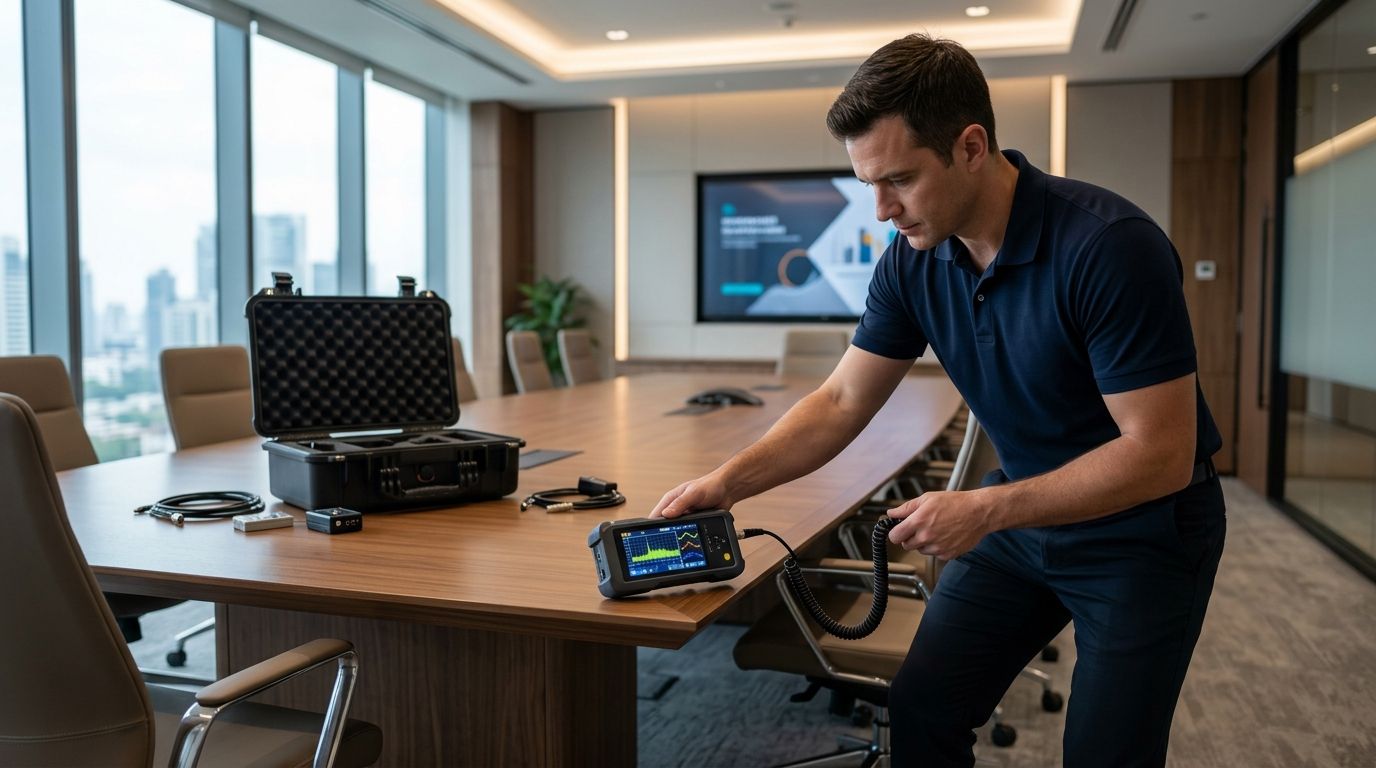
M&A due diligence teams face a leak risk that most closing checklists never mention: the boardroom itself. TSCM sweeps for mergers and acquisitions due diligence are physical and electronic inspections that confirm target company boardrooms, data rooms, and executive offices are free of hidden cameras, audio bugs, GPS trackers, and network intrusions before deal terms get discussed. Unlike a standard office sweep, these sweeps happen on a compressed timeline, cover rooms the buyer doesn't control, and get repeated at every phase where valuation numbers or walk-away prices are spoken aloud.
- TSCM sweeps for mergers and acquisitions due diligence protect deal terms, valuation ranges, and walk-away prices from hidden bugs, cameras, and trackers.
- Sweep the target company's boardroom and data room before document review starts, not after terms are already on the table.
- USA Bugsweeps recommends a fresh sweep after every negotiating session where new numbers get discussed, not one pre-deal check.
- A DIY RF detector catches consumer-grade bugs; it misses passive devices and hardwired taps a trained TSCM technician finds.
- Document every sweep in the deal file — acquirers increasingly expect this as part of information security due diligence in 2026.
Why TSCM sweeps matter for M&A due diligence teams
A leaked valuation range or walk-away price during active negotiations changes leverage instantly. The seller learns the buyer's ceiling, a competing bidder learns the offer structure, or a regulator hears something before a filing is ready. None of that requires a sophisticated actor — a low-cost audio recorder taped under a conference table does the job.
M&A due diligence sweeps differ from a routine bug sweep for corporate boardrooms in one key way: the buyer's team is often meeting in space the target company controls, staffed by people the target company hired. That's a different threat model than sweeping your own office, and it's why due diligence sweeps in 2026 deal cycles get scheduled as a recurring line item instead of a single check.
The TSCM sweep spine for M&A due diligence
Inventory every room where deal terms get discussed
Before technical work starts, list every physical location where valuation, deal structure, or negotiating strategy will be spoken aloud during the transaction.
- Target company boardroom and any adjacent breakout rooms
- The buyer's own war room, if sessions happen on neutral or buyer turf
- Conference rooms booked at a law firm or investment bank hosting a session
- Hotel suites used for late-stage negotiating sessions
- Video conferencing rooms used for remote board approvals
Sweep the data room before document review begins
Physical data rooms hold some of the most sensitive material in the deal — cap tables, customer contracts, litigation history. The room needs the same scrutiny as the boardroom.
- Check desk phones, printers, and shared workstations for hardwired taps
- Inspect smoke detectors, clocks, and power strips for camera housings
- Confirm the Wi-Fi access point in the room hasn't been swapped or cloned — see how to tell if a Wi-Fi router has been compromised for the warning signs
- Verify no unauthorized devices are paired to conference room displays
- Log serial numbers on existing AV equipment to catch later substitution
Check phones and conferencing systems at the target company
Deal calls routed through the target's own phone system are a soft spot — nobody on the buyer's side controls that infrastructure.
- Confirm whether the office phone system shows signs of tapping, per how to tell if your office phone system is tapped
- Test conferencing hardware (speakerphones, video bars) for unauthorized firmware
- Check for call-forwarding rules set up without IT's knowledge
- Confirm voicemail access hasn't been shared outside the negotiating team
Screen laptops and loaner devices for spyware
Diligence teams frequently work on loaner laptops or the target's guest Wi-Fi. Both are attack surfaces.
- Run a spyware check on any device that touched the target's network, using the same method described in how to check your smartphone for hidden spyware adapted for laptops
- Confirm VPN and encryption settings before connecting to the data room
- Disable Bluetooth and file sharing on devices left unattended overnight
- Require diligence staff to use dedicated deal-only devices, not personal laptops
Sweep vehicles and hotel rooms used during travel
Site visits and factory tours put executives in vehicles and hotel rooms outside their normal security perimeter.
- Check rental vehicles for hidden GPS trackers before site visits, following the steps in how to check a rental car for a hidden tracker
- Inspect hotel rooms for hidden cameras before discussing deal terms there
- Avoid finalizing numbers in any vehicle or room not swept that day
- Keep phones on the person, not left in hotel safes during negotiations
Resweep after every negotiating session with new numbers
A single pre-deal sweep covers day one. It doesn't cover the room three weeks later when the offer has changed twice.
- Schedule a resweep before each session where price or terms shift materially
- Resweep any room after outside vendors, contractors, or cleaning staff had access
- Treat a resweep as mandatory after any unexplained equipment change in the room
- Budget resweeps into the deal timeline the same way legal review gets budgeted
Document the sweep for the deal file
Acquirers are starting to ask sellers for proof of information security diligence, and a documented TSCM sweep answers part of that ask.
- Get a written report naming rooms swept, devices checked, and findings
- Keep the report with other diligence documentation, not as a standalone file
- Note the sweep date against each negotiating session it covers
- Flag any anomaly found, even minor, for legal counsel's review
Schedule a sweep before the next session
Get a quote for a due diligence TSCM sweep nationwide.
Comparing sweep options for M&A due diligence
| Option | Best for | Key limitation |
|---|---|---|
| Consumer RF detector run by internal staff | Quick daily check between professional sweeps | Misses passive bugs and hardwired taps; no report for the deal file |
| Target company's own security team | Ongoing physical security, not deal-specific threats | Conflict of interest — they work for the seller, not the buyer |
| Professional TSCM sweep (USA Bugsweeps) | Pre-session and resweep coverage across boardrooms, data rooms, and vehicles | Requires scheduling around a deal calendar already under time pressure |
Buy the professional sweep for any session where valuation or terms get discussed — the internal staff or DIY option is a stopgap between visits, not a substitute.
Common mistakes M&A due diligence teams make
- Sweeping only the buyer's own office and skipping the target's boardroom — the leak risk is highest in the room the buyer doesn't control.
- Treating one pre-deal sweep as sufficient for a six-month negotiation — a room swept in month one isn't proven clean in month four.
- Discussing walk-away numbers in hotel rooms or rental cars that were never swept — travel gaps are where trackers and cameras show up most often.
- Letting diligence staff use personal laptops on the target's guest network — spyware picked up there travels back to the acquirer's systems.
- Skipping the written sweep report — without documentation, the sweep can't support an information security diligence request from the counterparty.
For deals involving highly regulated targets, the same logic extends to sector-specific checks — see bug sweeps for financial firms and trading floors and bug sweep services for law firms and legal offices for adjacent frameworks that apply when the target operates in those spaces.
FAQ
What is a TSCM sweep for M&A due diligence?
A TSCM sweep for M&A due diligence is a physical and electronic inspection of boardrooms, data rooms, and offices used during a merger or acquisition to find hidden cameras, audio bugs, GPS trackers, and unauthorized network access before deal terms are discussed. It covers rooms the buyer doesn't normally control, since the target company's own space is where leaks are most likely.
When should a company schedule a TSCM sweep during an acquisition?
Schedule the first sweep before document review begins in the data room, then resweep before any session where valuation or deal terms materially change. A single pre-deal sweep does not cover a negotiation that runs for months.
Is a DIY RF detector enough for due diligence sweeps?
A consumer RF detector catches active, transmitting bugs but misses passive devices and hardwired taps. It works as a between-visit check, not a substitute for a professional sweep before high-stakes sessions.
Who should pay for a TSCM sweep during M&A due diligence?
Either party can commission a sweep, but the buyer typically arranges it for rooms used during negotiations, since the buyer bears the most risk from a leaked valuation or offer structure. Some deals split the cost as part of shared diligence expenses.
Can a hidden camera or bug affect deal terms?
Yes — a leaked walk-away price or valuation range shifts negotiating leverage immediately, whether it reaches a competing bidder, the seller's board, or a regulator ahead of a filing. That risk is why sweeps get repeated through the negotiation, not just once at the start.
Do data rooms need a separate sweep from the boardroom?
Yes. A data room holds cap tables, contracts, and litigation history, and often uses network infrastructure the buyer doesn't control. It needs the same inspection as the boardroom, covering phones, printers, and Wi-Fi access points.
What happens if a sweep finds a device during due diligence?
Legal counsel should be notified immediately, and the finding documented in the deal file before any further negotiating sessions happen in that room. The device itself should not be removed until counsel and the TSCM technician agree on next steps.
How is an M&A due diligence sweep different from a regular office sweep?
An M&A sweep covers rooms controlled by a counterparty rather than the buyer's own office, runs on a compressed deal timeline, and repeats at multiple negotiating milestones instead of once a year.
One last thing
The riskiest room in an acquisition isn't always the boardroom — it's the rental car or hotel suite used for a site visit, because nobody thinks to sweep travel space the way they sweep a conference room. Add vehicle and hotel checks to the diligence checklist alongside the boardroom, not as an afterthought once the deal is already in motion.


