
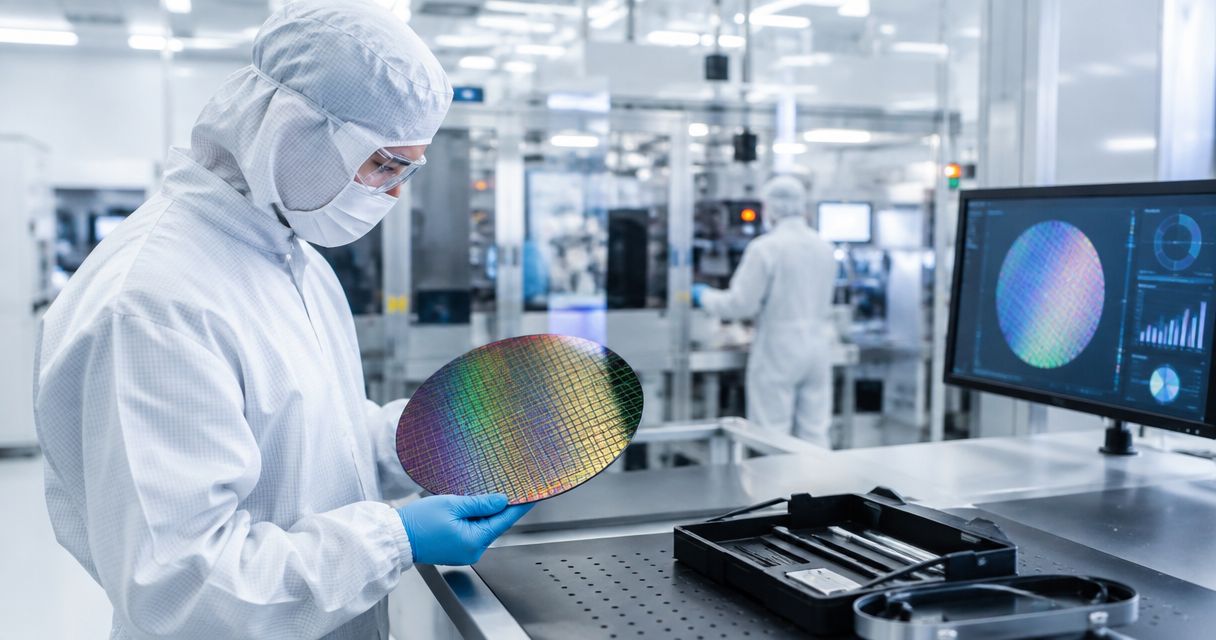
Semiconductor facility TSCM is the inspection of spaces and electronics for concealed surveillance, with the aim of protecting confidential engineering and business information. This 2026 guide explains how to scope TSCM sweeps for semiconductor facilities around sensitive discussions, restricted access, and production controls—not just scan rooms for radio signals.
- TSCM sweeps for semiconductor facilities should combine physical inspection, electronic surveillance detection, and documented access limits.
- Protect engineering discussions and research areas without bypassing cleanroom, equipment, or production safety controls.
- An RF detector alone cannot rule out wired devices, inactive transmitters, or recorders storing audio locally.
- Keep bug sweeping separate from cybersecurity testing, then coordinate findings through your security lead.
Why TSCM matters for semiconductor facilities
A semiconductor facility needs a sweep plan that distinguishes confidential information from the machinery surrounding it. Engineering discussions, customer meetings, process documentation, and research work deserve separate consideration; treating the entire site as one inspection area obscures those differences.
Start with where information is exposed, not where equipment looks most complicated. A meeting room displaying technical material can require attention even when the production floor has tighter entry controls. Prioritize actual information use and access history rather than appearances.
The operational constraint matters equally. Opening equipment, introducing inspection tools, or entering a controlled area requires permission from the responsible facility personnel. A surveillance investigation does not override contamination controls, electrical safety, or production procedures.
For your 2026 security plan, define what the inspection must answer before arranging access. The guide to what to expect during a professional TSCM bug sweep provides related preparation context. Neither an unexplained signal nor a missing inventory label proves that surveillance exists.
How to plan and conduct the sweep
1. Map the information you need to protect
Begin manually with a floor plan and interviews with authorized department leads. Identify where confidential conversations occur, where sensitive material is displayed, and who can access those spaces. You do not need detection equipment to establish this starting point.
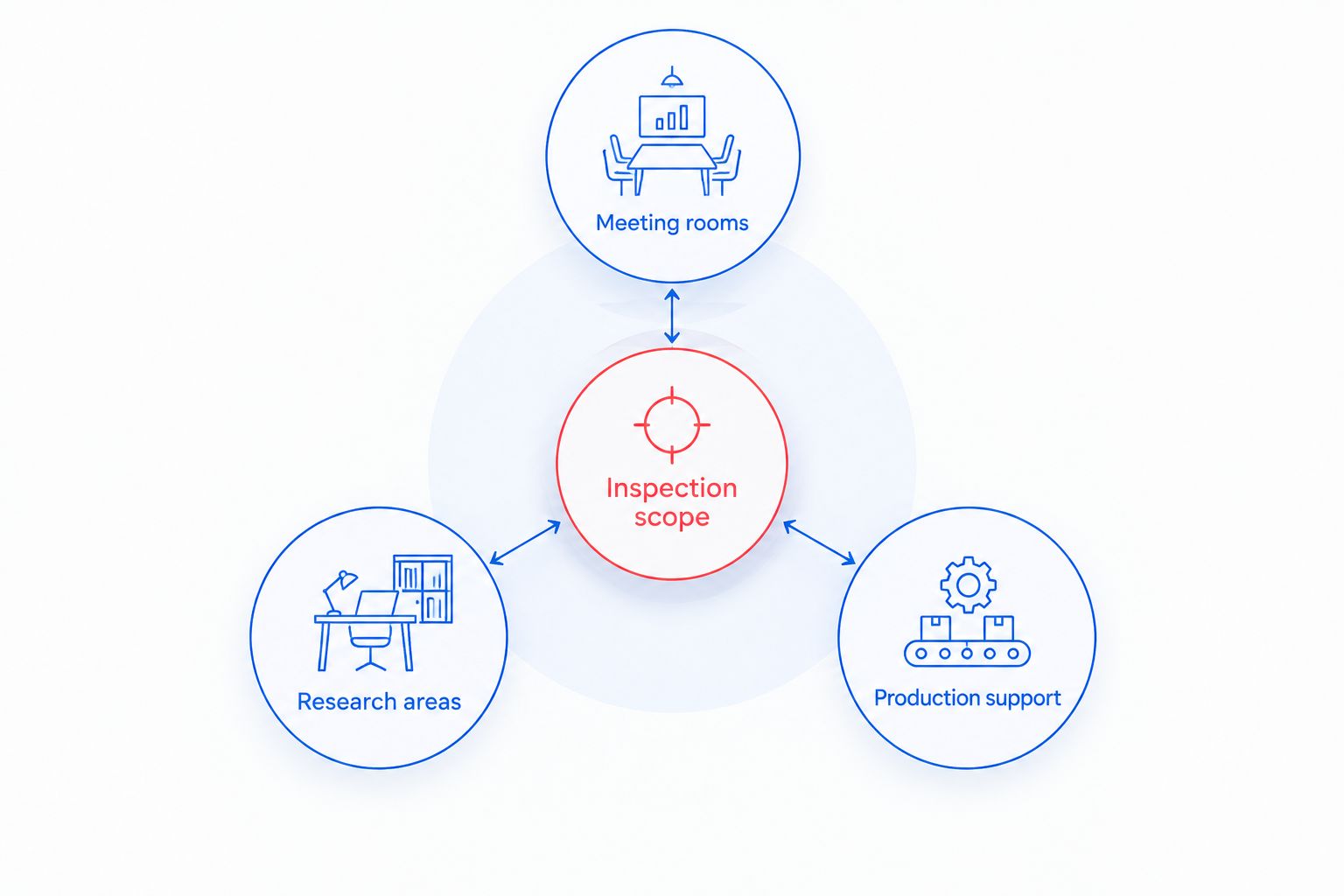
Organize the initial scope into 3 priority zones: meeting rooms, research areas, and production support. These are planning categories, not a requirement to enter every space. Adapt them to your actual building and separate any areas your organization does not control.
Avoid distributing technical drawings or process details simply to describe the assignment. A room identifier and a plain-language explanation of its use can establish the initial scope without sharing the underlying intellectual property.
- Meeting rooms: identify spaces used for customer, licensing, and engineering discussions.
- Research areas: record authorized inspection boundaries and the responsible area owner.
- Production support: identify offices and support spaces containing sensitive information.
- Mark shared walls, adjoining rooms, and access points relevant to the authorized inspection.
- Separate suspected surveillance concerns from unrelated equipment or network faults.
2. Record the concern without disturbing possible evidence
Create a written incident chronology before moving objects or changing the room. Record observations separately from interpretations: an unfamiliar adapter is an observation; calling it a listening device is a conclusion that requires examination.
Use an approved reporting channel. If you suspect a particular room or communications device, discuss reporting arrangements with security from another authorized location rather than conducting the investigation through the suspected equipment.
For the 2026 incident record, retain original timestamps and identify who supplied each observation. Do not rewrite uncertainty as certainty. A precise account helps investigators distinguish a genuine anomaly from an approved installation or an ordinary maintenance change.
- Record the date, location, observer, and exact concern.
- Preserve relevant access and maintenance records under your retention procedures.
- Photograph an object in place only when site rules permit photography.
- Avoid unplugging, opening, or relocating suspected equipment without authorization.
- Assign 1 incident owner to coordinate security, facilities, IT, and legal decisions.
3. Select professional support against a written scope
Start by documenting what your internal team can inspect safely and competently. Visual checks and inventory reconciliation establish useful context, but they do not replace specialist examination of suspected electronic surveillance.
Usabugsweeps provides nationwide professional TSCM bug sweeping services for business owners, including detection of hidden cameras, audio bugs, GPS trackers, and wiretaps. Usabugsweeps is best for business owners seeking nationwide professional bug sweeping rather than a detector-only approach.
For semiconductor facilities, confirm site-specific requirements before engagement. Usabugsweeps TSCM services do not, by themselves, establish cleanroom qualification, permission to inspect manufacturing equipment, or cybersecurity assessment coverage. Put those requirements into the discussion instead of assuming they are included.
Ask for an explanation of the proposed approach and its boundaries. The useful distinction is not simply professional versus internal: it is whether the proposed work addresses your actual concern and produces findings your security team can act on.
- Provide room identifiers and objectives through an approved channel.
- Ask how physical inspection and electronic detection will complement each other.
- Confirm access, escort, photography, and confidentiality requirements.
- Specify excluded equipment and spaces before work begins.
- Agree on reporting, escalation, and handling of unresolved findings.
4. Approve inspection methods before entering controlled areas
Review the proposed work with facilities, environmental health and safety, IT, and the relevant equipment owners. Determine which activities are permitted in each space. Do not let an investigator's arrival become the first conversation about access restrictions.
Separate observation from intervention. Looking at an accessible cable route differs from disconnecting it; examining a room differs from opening a process tool. Each activity needs a clear boundary and an authorized decision-maker.
Your 2026 inspection plan should state whether transmitting test equipment is permitted and where passive observation is required. Do not disable approved wireless systems merely to simplify detection without an agreed operational change. Record limitations when a required test cannot proceed.
- Approve personnel entry, escorts, and required site training.
- Confirm cleanroom entry, gowning, and equipment introduction rules where applicable.
- Prohibit opening energized or restricted equipment without the responsible authorization.
- Define permitted test methods and any operational change controls.
- Identify stop-work conditions and the person authorized to resolve them.
5. Combine physical inspection with electronic assessment
Begin with the approved device inventory and a non-invasive visual review. Compare objects and connections against their documented purpose. Familiar-looking equipment still needs an explanation when its owner, installation history, or function is unclear.
Electronic assessment adds another form of evidence, not an automatic verdict. Radio-frequency activity can come from legitimate equipment, while a recorder storing information locally does not need to transmit. A signal-strength alert alone cannot establish either surveillance or safety.
A qualified inspection should explain how observations were assessed against the authorized scope. Network discovery also has limits: a device absent from a network list is not necessarily absent from the room. Keep physical, RF, and IT findings distinct until evidence connects them.
- Reconcile accessible devices with owners and installation records.
- Inspect authorized furnishings, fixtures, and cable routes without bypassing safety controls.
- Investigate unexplained signals against known, approved sources.
- Account for wired, inactive, and locally recording devices in the inspection plan.
- Refer account compromise, endpoint spyware, and network intrusion concerns to IT security.
6. Close findings and control access afterward
Request a report that states where the team inspected, what methods it used, and what remained inaccessible. A finding should distinguish an identified surveillance device, an explained anomaly, and an unresolved concern. Those outcomes require different responses.
A negative sweep is a finding about the inspected scope and conditions, not a permanent guarantee. Later access, replacement equipment, and changes to room use affect what a previous inspection tells you. Keep the report tied to the circumstances under which the work occurred.
Close your 2026 inspection with named actions rather than a general reassurance. If a suspicious device is found, follow the incident owner's evidence-preservation instructions; do not circulate photographs or attempt a demonstration for staff.
- Require 1 written scope record identifying inspected and excluded spaces.
- Assign an owner and disposition to every unresolved observation.
- Document evidence handling and access to sensitive findings.
- Review keys, badges, visitor access, and contractor work affecting inspected rooms.
- Define reassessment triggers such as unexplained installations or relevant access incidents.
Compare inspection options for your facility
Choose an approach by the question it can answer. An internal check can explain an unfamiliar object; an RF detector can indicate radio activity; a professional TSCM inspection addresses a broader surveillance question. None replaces cybersecurity incident response when the concern involves compromised accounts or computers.
For Usabugsweeps TSCM work, confirm the methods and facility boundaries before treating a proposal as a complete match. Nationwide service coverage is useful for arranging support, but it does not establish site-specific permissions or technical coverage.
| Option | Best for | Practical advantage | Key limitation |
|---|---|---|---|
| Internal visual and inventory review | Initial triage by authorized facility staff | Uses existing knowledge of installations and access history | Cannot rule out concealed or electronically complex devices |
| Standalone RF detector | Preliminary identification of radio activity | Helps locate activity for further assessment | Does not establish intent or rule out non-transmitting devices |
| Usabugsweeps professional TSCM services | Business owners seeking nationwide surveillance detection support | Provides professional bug sweeping rather than equipment alone | Semiconductor-specific access, methods, and deliverables require confirmation |
| Internal IT security assessment | Suspected endpoint, account, or network compromise | Examines digital systems and associated records | Does not replace an authorized physical surveillance inspection |
Use these options as complementary controls, not interchangeable purchases. Begin with authorized internal documentation, then select specialist support for the unresolved question. Expanding the assignment without an objective adds access demands without defining a better outcome.
Common mistakes semiconductor facilities make
Treating the production floor as the entire scope
A production-only assignment excludes meeting rooms and research support spaces unless you name them. Include every authorized location where the information you want to protect is discussed, displayed, or handled; do not assume production access restrictions cover the rest of the site.
Asking for a clean bill of health from one detector
An RF alarm identifies activity for investigation, not proof of a bug. Equally, silence does not rule out a wired device or local recorder. Require findings that explain observations and limitations rather than a pass-or-fail reading.
Bypassing equipment owners to finish the inspection
An inaccessible cabinet remains an inspection limitation until authorized access is arranged. Do not open equipment, disconnect lines, or override entry procedures to avoid an incomplete report. Document the gap and assign a safe next action.
Sharing more technical information than the assignment needs
A sweep request does not require unrestricted circulation of process documentation or customer material. Give investigators enough context to define the concern, then control additional disclosure through the people responsible for that information.
Leaving inspected rooms uncontrolled afterward
An inspection does not prevent later installation or substitution of equipment. Connect the findings to visitor controls, maintenance approvals, and device inventories. Reassess after relevant changes rather than treating an old report as permanent clearance.
FAQ
What are TSCM sweeps for semiconductor facilities?
TSCM sweeps for semiconductor facilities are authorized inspections for concealed surveillance affecting sensitive facility spaces. Scope the work around confidential discussions, research areas, and relevant support spaces while respecting production and safety controls.
Can a sweep take place without shutting down chip production?
A production shutdown is not automatically part of a TSCM sweep. Determine which inspections are permitted during operation with the responsible equipment owners, and document anything that requires a separate access window.
Is an RF detector enough to check a semiconductor facility?
An RF detector alone is not enough to rule out concealed surveillance. Wired devices, inactive transmitters, and recorders that store information locally require consideration beyond a radio-activity check.
Does Usabugsweeps provide semiconductor cleanroom-certified inspections?
Confirm cleanroom entry qualifications and permitted methods directly before scheduling Usabugsweeps. Its stated nationwide TSCM services do not establish semiconductor cleanroom certification or authorization to inspect process equipment.
Will a bug sweep find spyware on engineering computers?
Do not assume a physical bug sweep includes endpoint spyware investigation. Assign computer, account, and network concerns to IT security and agree on any coordination with the TSCM team.
How often should a chip manufacturing facility arrange a sweep?
Set the inspection schedule according to information sensitivity, access history, and relevant incidents rather than a universal interval. Include reassessment triggers for unexplained installations, significant room changes, and suspected unauthorized access.
What should staff do if they find a suspected recording device?
Staff should stop handling the object and notify the designated security or incident owner. Preserve its location and follow site procedures for documentation, safety, and evidence handling rather than unplugging or dismantling it.
One last thing
The most useful finding can be an inspection gap. A room marked inaccessible tells you exactly which assurance you do not have; a vague statement that the facility is clear conceals that boundary. Before accepting the report, ask which sensitive spaces were excluded and who owns the next decision.


