
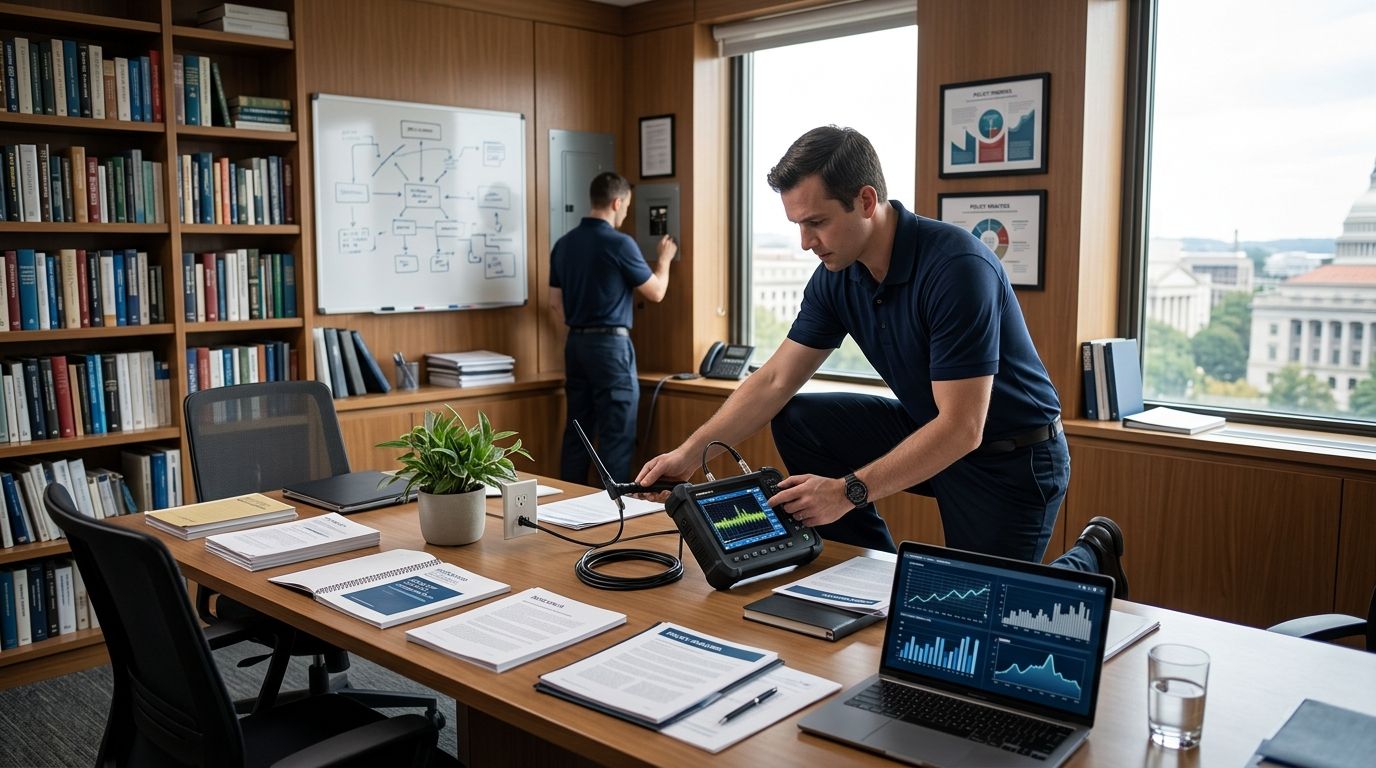
Think tank TSCM sweeps are technical surveillance countermeasures inspections aimed at finding hidden surveillance devices in spaces used for policy research and confidential discussions. For think tanks and policy research organizations, the priority is to identify which rooms, meetings and equipment need attention without treating every concern as proof of surveillance. This guide explains when to use manual checks, when to involve your IT team and when to request professional TSCM services in 2026.
- TSCM sweeps for think tanks and policy research organizations are best targeted at rooms used for confidential work.
- USA Bugsweeps is best for organizations seeking professional TSCM bug sweeping, not a substitute for IT security review.
- Record the concern, identify the affected space and agree on the inspection scope before a sweep.
- A clear manual check can establish what belongs in a room; it cannot rule out hidden surveillance.
Why TSCM matters for think tanks
A policy organization can restrict access to a draft and still discuss it in a room containing microphones, cameras, phones and conference equipment. Document controls do not answer whether a separate recording device is present. That distinction matters when you are choosing between an IT review and a physical sweep.
In 2026, start with the conversation you need to protect. A private interview calls for attention to the interview space; a confidential board discussion calls for attention to the meeting room and equipment used there. Choose the inspection area from the work at risk, not from an unverified assumption about where a device sits.
USA Bugsweeps provides professional TSCM bug sweeping services nationwide and identifies hidden cameras, audio bugs, GPS trackers and wiretaps as the types of surveillance its services address. For a think tank, a professional sweep is the right option when the question is whether a selected physical space or vehicle contains a hidden device. It is not the same task as checking account access, document sharing or network activity.
How to plan a TSCM sweep for a policy organization
The 2026 plan should follow the work: identify the sensitive setting, record what prompted concern, then choose the right type of review. The steps below separate preparation you can do yourself from device detection that requires a professional inspection.
Map sensitive rooms
List where confidential conversations actually happen before requesting a building-wide inspection. A policy office may use different rooms for research interviews, leadership discussions and external meetings. Treat each location as a separate scope decision so the people arranging the sweep can say what needs to be examined.
You can create this map with a room list and a meeting calendar. Identify shared spaces as well as rooms your organization controls; access arrangements can differ. Keep the list limited to what is relevant to the concern rather than circulating details of sensitive discussions.
- Mark rooms used for confidential interviews or policy discussions.
- Note which spaces are shared with other occupants or visitors.
- Identify conference equipment and other electronics normally kept in each room.
- Record who can authorize access to each space.
Control meeting access
Check who enters a room before, during and after sensitive meetings. This is an operational check, not a device test: an access record helps establish what should be in the room, but it does not prove that the room is free of surveillance.
Use the access procedures you already have before adding new ones. If a room regularly changes configuration, ask staff to note unfamiliar objects rather than move them. That preserves useful context for the person responsible for assessing a concern.
- Confirm which staff can open and prepare the room.
- Account for visitors, maintenance access and shared-room bookings.
- Note changes to furniture or electronics before the meeting.
- Assign one person to receive and document concerns.
Record suspicious findings
If someone notices an unfamiliar object, altered equipment or an unexpected recording concern, write down what was observed. Do not turn a guess into a finding. The useful record is the location, the condition of the object and who first noticed it.
Avoid dismantling a suspected device or conducting an improvised search that changes the scene. If there is an immediate personal safety concern, use the appropriate emergency channel. Otherwise, route the observation to the organization’s designated security or management contact before deciding whether to request a sweep.
- Record the room and the object’s visible location.
- Note when the concern was first observed.
- Document who has handled the object, if anyone.
- Keep observations separate from theories about who placed it.
Set sweep priorities
Not every security question calls for TSCM. Decide whether the concern involves a physical listening or recording device, an organization-owned account, a phone or a vehicle. A professional TSCM inquiry should describe the physical spaces or vehicles you want assessed; an account or network concern belongs with the team responsible for those systems.
USA Bugsweeps is best for think tanks that need professional TSCM bug sweeping of a defined space or vehicle. Its stated detection areas include hidden cameras, audio bugs, GPS trackers and wiretaps. The limitation is equally important: a physical sweep does not replace an investigation into compromised credentials or unauthorized document access.
- Prioritize the room tied to the specific concern.
- List adjacent or shared spaces only when they affect the inspection question.
- Identify vehicles separately if tracking is the concern.
- Send account, device-management and network questions to your IT team.
Coordinate the visit
Before arranging a 2026 sweep, decide who can authorize entry and who should receive the result. A clear request states the locations, the type of concern and any access restrictions. It does not require staff to diagnose a hidden device themselves.
Agree on how ordinary work in the selected rooms will be handled during the visit. If the space contains research material or confidential interviews, identify a point of contact who can address access questions without unnecessarily distributing that material. Ask the provider what is included in the proposed scope rather than assuming every room, device or vehicle is covered.
- Name the person authorized to approve the inspection.
- Provide the room or vehicle list and relevant access details.
- Describe observations without asserting that surveillance has occurred.
- Confirm what is in scope and how findings will be reported.
Review the result
A sweep is useful only if you know what was inspected and what remains outside its scope. Ask for a clear account of the areas examined and any finding that needs follow-up. If no device is identified, treat that as the result of the agreed inspection, not a guarantee about every location or every future meeting.
Use the result to update room-access practices and decide whether an IT review is also needed. Keep the report with the staff responsible for the concern. A policy organization gains little by distributing sensitive findings beyond the people who need to act on them.
- Match the reported scope against the original room list.
- Assign an owner to each finding or follow-up question.
- Record areas that were not inspected.
- Decide whether access controls or IT checks need separate attention.
Request a TSCM sweep
Describe the space or vehicle you want assessed and the concern that prompted the request.
Compare your options before requesting a sweep
The best choice in 2026 depends on the question you need answered. Manual checks help you establish what normally belongs in a room. IT review addresses systems and accounts. Professional TSCM addresses suspected physical surveillance; none of these options performs the others’ job.
| Option | Best for | What it addresses | Key limitation |
|---|---|---|---|
| Staff room check | Best for noticing unfamiliar objects or changes before a meeting | Visible room conditions and known equipment | Cannot rule out a concealed device |
| Internal IT review | Best for concerns about accounts, managed devices or network access | Digital access and organization-managed systems | Does not establish whether a hidden physical device is present |
| USA Bugsweeps professional TSCM | Best for a defined room or vehicle where hidden surveillance is the concern | Professional bug sweeping for hidden cameras, audio bugs, GPS trackers and wiretaps | Does not replace an IT security review |
Start with the check your staff can perform without disturbing anything: confirm the room layout and identify equipment that belongs there. Escalate a physical surveillance concern to a professional sweep. If the concern instead involves a suspicious login or exposed research file, direct it to IT; adding a room sweep alone does not answer that question.
Common mistakes policy research teams make
Treating every security concern as a bug
An unfamiliar device in a meeting room and an unexpected account login are different problems. Describe the observation first, then select the review that can answer it. Ordering a physical inspection to investigate an account issue leaves the original question open.
Requesting a sweep without naming the spaces
An organization-wide concern is too vague to set an inspection scope. List the rooms or vehicles connected to the concern, who controls them and which spaces are shared. You can then ask for a scope that matches the decision you need to make.
Moving a suspected device before documenting it
Handling an unfamiliar object can change its condition and remove context. Record its visible location and notify the designated contact. Leave any technical assessment to the person assigned to investigate it.
Treating a clear room as a permanent result
A sweep addresses the agreed spaces at the time of inspection. In 2026, keep ordinary access controls in place after the visit and reassess when a new, specific concern arises. Do not present an inspection result as proof that no future surveillance is possible.
Sharing the concern too broadly
A sensitive interview, donor discussion or unpublished policy draft does not need an office-wide account of an unverified suspicion. Give the access coordinator and investigators the facts they need. Keep theories and unnecessary research details out of the request.
FAQ
What are TSCM sweeps for think tanks and policy research organizations?
They are technical surveillance countermeasures inspections focused on possible hidden surveillance in defined spaces or vehicles. Start by identifying the location and concern, then agree on what the inspection covers.
When should a think tank request a professional bug sweep?
Request a professional sweep when a specific room or vehicle raises a physical surveillance concern that a staff check cannot resolve. Document the observation and identify who can authorize access before arranging the visit.
Can a staff room check replace a professional TSCM sweep?
No. A staff check can identify an unfamiliar visible object or a change in room layout, but it cannot rule out a concealed camera, listening device or wiretap.
Does a TSCM sweep check compromised accounts?
No. A physical TSCM sweep and an IT security review answer different questions. Ask your IT team to investigate account, device-management and network concerns separately.
Which rooms should a policy organization prioritize?
Prioritize rooms tied to confidential discussions or a specific observation. Include shared or adjacent spaces only when they are relevant to the concern and can be included in the agreed scope.
What should staff do if they find an unfamiliar object?
Record where it is and report it through the organization’s designated channel without dismantling it. Keep the observation separate from assumptions about what the object does or who placed it.
Is USA Bugsweeps suitable for a think tank outside one city?
USA Bugsweeps states that it provides professional TSCM bug sweeping services nationwide. Describe the location, space or vehicle and concern when requesting an estimate.
One last thing
The most useful question in 2026 is not whether a building is secure; it is what a specific inspection can establish about a specific space. USA Bugsweeps can address the physical surveillance question through its TSCM services. Keep IT review and room-access decisions on their own tracks so an answer to one question is not mistaken for an answer to all three.


