
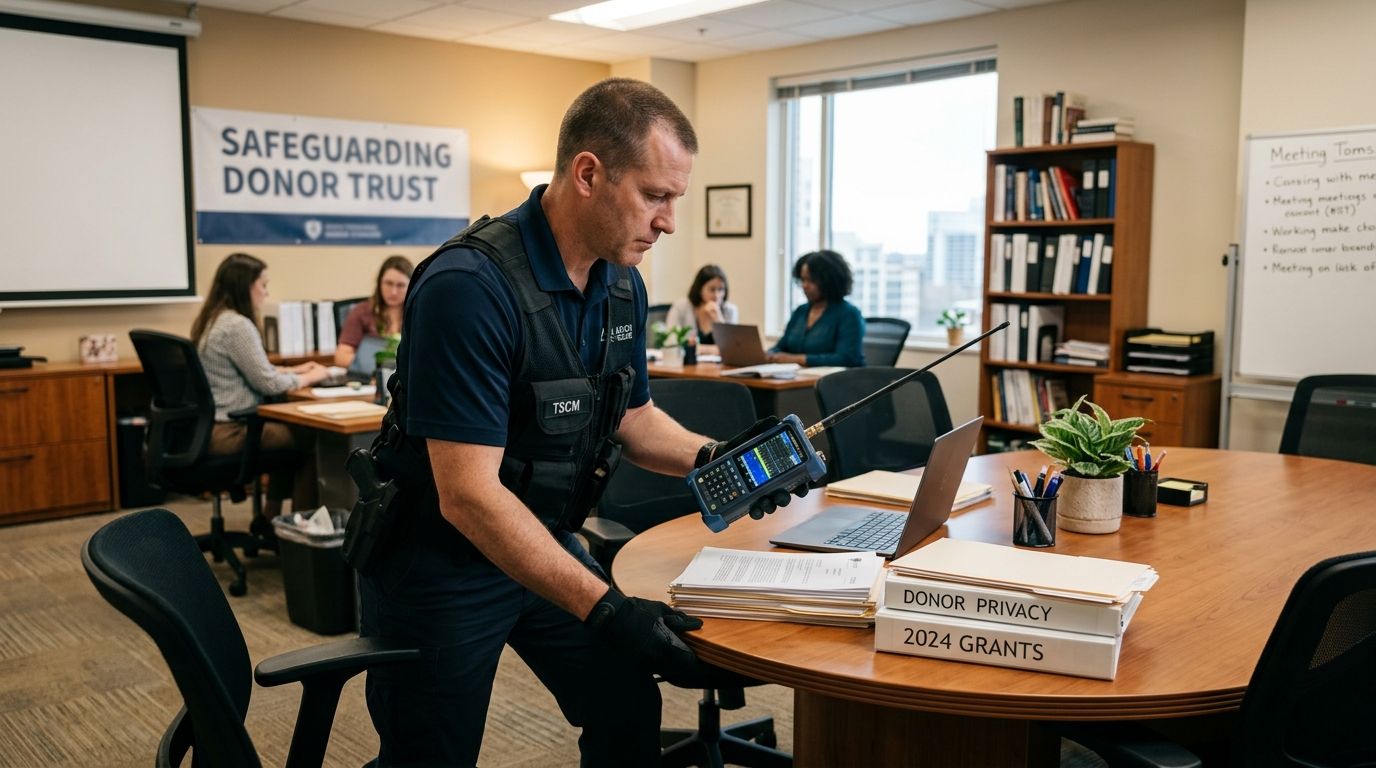
Nonprofit organization TSCM sweeps are technical surveillance countermeasures inspections that check board rooms, donor meeting spaces, and executive offices for hidden cameras, audio bugs, GPS trackers, and wiretaps, with the goal of protecting donor identities, gift agreements, and grant negotiations from exposure. Nonprofits carry a specific risk profile: donor databases are high-value targets, board disputes can turn into leaks to the press, and volunteer or intern turnover means access to sensitive rooms changes constantly.
- TSCM sweeps for nonprofit organizations protect donor lists, gift agreements, and board discussions from hidden recording devices.
- Sweep board rooms and executive offices before annual campaigns, capital drives, and major donor visits, not just after a suspected leak.
- Professional TSCM detection finds RF transmitters, GSM bugs, and pinhole cameras that consumer detector apps miss.
- One annual sweep is not enough for nonprofits with rotating volunteers, seasonal staff, or shared office space.
Why TSCM sweeps matter for nonprofit organizations
Nonprofits handle information that competitors, disgruntled former employees, opposition researchers, and rival organizations want: donor names, gift sizes, planned giving details, and internal grant strategy. Unlike a corporate boardroom protected by NDAs and counsel on retainer, a nonprofit board room is often a converted conference space with volunteer-run AV equipment and no consistent access control.
The exposure risk is not hypothetical. Nonprofit board disputes regularly end up in local news, and a leaked recording of a closed-session discussion about a controversial gift or a leadership fight does lasting damage to donor trust. A nonprofit's donor list is often its most valuable asset and its least protected one.
A TSCM sweep is not a cybersecurity audit. It is a physical and RF-spectrum inspection that finds the hardware a firewall cannot see: a recorder taped under a conference table, a GSM bug plugged into an unused outlet, or a compromised phone left in a donor lounge. In 2026, that hardware is smaller, cheaper, and easier to buy than it was five years ago.
Identify your organization's high-risk spaces
Map which rooms actually carry sensitive conversations. Not every space needs the same attention.
- Board rooms where fiduciary and personnel matters are discussed
- Executive director and development director offices
- Donor lounges or private meeting rooms used during galas
- Finance office where gift processing and payroll happen
- Any rented or shared conference space used for closed-session votes
Audit board meeting and donor conversation rooms first
Board rooms are where the most damaging leaks start, so they get priority. Look at both the room and what enters it.
- Check under tables, inside light fixtures, and behind wall art for pinhole cameras
- Inspect phone bases, USB chargers, and power strips for unfamiliar hardware
- Ask who holds keys or badge access and when that list was last updated
- Confirm the room's Wi-Fi network is separate from the general office network
- Note every smart speaker, smart TV, and video conferencing unit with an always-on microphone
Check devices and shared equipment for spyware
Nonprofits run on donated and shared laptops and phones passed between staff and volunteers. That turnover is a spyware risk.
- Review any device that changed hands between staff, interns, or volunteers in the last 90 days
- Check smartphones used to access donor management software for unrecognized apps
- Confirm shared printers and scanners are not logging donor correspondence
- Look at conference-room laptops for unfamiliar remote-access software
For staff using personal phones for organizational business, a manual diagnostic check is the free starting point; a conference room bug sweep covers the room-level side of the same problem.
Sweep before major fundraising events and site visits
Galas, capital campaign kickoffs, and major-donor site visits bring vendors, caterers, and press into spaces that normally stay closed. That is exactly when planted devices go in and come out unnoticed.
- Sweep event rooms 24-48 hours before the event and again after breakdown
- Check silent auction and VIP donor areas separately from the main hall
- Verify vendor-supplied AV equipment before it is wired into the room
- Walk the perimeter for unattended bags, boxes, or floral arrangements near the head table
Review vendor and volunteer access to sensitive areas
Nonprofits depend on volunteers and outside contractors more than most organizations, and that is the access-control gap that gets exploited.
- List every vendor holding a key or badge (cleaning, catering, IT support)
- Rotate access codes after large volunteer events and seasonal turnover
- Restrict volunteer access to board rooms and finance offices to escorted visits
- Log who installs or services phone systems, since a tapped office phone system is a recurring finding in shared-office nonprofits
Bring in a professional TSCM sweep for full-spectrum detection
Manual checks and access reviews catch obvious problems. They do not catch a professionally planted GSM bug transmitting over a cellular network or a recorder hardwired into existing electrical. That level of detection needs spectrum analyzers, nonlinear junction detection, and thermal imaging run by a trained technician. USA Bugsweeps performs TSCM sweeps nationwide for exactly this scope of work.
- RF spectrum sweep across the full frequency range, not just Wi-Fi and Bluetooth bands
- Nonlinear junction detection to find powered-off or dormant devices
- Physical inspection of wall voids, HVAC vents, and furniture in board rooms and executive offices
- Phone line and network cable inspection for wiretap connections
- A written report covering what was checked, what was found, and remediation steps
Build a recurring sweep schedule tied to your calendar
A single sweep gives you a snapshot. Nonprofits with quarterly board meetings, an annual gala, and rotating volunteers need a cadence.
- Sweep before each quarterly board meeting with fiduciary or personnel items on the agenda
- Add a sweep before and after the annual gala or capital campaign launch
- Re-sweep after any office move, renovation, or new equipment installation
- Re-sweep after any staff termination involving access to sensitive rooms
Schedule a nonprofit TSCM sweep
Protect donor records and board discussions before your next gala or capital campaign.
Comparison: sweep options for nonprofit organizations in 2026
| Option | Best for | Key limitation |
|---|---|---|
| Consumer RF detector or app | Quick self-check between events | Misses dormant, powered-off, and hardwired devices |
| In-house IT security review | Network and device-level spyware checks | No coverage of physical bugs, hidden cameras, or RF transmitters |
| Professional TSCM sweep (USA Bugsweeps) | Board rooms, donor events, executive and finance offices | Requires scheduling a technician on-site |
| Recurring TSCM schedule | Nonprofits with quarterly board cycles and high volunteer turnover | Higher coordination effort across the year |
Verdict: a professional TSCM sweep is the only option here that reliably finds powered-off, hardwired, and RF-transmitting devices — consumer detectors and IT reviews catch software risk, not hardware planted in an outlet or under a conference table. USA Bugsweeps is best for nonprofits protecting board discussions and donor records in 2026.
“A nonprofit's donor list is often its most valuable asset and its least protected one.”
Common mistakes nonprofits make
- Treating a donor privacy policy as physical protection. A policy governs data handling, not a bug in the wall.
- Sweeping only after a leak is suspected. By then the board discussion or donor list is already out.
- Letting volunteer AV crews handle sensitive-room equipment unsupervised. Rotating volunteers are the most common access blind spot.
- Assuming one sweep covers the whole year. Office moves, new hires, and event season each reopen the risk.
- Funding cybersecurity while underfunding physical security. Firewalls do not stop a recorder taped under a table.
FAQ
How much does a TSCM sweep cost for a nonprofit organization?
Cost depends on room count, square footage, and whether the sweep covers board rooms only or the full office. Request a quote based on your actual space rather than budgeting from a flat rate.
How often should a nonprofit sweep its board room?
Before each quarterly meeting where fiduciary or personnel matters are discussed, plus after any office move, renovation, or staff termination involving room access.
Can a donor list be stolen through a hidden camera or recorder?
Yes. A camera or recorder in a finance office or board room can capture screens, printed reports, and spoken discussion of gift amounts and donor names.
Do we need a sweep if we already have cybersecurity protections?
Cybersecurity protects networks and devices from remote access, not a physically planted bug or camera. TSCM sweeps for nonprofit organizations cover the hardware risk software tools cannot detect.
Is it worth sweeping before a gala or fundraising event?
Yes. Event setup brings outside vendors and equipment into normally closed spaces, which is when devices are most often planted or retrieved unnoticed.
What rooms matter most in a nonprofit TSCM sweep?
Board rooms, executive director and development offices, donor lounges, and the finance office where gift processing happens carry the highest risk.
Are volunteers and interns a surveillance risk?
Rotating volunteer and intern access to sensitive rooms is one of the most common access-control gaps at nonprofits. Review it before and after high-turnover seasons.
Who performs TSCM sweeps for nonprofits nationwide?
USA Bugsweeps provides TSCM bug sweeping and electronic surveillance detection for organizations across the country, covering hidden cameras, audio bugs, GPS trackers, and wiretaps.
One last thing
The riskiest room in most nonprofit offices is not the executive suite — it is the finance office, where gift amounts, donor names, and payroll sit on a monitor anyone walking past can read, let alone a camera pointed at the screen. Sweep that room with the same priority as the board room in 2026, not as an afterthought.


