
Instead of repeatedly checking phone noise or rewriting incident notes, document the facts once and route them to the right recipient: file an FCC consumer complaint for a telecommunications privacy issue, and report suspected criminal interception to law enforcement. This 2026 guide explains how to file an FCC complaint for a wiretap without treating an unverified symptom as proof.
- How to file an FCC complaint for a wiretap: document facts, identify the telecommunications issue, and preserve confirmation records.
- The FCC consumer complaint process is not a substitute for reporting suspected criminal interception to law enforcement.
- USA Bugsweeps provides professional TSCM services; technical findings and complaint filing serve different purposes.
- Phone noise, battery drain, and detector alerts alone do not establish that a wiretap exists.
Why this matters
A complaint belongs with the agency that can address the documented issue—not simply the agency associated with telephones. The FCC handles telecommunications consumer complaints, while law enforcement handles reports of suspected crimes. A carrier can also investigate service faults and account concerns.
USA Bugsweeps is best for homeowners, business owners, and vehicle owners seeking professional TSCM bug sweeping services. Its role is technical surveillance detection, not FCC complaint adjudication or criminal investigation. You can contact USA Bugsweeps to discuss the technical concern before deciding what findings belong in a report.
Keep those roles separate throughout your 2026 reporting workflow. A submitted complaint documents what you reported; it does not establish that interception occurred.
Before you start
- Prepare access and records: Have your contact details, affected telephone number or account information, carrier name, incident notes, and relevant correspondence. Use a trusted device and account if you have a concrete reason to question the affected device's security.
- Preserve evidence before changing equipment: Keep original photographs, messages, reports, and account notices. Confirm permission before inspecting business equipment or premises you do not control; do not open carrier infrastructure or dismantle suspicious devices.
- Check the jurisdiction first: The FCC consumer portal is not a dedicated criminal wiretap-reporting system. If your concern is a hidden recorder, stalking, threats, or suspected unauthorized interception, contact the appropriate law enforcement agency rather than waiting for an FCC response.
If you face immediate danger, leave the location when safe and contact emergency services. Do not delay urgent assistance to finish collecting evidence.
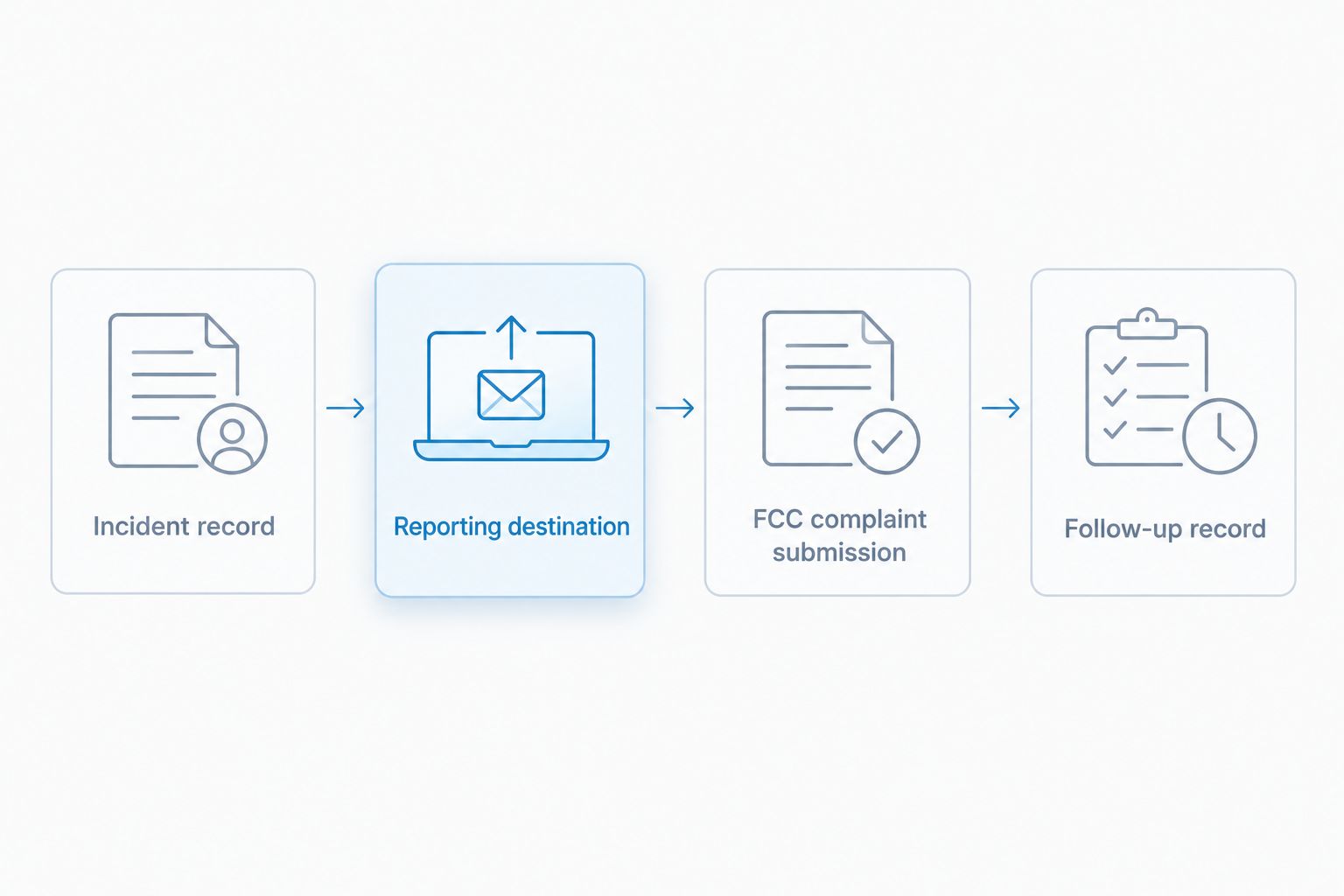
Incident record
Establish the facts before selecting a complaint category
- Write a factual chronology. Record when each event happened, where it happened, the affected service or equipment, and what you directly observed. Use 24-hour timestamps with a time zone so records from different systems remain comparable.
- Separate observations from interpretations. Describe an audible click as an audible click—not as confirmed interception. Record a detector alert with its location and circumstances rather than labeling it a listening device.
- Preserve original files. Retain original photographs, messages, and technical reports. Make working copies for annotation and submission, keeping 2 separate copies of important records in locations you control.
- Ask for technical clarification. If an examiner identifies a suspicious item or condition, ask what was observed, how it was assessed, and what remains unconfirmed. Do not turn a limited finding into a broader accusation.
Expected result: You have a chronology that another person can understand without accepting your interpretation in advance.
For a practical 2026 case folder, use descriptive filenames containing the incident date and document type. Keep incident dates separate from file creation dates: downloading a photograph today does not establish when the photographed event occurred.
Evidence packet
Build a 1-page summary supported by separate attachments. Include the affected service, your direct observations, prior contacts, and the action you are requesting.
Do not attach entire personal archives. Select records relevant to the issue, redact unrelated sensitive information on submission copies, and preserve the unredacted originals securely. Review documents for other people's telephone numbers, private conversations, and account credentials before sharing them.
Reporting destination
Match the documented issue to the recipient
- Identify the primary concern. Decide whether you are reporting a telecommunications privacy problem, a service fault, a suspicious physical device, or suspected criminal conduct. More than one concern can exist, but each needs a clear description.
- Contact the carrier for service or account questions. Request a service investigation or account-security review as appropriate. Save the reference number and the carrier's actual explanation.
- Contact law enforcement for suspected crimes. Explain the observations, any threats, and any physical evidence. Ask how to preserve an item rather than removing or testing it yourself.
- Use the FCC process for the telecommunications issue. State the connection to a carrier, telephone service, or communications privacy concern. Do not assume every hidden microphone falls within the FCC consumer complaint process.
Expected result: Each recipient receives an issue it can assess, rather than a broad allegation with no clear service connection.
Which reporting route fits your situation?
These options are complementary, not interchangeable. Select the route based on the facts you can describe.
| Route | Best for | Practical benefit | Limitation |
|---|---|---|---|
| Carrier support or security team | Service faults and account concerns | Can examine its own service and account records | Does not replace an independent criminal investigation |
| FCC consumer complaint | Telecommunications service or privacy concerns within FCC scope | Creates a documented regulatory complaint | Is not an emergency response or dedicated wiretap investigation |
| Law enforcement | Suspected unlawful interception, threats, stalking, or discovered devices | Can assess a criminal report and evidence handling | Reporting does not guarantee an investigation or particular outcome |
| Professional TSCM assessment | Technical examination of an authorized space or equipment | Can help distinguish findings from assumptions | Cannot by itself establish who installed a device or whether conduct was unlawful |
USA Bugsweeps TSCM services address technical surveillance concerns, not legal conclusions. A physical sweep also has a defined scope: it does not, by itself, rule out account compromise or interception elsewhere in a communications network.
FCC complaint submission
Complete the consumer complaint with a narrow factual narrative
- Find the official FCC Consumer Complaint Center. Start from the FCC's official government website. Confirm that you are using an FCC government page before entering personal or account information; avoid third-party complaint services.
- Choose the relevant service category. For a telephone-service issue, select Phone. Read the available issue descriptions and select the option that actually matches your concern; do not choose an unrelated category merely to submit something.
- Enter accurate contact and service details. Identify the affected telephone number and provider where requested. Distinguish your own account from a business account you are authorized to represent.
- Describe facts, previous contacts, and requested action. Explain what happened, what evidence supports it, what the carrier said, and what you want reviewed. Identify suspected interception as suspected unless a qualified finding establishes more.
- Review before submission. Check dates, telephone numbers, attachments, and the recipient's scope. Use Submit only after removing unsupported accusations and unnecessary personal information.
Expected result: Your FCC complaint describes a specific telecommunications concern and gives the recipient enough context to assess it.
For your 2026 submission, follow the live form's wording and attachment instructions. Do not assume an older screenshot or third-party tutorial matches the current form.
What belongs in the complaint narrative?
Use this order to keep the account readable:
- Service: Identify the affected telephone service and provider.
- Observation: Describe the event or documented account condition.
- Evidence: Identify relevant records without overstating their meaning.
- Prior action: Summarize carrier contacts and reference numbers.
- Request: Ask for review of the specific service or privacy concern.
Request an outcome within the recipient's role. A carrier explanation or review of a telecommunications privacy issue is different from asking the FCC to identify an alleged offender, search a property, or remove a device.
Avoid naming a suspected individual based only on suspicion. If identifying information is relevant to a criminal report, discuss it with law enforcement or your attorney through the appropriate channel.
Confirmation and follow-up record
Keep submissions, responses, and evidence connected
- Save the submission record. Preserve the confirmation page, confirmation message, reference number, and a copy of the narrative and attachments you submitted. Record the submission date separately from incident dates.
- Create a response log. Record each incoming message, the sender, the reference number, and any requested action. Keep carrier, FCC, and police references distinct.
- Answer requests factually. Supply relevant clarification through the channel identified in legitimate case correspondence. Verify unexpected requests before sending sensitive documents.
- Record unresolved questions. Distinguish an unanswered question from an established finding. If the carrier identifies a service fault, add that explanation to the chronology rather than ignoring it.
Expected result: You can show exactly what was reported, what changed, and which recipient provided each response.
Evidence handling matters when a suspicious object is involved. The bug sweep to chain-of-custody documentation workflow provides a related starting point for organizing that handoff.
Keep the reporting sequence simple: preserve the record, choose the recipient, submit the relevant issue, and retain the response. Do not let multiple reporting channels produce contradictory versions of the same event.
When new evidence appears
Update the existing record rather than restarting the entire process. A new technical report, carrier explanation, or police reference can change what you should report and to whom.
- New technical finding: Preserve the report and distinguish the examiner's conclusion from your interpretation.
- New carrier explanation: Record whether it addresses the original issue or leaves a specific question unresolved.
- New threat or discovered device: Contact law enforcement promptly; do not wait for regulatory correspondence.
- Correction to an earlier statement: Clearly identify the correction through the relevant case channel instead of silently changing your saved narrative.
For a 2026 case involving several recipients, keep one master chronology and separate submission copies. This preserves consistency without sending every recipient every private document.
Troubleshooting
No complaint category fits the allegation
Do not force a hidden-recorder discovery into an unrelated telephone-service category. Reassess the telecommunications connection and ask the relevant agency which reporting channel applies; suspected criminal interception belongs with law enforcement.
The only evidence is noise or a detector alert
Treat the signal as an observation, not a finding. Ask the carrier to investigate service symptoms and obtain an appropriate technical assessment when justified; ordinary interference and equipment faults do not establish surveillance.
The form will not accept an attachment
Check the live form's file-type and size instructions. Preserve the original, prepare a supported submission copy, and identify the relevant document in the narrative without assuming an unuploaded file reached the recipient.
You submitted but cannot find confirmation
Check the email address you entered and its spam folder. Preserve any saved submission screen, then use the FCC's official assistance options to clarify the status rather than repeatedly submitting duplicate complaints.
Someone asks you to remove a suspicious device
Pause before handling it. Ask law enforcement or a qualified examiner for instructions, especially if removal would disturb evidence, expose electrical components, or increase a safety risk.
Customize your workflow
For a business telephone system, involve the authorized administrator and distinguish desk phones, network equipment, carrier service, and user accounts. A room sweep and a telephone-system investigation answer different questions.
For a home concern, separate physical-device observations from account-security symptoms. For a vehicle concern, describe the actual device or finding instead of calling every tracker a wiretap.
Ask USA Bugsweeps to discuss the scope of a TSCM assessment before treating a sweep as an answer to every communications concern. Preserve records before making changes, but prioritize immediate safety and necessary protective action over perfect documentation.
Discuss your surveillance detection concern
Describe the property, equipment, and observations relevant to a professional TSCM assessment.
FAQ
How do I file an FCC complaint for a suspected wiretap?
Use the official FCC Consumer Complaint Center for a relevant telecommunications service or privacy concern, select the matching category, and submit a factual account. Preserve the confirmation and report suspected criminal interception separately to law enforcement.
Does the FCC investigate every reported wiretap?
No. The FCC consumer complaint process is not a dedicated criminal wiretap investigation service. The issue must fit the FCC's telecommunications role, and suspected crimes require the appropriate law enforcement channel.
Should I contact my phone carrier before filing?
Contact the carrier for service faults or account-security concerns and preserve its response. Do not delay an urgent law enforcement report or safety action while waiting for carrier assistance.
Do clicks or static prove that my phone is tapped?
No. Clicks and static do not establish interception because service and equipment problems can also produce noise. Record the symptom and request appropriate technical investigation rather than reporting the noise as confirmed surveillance.
Can a professional bug sweep prove who installed a device?
A technical finding alone does not necessarily establish who installed a device or whether its use was unlawful. Attribution and legal conclusions require additional evidence and the appropriate investigative process.
Should I remove a suspected wiretap before reporting it?
Do not dismantle or remove suspicious equipment without appropriate guidance. Prioritize safety, document what you can observe safely, and ask law enforcement or a qualified examiner about preservation.
What should I save after submitting an FCC complaint?
Save the confirmation, reference number, submitted narrative, attachments, and subsequent correspondence. Keep incident dates separate from submission dates and connect each response to the correct case reference.
One last thing
A complaint confirmation proves submission, not surveillance. Keep that distinction visible in your records: it prevents an administrative acknowledgment from becoming an unsupported technical claim when you speak with a carrier, investigator, employer, or attorney.


