
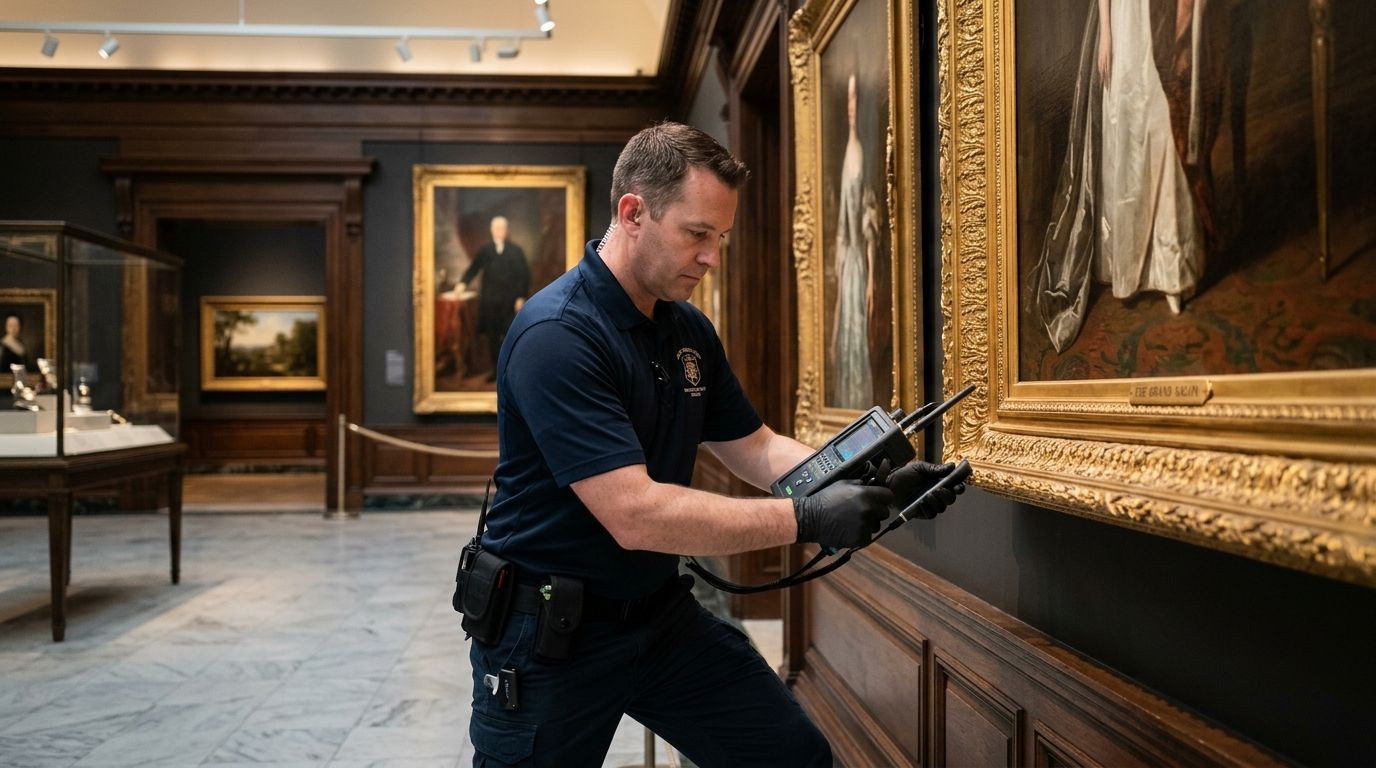
Bug sweep services for museums and art galleries locate hidden cameras, audio transmitters, and GPS trackers planted to steal exhibition logistics, insurance appraisals, loan schedules, or donor financial data before a theft or a leak. Museums carry a threat profile that a typical office sweep doesn't cover — the target is often a Rembrandt's shipping route or a board member's pledge amount, not a sales pitch.
- Bug sweep services for museums cover exhibition halls, curator offices, and board rooms, not just the front desk.
- USA Bugsweeps runs TSCM inspections around loan arrivals, gala events, and after any suspected breach.
- Consumer RF detectors miss dormant recorders and devices that burst-transmit data once a day.
- Museums handling eight-figure loan collections should sweep before every major acquisition announcement, not just once a year.
Why this matters
A museum's real assets aren't only on the walls. Loan agreements, transport routes, alarm codes, and appraisal values sit in curator inboxes and director calendars, and any of that data is worth more to a thief than the painting itself once they know the shipment schedule. A microphone planted in a boardroom during a loan negotiation tells a buyer or a competitor exactly when a piece moves and how it's guarded.
Galleries handling private collections face a second exposure: donor conversations about six- and seven-figure gifts happen in the same offices where staff discuss security vendor contracts. One planted device in the wrong room compromises both at once. USA Bugsweeps treats museums as a distinct category precisely because the rooms that need sweeping — registrar offices, loading docks, board rooms — don't match a standard corporate floor plan.
Why bug sweep services matter for museums and galleries
Museums move high-value objects on predictable schedules: loan periods, gala openings, traveling exhibitions. That predictability is exactly what makes them attractive to anyone running electronic surveillance. A device that records six weeks of curator calls captures the exact date a $40 million loan collection arrives, the transport company's name, and the alarm vendor's maintenance window.
Insurance underwriters for fine art increasingly ask about physical and electronic security posture before renewing high-value policies. A documented TSCM sweep, run on a set schedule, gives a museum's risk management team something concrete to show an underwriter beyond a camera system and a guard rotation.
Audit the security control room first
The control room is where alarm codes, camera feeds, and guard schedules live in one place. It's the highest-value single room in the building for anyone planning a theft, and it's routinely overlooked because staff assume physical access control is enough.
- Check every phone extension and VoIP handset for unauthorized call-forwarding or hidden microphones
- Inspect wall clocks, smoke detectors, and power strips — common housings for pinhole cameras
- Confirm the Wi-Fi network isn't broadcasting an unrecognized SSID from inside the room
- Review who has physical key or badge access to the space and when it was last audited
Inspect exhibition halls before high-value loans arrive
Exhibition halls change configuration constantly, which makes a planted device easy to miss between installs. Sweep the space before major pieces arrive, not after.
- Check display case wiring and lighting fixtures for added components
- Scan HVAC vents and false ceilings near the loading dock entrance
- Test for RF activity spikes during install week versus a quiet baseline week
- Verify vendor and contractor equipment left behind after installation is accounted for
Check director and curator offices
Curators and directors negotiate loan terms, insurance values, and acquisition budgets from their desks. These offices see less traffic than public galleries, which gives a planted device more time to sit undetected.
- Inspect desk phones, USB chargers, and desk lamps for added hardware
- Check bookshelves and picture frames for battery-powered recorders
- Confirm laptop webcams and microphones aren't compromised by spyware
- Review who accessed the office during off-hours in badge logs
Sweep board rooms and donor meeting spaces
Board meetings cover acquisition budgets, security vendor contracts, and major gift negotiations in one sitting. A device here captures the museum's most sensitive financial conversations in a single recording. The same principle applies to any conference room used for high-stakes discussions — museum board rooms carry the same exposure as a corporate one, just with donor pledges instead of deal terms.
- Check under the conference table and inside AV equipment housings
- Inspect ceiling tiles and light fixtures directly above the seating area
- Test wireless presentation systems for unauthorized connections
- Confirm visiting board members' devices aren't left unattended in the room
Bring in a certified TSCM sweep for major loans and acquisitions
A do-it-yourself RF detector catches obvious, always-on transmitters. It won't catch a device that records locally and dumps data once a day, or one built into an existing fixture rather than added afterward. A museum preparing for an eight-figure loan or a major acquisition announcement should schedule a certified sweep, not run a consumer detector and call it done. USA Bugsweeps runs full-spectrum RF, nonlinear junction detection, and physical inspection across the rooms that matter most — control room, curator offices, board room, loading dock — timed around the exhibition calendar rather than a generic annual date.
Screen phone systems and network infrastructure
Museum phone systems often run on legacy PBX hardware alongside newer VoIP lines, and older systems are easier to tap without detection. A tapped office phone system can leak an entire negotiation without anyone in the room knowing.
- Check the phone closet for unauthorized splices or added hardware
- Confirm network switches match the IT department's inventory
- Test for line noise or static that could indicate an inline tap
- Review remote access logs on the VoIP system for unrecognized devices
Schedule recurring sweeps around the exhibition calendar
A single annual sweep misses the windows that matter most: install week for a traveling exhibition, the week before a gala, and immediately after any staff turnover in a security-sensitive role. Build the sweep schedule around the museum's actual calendar, not a fixed date on the compliance checklist.
Comparing your options
| Option | Best for | Key limitation |
|---|---|---|
| Consumer RF detector | Small galleries running a quick self-check between exhibitions | Misses dormant recorders and devices that burst-transmit data |
| In-house security audit | Museums with an existing security team and camera system | Staff typically aren't trained on TSCM-grade detection equipment |
| Certified TSCM sweep | Museums preparing for high-value loans, galas, or after a suspected breach | Requires scheduling around exhibition and event hours |
| Insurance-mandated assessment | Institutions renewing fine-art insurance policies | Covers physical security gaps, not electronic eavesdropping devices |
Verdict: a consumer RF detector is fine for a monthly self-check between exhibitions — it's a Skip for anything tied to a major loan or acquisition. A certified TSCM sweep is the only option on this list built to catch dormant and burst-transmitting devices, which makes it the Buy for any museum moving high-value pieces or handling donor negotiations in the same rooms.
Get a museum security sweep quote
Schedule a TSCM inspection around your next loan or gala date.
Common mistakes museums make
- Sweeping only public galleries and skipping back-of-house offices — curator and registrar offices hold the data thieves actually want.
- Treating a camera system audit as a bug sweep — cameras deter break-ins; they don't detect a microphone planted in a curator's office.
- Running the sweep on a fixed annual date instead of around the exhibition calendar — a device planted during install week for a traveling show can sit undetected for months on an annual schedule.
- Assuming vendor and contractor staff are automatically trusted — installers, movers, and AV contractors have unsupervised access to exhibition halls during setup.
- Not re-sweeping after a security staff departure — a former employee with control room access is one of the most common sources of planted devices in institutional settings.
FAQ
What do bug sweep services for museums actually check?
A museum bug sweep inspects control rooms, curator and director offices, board rooms, exhibition halls, and phone systems for hidden cameras, audio transmitters, and GPS trackers. It combines RF spectrum scanning with physical inspection of fixtures, vents, and furniture.
How often should a museum schedule a TSCM sweep?
Museums moving high-value loans should sweep before major installs, before galas, and after any security staff turnover, not just once a year. A fixed annual date misses the windows when a device is most likely to be planted.
Is a consumer RF detector enough for a small gallery?
A consumer RF detector catches always-on transmitters but misses devices that record locally or burst-transmit data once a day. It's fine for a quick self-check between exhibitions, not for high-value loan periods.
Where do planted devices most often show up in museums?
Control rooms, curator offices, and board rooms see the most planted devices because they hold alarm codes, loan schedules, and financial negotiations in one place. Exhibition halls are also exposed during install and de-install weeks.
Can a phone system be tapped without the museum knowing?
Yes, legacy PBX systems are easier to tap undetected than modern VoIP lines. A phone system sweep checks for unauthorized splices in the phone closet and line noise that indicates an inline tap.
Does an insurance security assessment cover electronic bugs?
No, insurance-mandated assessments for fine-art policies typically cover physical security gaps like locks, alarms, and cameras. They don't check for electronic eavesdropping devices, which requires a separate TSCM sweep.
Should vendors and contractors be swept for as a risk source?
Yes, installers, art handlers, and AV contractors have unsupervised access to exhibition halls during setup and are a common entry point for planted devices. A post-install sweep should be standard practice.
One last thing
The room museums sweep least often — the loading dock office — is the one with the clearest view of shipment schedules, transport company names, and insurance values written on paperwork left in plain sight. A camera or recorder in that one room tells an outside party everything they need to plan a theft around the piece, not the building.


