
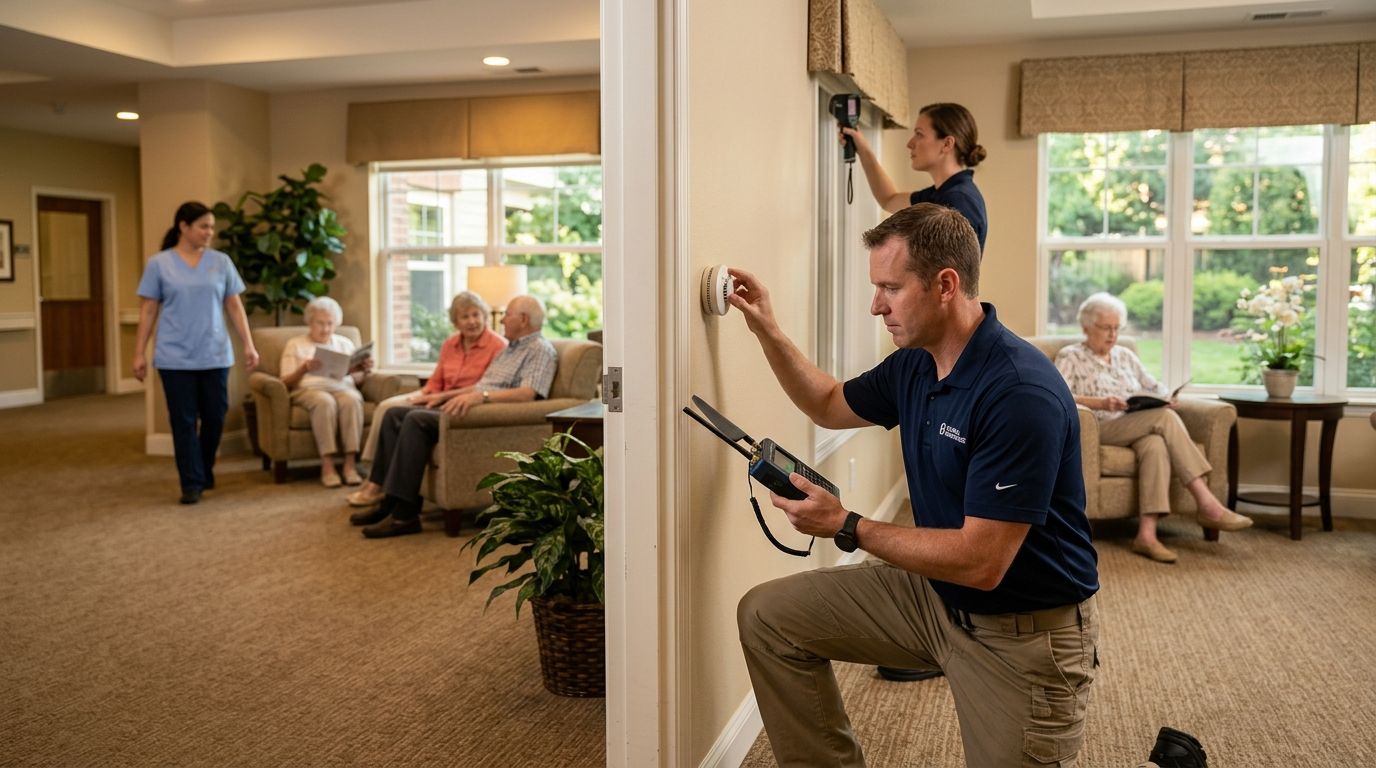
Counter surveillance sweeps for assisted living facilities check resident rooms, common areas, staff offices, and transport vehicles for hidden cameras, audio bugs, and GPS trackers planted by family members, staff, or outside parties. In 2026, facilities that skip this step are relying on hope, not verification, to protect residents who often can't advocate for their own privacy.
- Counter surveillance sweeps for assisted living facilities cover resident rooms, bathrooms, common areas, and staff offices for hidden cameras and audio bugs.
- Family-installed nanny cams disguised as clocks or photo frames are the most common device found in senior care settings.
- USA Bugsweeps recommends sweeps before move-in, after any complaint, and on a recurring schedule tied to licensing inspections.
- RF detector apps miss most non-transmitting recorders; a professional TSCM sweep checks both RF spectrum and physical hiding spots.
- Skip DIY sweeps for HIPAA-sensitive spaces like medication rooms and shared bathrooms.
Why counter surveillance sweeps matter for assisted living
Assisted living residents are a uniquely exposed population: many have limited mobility, cognitive decline, or family disputes over caregiving decisions that make hidden recording tempting for someone on either side. A camera hidden in a resident's room doesn't just violate that resident's privacy — it exposes the facility to state licensing complaints, family lawsuits, and local news coverage that follows the same pattern seen in hidden-camera stories out of schools and daycare centers. USA Bugsweeps treats senior care buildings as multi-tenant private residences, not as one commercial space.
Unlike an office or retail sweep, an assisted living sweep has to account for devices installed with good intentions — a family member worried about neglect who tapes a camera inside a stuffed animal or wall clock without telling staff or getting resident consent. That device is still a privacy problem even though nobody meant harm by it. A facility-wide TSCM sweep in 2026 has to catch both malicious and well-meaning hidden devices, because the legal exposure is identical either way.
How to run counter surveillance sweeps in assisted living facilities
Audit every resident room individually
Each room in an assisted living facility is effectively a private residence and needs its own visual and RF check, not a hallway walk-through.
- Check smoke detectors, clock radios, and picture frames for pinhole lenses
- Inspect USB chargers and power strips that residents or family brought from home
- Look behind wall-mounted TVs and inside stuffed animals or decorative pillows
- Check bathroom vents, towel racks, and shower fixtures for disguised cameras
- Log every device found with room number, date, and photo evidence
Sweep common areas and dining rooms
Shared spaces get less scrutiny than private rooms but see far more foot traffic and staff interaction.
- Check smoke detectors and exit signs in dining halls and activity rooms
- Inspect thermostats and wall outlets near seating areas
- Look at decorative items — clocks, plants, picture frames — for anything recently added
- Review any new furniture or fixtures installed in the past 90 days
Check staff offices, nurse stations, and medication rooms
These spaces hold protected health information, and a bug here is a compliance issue on top of a privacy one. The approach mirrors a patient privacy sweep for medical offices: assume any recording device captures PHI discussions, not just conversations.
- Check phone systems and desk phones for line taps
- Inspect computer workstations for unfamiliar USB devices
- Sweep the medication dispensing room separately from general nurse stations
- Check filing cabinets and drawers for planted audio recorders
Test the facility Wi-Fi and connected devices
Most hidden cameras sold today transmit over Wi-Fi, which means the network itself is a detection point.
- Pull a full list of devices connected to the facility router
- Flag any device name that doesn't match approved facility equipment
- Check for unfamiliar smart plugs, hubs, or IoT devices in resident rooms
- Confirm guest Wi-Fi is segmented from staff and medical record systems
Inspect transport vans and facility vehicles
GPS trackers on facility vans raise the same concerns as fleet tracking in other industries, except the passengers are residents who can't consent to being tracked by a third party.
- Check the undercarriage and wheel wells for magnetic GPS units
- Inspect the OBD-II port for unauthorized dongles
- Look inside the glovebox and under seats for battery-powered trackers
- Confirm any tracking device present is facility-owned and disclosed to families
Build a move-in and move-out inspection routine
Every new resident is a fresh opportunity for a family member's device to enter the building unnoticed, and every move-out is a chance to miss a device left behind. The same logic used when checking a new home for hidden surveillance before moving in applies directly to a resident's room turnover.
- Sweep the room before the new resident's belongings arrive
- Re-sweep after the family finishes decorating and setting up
- Document the sweep in the resident's admission file
- Repeat the process at move-out before the room is reassigned
Time sweeps around licensing inspections and ombudsman visits
State surveyors and long-term care ombudsmen show up on a schedule administrators can plan around, and a documented sweep ahead of that visit protects the facility if a complaint surfaces during the inspection.
- Schedule a full-facility sweep 30 days ahead of expected inspection windows
- Keep sweep reports on file for at least the length of the current licensing cycle
- Brief department heads on what was checked, not just that a sweep occurred
- Loop in legal counsel if any device is found before the ombudsman visit
Schedule a facility-wide TSCM sweep
Coverage for resident rooms, common areas, staff offices, and transport vans.
Comparison: sweep options for assisted living facilities
| Option | Best for | Detection method | Key limitation |
|---|---|---|---|
| Visual walkthrough by staff | Catching obvious disguised devices during routine cleaning | Naked-eye inspection | Misses non-visible and transmitting devices entirely |
| Consumer RF detector app | Spot-checking a single room after a family complaint | Phone-based signal scanning | High false-positive rate near Wi-Fi routers and medical equipment |
| Handheld RF detector device | Facilities running their own periodic checks between professional sweeps | Radio frequency scanning | Doesn't catch devices that aren't actively transmitting |
| Professional TSCM sweep | Full-facility coverage before inspections, move-ins, or after a complaint | RF spectrum analysis plus physical inspection | Requires scheduling a technician on-site |
A professional TSCM sweep is the only option here that catches both transmitting and non-transmitting devices, which makes it the right call for any facility carrying licensing risk.
Staff walkthroughs still have a place. They cost nothing, they happen daily, and a housekeeper who knows what a pinhole lens looks like will catch the lazy installs. They just don't substitute for spectrum analysis.
“A sweep with no paper trail is worthless the moment a family alleges the facility knew or should have known.”
Common mistakes assisted living facilities make
- Assuming state licensing already covers this. Most state health department surveys check care quality and safety, not electronic privacy — a clean survey doesn't mean the building is clean of hidden devices.
- Ignoring family-installed cameras because they mean well. A camera a daughter installs to monitor her father's care still records staff, roommates, and visitors who never consented.
- Sweeping only after a complaint. Reactive sweeps catch the device that triggered the complaint and miss whatever has been sitting in another wing for months.
- Skipping shared bathrooms and shower rooms. These spaces get the same disguised-camera treatment seen in school restroom cases, and they are consistently under-checked in senior care buildings.
- Not documenting sweep results. No written report means no defense, no timeline, and no proof the facility acted.
FAQ
What's the best way to detect hidden cameras in an assisted living facility?
A professional TSCM sweep that combines RF spectrum scanning with a physical inspection of smoke detectors, clocks, outlets, and vents is the most reliable method in 2026. Consumer apps and handheld detectors catch some transmitting devices but miss recorders that store footage locally.
Is it legal for a family member to put a camera in a resident's room?
Laws vary by state, and recording without the consent of everyone captured — including staff and roommates — carries legal risk in most jurisdictions even when the intent is monitoring care. Facilities should require written disclosure before any camera is installed.
How often should assisted living facilities sweep for surveillance devices?
A recurring schedule tied to move-ins, move-outs, and licensing inspection windows catches most issues before they become complaints. Add an extra sweep any time a family dispute or staff complaint raises concerns.
Can staff be recording residents without consent?
Yes, and it happens both maliciously and as informal proof-gathering during disputes over care quality. A sweep that covers staff areas, not just resident rooms, is what catches this pattern.
Do RF detector apps work in nursing homes and assisted living facilities?
RF detector apps can flag actively transmitting Wi-Fi cameras, but they produce frequent false positives near routers and medical monitoring equipment. Treat them as a supplement to a professional sweep, not a replacement.
Which rooms get missed most often during a facility sweep?
Shared bathrooms, shower rooms, and medication storage areas are skipped most often because staff assume those spaces carry less privacy risk than bedrooms. All three are high-value hiding spots.
How much does a TSCM sweep cost for an assisted living facility?
Cost depends on the number of rooms, common areas, and vehicles covered, so pricing is scoped per building. Request a quote from USA Bugsweeps to get a figure for your facility.
Are GPS trackers a concern for assisted living transport vans?
Yes — an unauthorized GPS tracker on a facility van lets someone outside the organization map resident pickup and drop-off patterns. Vehicle checks belong in every full-facility counter surveillance sweep.
One last thing
The disguised devices found in assisted living rooms — clock cameras, smoke-detector lenses, USB chargers with hidden lenses — are the same hardware category that turns up in hidden camera detection for daycare and childcare centers and in school restroom cases covered by local news. Facilities that build their 2026 sweep checklist off a daycare checklist rather than an office checklist find more devices, because the hiding spots barely change between vulnerable-population settings.


