
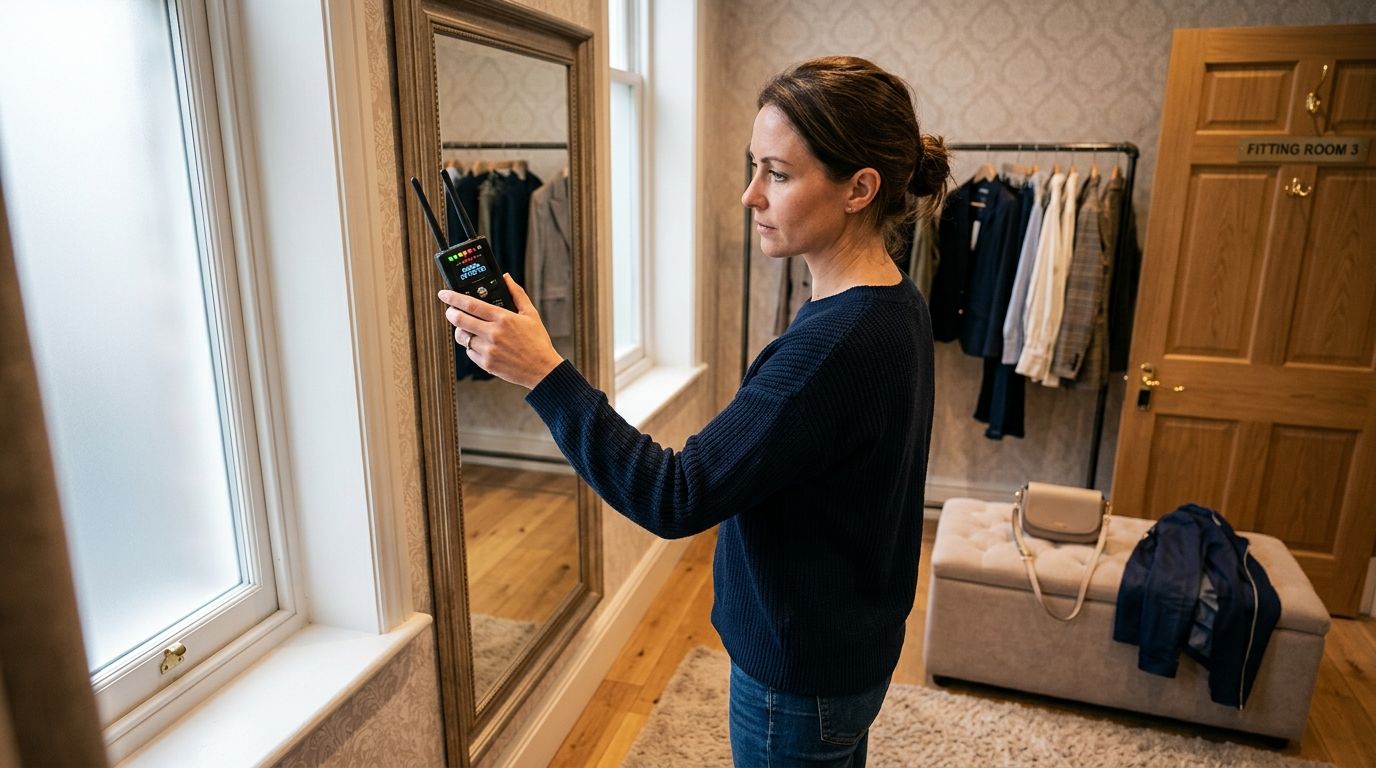
Fitting rooms are one of the highest-risk blind spots in retail security in 2026 — small, private, unmonitored by staff for minutes at a time, and legally sensitive the moment a hidden camera turns up in one. The best hidden camera detectors for fitting rooms combine RF signal detection with lens-detection scanning, and the strongest protection pairs a self-check tool with a scheduled professional TSCM sweep.
- A professional TSCM sweep catches both transmitting and non-transmitting (SD-card) cameras that handheld tools miss.
- Handheld RF detectors are the best hidden camera detectors for fitting rooms for daily staff self-checks between sweeps.
- Lens detectors find hardwired cameras with zero radio signature — RF-only tools can't see them.
- Combo RF-and-lens units are the practical middle ground for retailers who need one device, not two.
Why this matters
A hidden camera in a fitting room isn't a hypothetical for retailers in 2026 — it's a lawsuit, a news segment, and a state-level privacy violation charge depending on jurisdiction. Most states classify recording in a place with a reasonable expectation of privacy as a felony, and store owners who missed a camera planted by an employee or outside intruder have been named in civil suits alongside the person who planted it.
Self-checks with a consumer detector reduce risk between visits, but they don't replace professional-grade detection for home use or a documented commercial sweep. Insurance carriers and attorneys increasingly ask for a sweep log, not a verbal assurance, when a claim gets filed.
What makes the best hidden camera detector for a fitting room
- Detects both RF-transmitting cameras and non-transmitting cameras that only write to an SD card
- Includes a lens-detection mode that catches reflective pinhole glass through vents, hooks, and mirror edges
- Covers a wide enough frequency range to flag 2.4GHz and 5.8GHz wireless cameras, not just Wi-Fi-band devices
- Fast enough to run a full check in under 60 seconds between customers
- Doesn't throw false positives from store Wi-Fi routers, POS terminals, or RFID security tags
- Produces a documented result you can hand to legal or insurance if something is found
At a glance
| Detector Type | Best For | Standout Feature | Key Limitation |
|---|---|---|---|
| Professional TSCM Sweep | Compliance and legal protection | Full RF spectrum analysis plus physical lens inspection | Scheduled visit, not a daily tool |
| Handheld RF Signal Detector | Daily staff self-checks | Flags any transmitting device in seconds | Misses SD-card-only cameras with no transmission |
| Multi-LED Lens Detector | Finding hardwired or SD-card cameras | Reflects pinhole lenses hidden in hooks and vents | Needs low light and a slow manual scan |
| Smartphone + IR Flashlight Method | Zero-budget spot-checks | Uses a phone camera to catch IR LED glow | Unreliable on cameras with no visible IR emitter |
| Combo RF + Lens Handheld Unit | All-in-one retail security tool | Toggles between RF scan and lens sweep in one device | Less thorough than a full professional sweep |
1. Professional TSCM sweep: best for compliance and legal protection
A scheduled technical surveillance countermeasures sweep uses spectrum analyzers, nonlinear junction detectors, and a physical inspection of every fixture, mirror, and vent in the fitting room. It's the only method on this list built to catch a camera that never transmits a signal — the ones storing footage locally on an SD card, which are invisible to any RF-only detector.
USA Bugsweeps pros:
- Documented, dated result that holds up for insurance and legal purposes
- Catches both transmitting and non-transmitting devices in one visit
- Finds hardwired taps and audio devices, not just cameras
USA Bugsweeps cons:
- Requires scheduling, not an instant self-check
- Overkill for a single fitting room with no prior incident
Best for: retailers with multiple locations, prior incidents, or a compliance requirement. Verdict: Buy.
2. Handheld RF signal detector: best for daily staff self-checks
An RF detector scans the airwaves for any device transmitting a wireless signal — the method most consumer-grade hidden camera detectors rely on. Staff sweep the fitting room in under a minute at shift change, and the device beeps or lights up when it picks up a transmitting camera or bug.
RF detector pros:
- Fast, no training required
- Catches Wi-Fi and cellular-connected cameras streaming live footage
- Cheap enough to run multiple times a day
RF detector cons:
- Blind to SD-card-only cameras with zero transmission
- Can false-positive near routers, security tags, and POS hardware
A detailed walkthrough of the method sits in the guide on finding a hidden camera using an RF detector. Best for: daily between-sweep checks. Verdict: Buy.
3. Multi-LED lens detector: best for finding hardwired or SD-card cameras
Lens detectors flood a dark room with LED light at a specific angle and rely on the human eye to spot the telltale reflective glint off a camera lens — the same principle used to spot a scope or binocular lens across a field. It's the only consumer method that catches a camera with zero radio signature.
Lens detector pros:
- Catches non-transmitting cameras that RF tools miss entirely
- No electronics to malfunction or drain a battery mid-shift
- Works on cameras hidden in hooks, vents, and smoke detectors
Lens detector cons:
- Requires the room to be dark, slowing down a busy retail floor
- Manual scanning misses cameras at odd angles if the operator moves too fast
Best for: a slower, end-of-day thorough check rather than a between-customer scan. Verdict: Hold — pair it with an RF detector rather than relying on it alone.
“A camera that never transmits a signal is invisible to every RF detector on the market — that's what a lens sweep is for.”
4. Smartphone camera and IR flashlight method: best for zero-budget spot-checks
This method uses a phone's camera to view the room through an infrared flashlight app, since most cheap hidden cameras emit a faint IR glow visible only through a digital sensor. It costs nothing beyond a phone already on the sales floor.
Smartphone method pros:
- Free, no equipment purchase needed
- Staff can run it during a closing checklist without extra training
- Works reasonably well on budget cameras with visible IR LEDs
Smartphone method cons:
- Higher-end cameras with IR filters or no active IR emitter go undetected
- Slow and easy to do wrong on a first attempt
A step-by-step version of this technique is covered in detecting hidden cameras using your phone camera. Best for: small retailers with no budget for a dedicated detector. Verdict: Hold — fine as a backup, not a primary defense in 2026.
5. Combo RF + lens handheld unit: best for an all-in-one retail security tool
A combo unit puts an RF scanner and a lens-detection LED array in a single handheld device, letting one employee toggle between modes without carrying two tools. It's the practical middle ground for a retailer who wants better coverage than RF alone but doesn't want to buy two separate devices.
Combo unit pros:
- One device covers both transmitting and non-transmitting cameras
- Faster than running two separate checks back to back
- Reasonable option for multi-location retail chains
Combo unit cons:
- Each mode is generally less sensitive than a dedicated single-purpose tool
- Still won't catch what a full professional sweep finds, like hardwired taps behind drywall
Best for: retail security teams that want one tool for routine checks. Verdict: Buy as a daily-use supplement, not a replacement for scheduled professional sweeps.
Schedule a fitting room bug sweep
Get a documented TSCM sweep for your retail location.
How we ranked these
Each detector type was scored against the six criteria above — coverage of transmitting versus non-transmitting cameras, speed for a retail floor, false-positive rate, and whether the result holds up as documentation. Methods that only catch one camera type (RF-only or lens-only) ranked below tools and services that cover both.
Which hidden camera detector should you choose for a fitting room?
If you run a single-location store with no prior incident, start with a handheld RF detector for daily checks and a lens detector for a weekly deeper scan. If you've had a prior incident, operate multiple locations, or need a documented result for insurance or legal reasons, a professional TSCM sweep is the right call in 2026 — it's the only option on this list that reliably catches SD-card-only cameras alongside transmitting devices. Related setups, like hidden camera detection for gym and spa owners, follow the same logic for other private-space businesses.
FAQ
What's the best hidden camera detector for a fitting room?
A combination of a handheld RF signal detector for daily checks and a professional TSCM sweep for documented, thorough detection is the strongest setup in 2026. RF-only tools miss SD-card cameras with no wireless transmission.
Can an RF detector find every hidden camera in a fitting room?
No. RF detectors only find cameras actively transmitting a wireless signal. A camera recording to an SD card with no transmission is invisible to an RF-only device and needs a lens detector or physical inspection to find.
How often should a retailer sweep fitting rooms for hidden cameras?
Daily self-checks with a handheld RF detector are reasonable for high-traffic stores, with a full professional sweep scheduled periodically or immediately after any reported incident or staff turnover.
Is a smartphone flashlight app reliable for finding hidden cameras?
It's a useful zero-cost backup but not a primary defense. It only catches cameras with a visible active infrared LED, so cameras with IR filters or no IR emitter go undetected.
What's the difference between a lens detector and an RF detector?
An RF detector picks up wireless transmission signals from a camera or bug. A lens detector uses reflected light to visually spot a camera lens, which is the only reliable way to catch non-transmitting, SD-card-only cameras.
Do hidden camera detectors work through mirrors in a fitting room?
Lens detectors can catch a reflective lens hidden behind two-way mirror glass if the scan angle is right, but a physical inspection during a professional sweep is more reliable for mirror-based hides.
Are hidden cameras in fitting rooms illegal?
Yes, in nearly every U.S. state, recording someone in a fitting room without consent violates privacy laws and can carry felony charges, which is why retailers document their detection efforts.
Should a retail chain hire a professional sweep or rely on staff checks alone?
Multi-location retailers with prior incidents or compliance requirements should combine both: daily staff checks with a handheld detector plus a scheduled professional TSCM sweep across locations for a documented result.
One last thing
The detector detail most retailers get wrong in 2026 isn't the device — it's the assumption that an RF sweep alone is enough. A camera recording only to a local SD card with no Wi-Fi or Bluetooth radio active will pass an RF scan every single time, which is exactly why a lens-detection pass or a professional inspection matters even after a clean RF check.


