
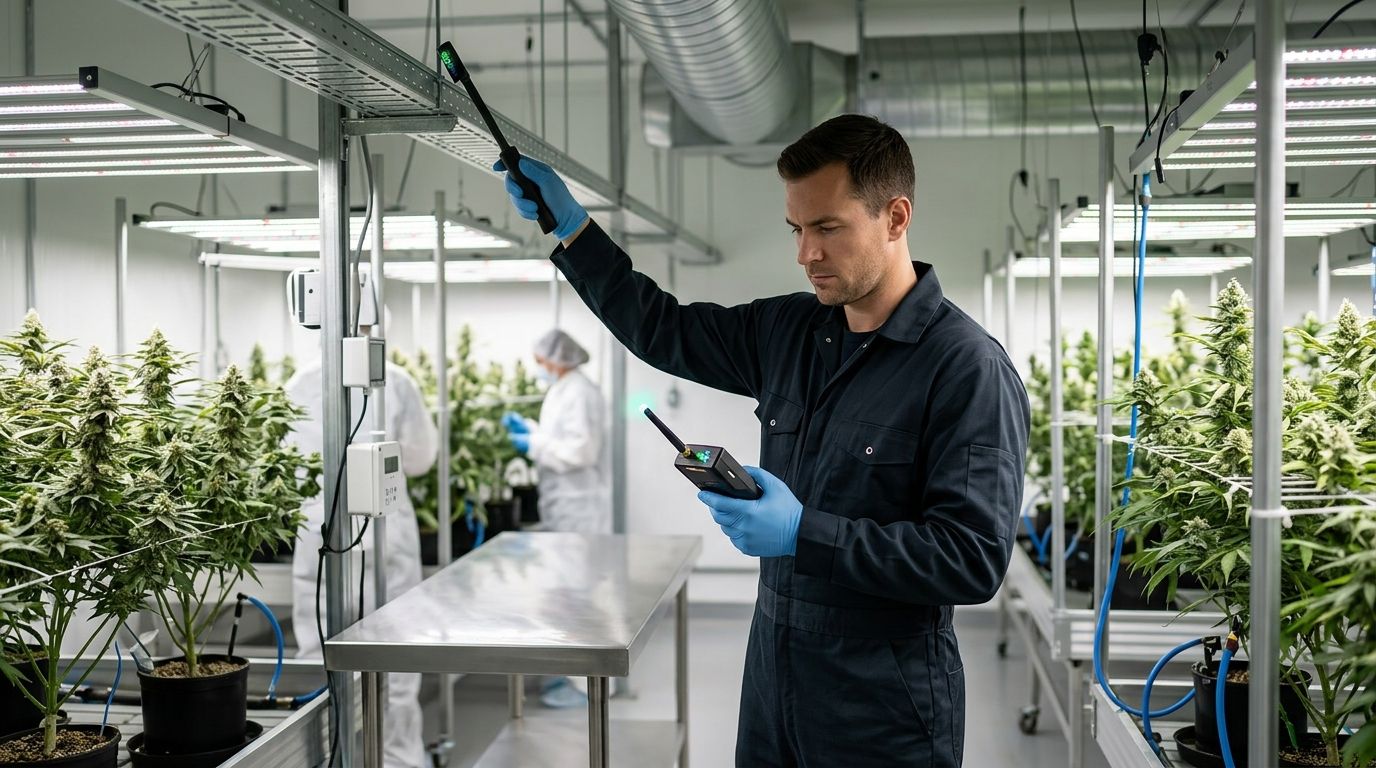
Cannabis cultivation facility bug sweeps are on-site TSCM inspections of grow rooms, drying and curing areas, control rooms, and fleet vehicles with the aim of protecting cultivar genetics, yield projections, and license compliance data from theft or leaks. A cultivation site differs from a retail dispensary because the real value sits in proprietary genetics, harvest schedules, and vendor contracts rather than cash at a point-of-sale terminal, and that changes where a sweep technician looks first.
- Bug sweep services for cannabis cultivation facilities focus on grow rooms, mother rooms, and manager offices, not just the front lobby.
- USA Bugsweeps runs TSCM inspections across cultivation sites nationwide in 2026, checking RF spectrum, wiring, and state-mandated camera systems.
- State compliance cameras are a common blind spot: monitored by regulators, never audited for tampering or added transmitters.
- DIY RF detectors catch active transmitters but miss passive bugs and wired taps hidden in HVAC or lighting infrastructure.
- Facilities investigating a genetics leak need a professional sweep before the next harvest cycle, not after.
Why bug sweeps matter for cannabis cultivation facilities
Cultivation operations run on data worth more than the flower itself: strain genetics, feeding schedules, yield-per-light numbers, and buyer contracts. A competitor, disgruntled employee, or investor on the wrong side of a dispute doesn't need to steal plants to hurt a facility. A hidden microphone in the manager's office or a camera pointed at a monitor screen does the job.
Cannabis is also one of the most heavily regulated industries still running cash-heavy transactions under mandatory state video surveillance rules. That combination attracts three distinct threats: corporate espionage targeting cultivar IP, internal theft rings coordinating around camera blind spots, and surveillance by parties building a compliance case for leverage in a dispute. Bug sweep services for cannabis cultivation facilities address all three, but the inspection has to be scoped differently than a standard office sweep because of the physical layout — grow rooms, drying rooms, and mechanical spaces that most TSCM checklists never cover.
If your facility holds a proprietary genetics library or is mid-negotiation on a licensing deal, treat a sweep as due diligence rather than a reaction to an incident. Operators who already suspect a leak should also look at the approach used for cannabis dispensary bug sweeps, since dispensary and cultivation sites usually share regulators, insurance carriers, and often the same ownership group.
How to sweep a cultivation facility for hidden surveillance
Audit your existing camera and access control system first
Before anyone brings in RF gear, inventory what is already installed and who can see the feeds. Most cultivation facilities run two camera systems — a compliance system mandated by the state and a private security system — and confusion between the two is exactly where gaps hide.
- List every camera, DVR, and NVR on the property, including units left by a prior tenant or operator
- Confirm who holds admin credentials to the video management system, including former employees
- Check for cameras rebroadcasting over Wi-Fi instead of the wired compliance network
- Flag any camera or sensor whose installer or vendor nobody can name
- Review remote access logs for the video system going back at least 90 days
Inspect grow rooms and drying areas for unauthorized transmitters
Grow rooms have metal racking, high-intensity lighting ballasts, and dense wiring. That makes them an easy place to hide a device and a difficult place to find one with a consumer detector. Drying and curing rooms are lower-traffic and get checked even less often.
- Check light fixtures, ballast housings, and timer boxes for added components
- Inspect irrigation controllers and environmental sensors for tampered wiring
- Look behind and under rolling benches, trellis anchors, and drying racks
- Sweep HVAC vents and dehumidifier housings, common spots for audio devices
- Check any USB ports or outlets added after the original electrical build
Check the security office and manager's office for compromised devices
The room where compliance reports, buyer contracts, and genetics records get discussed is a higher-value target than the grow floor. Anyone can walk a grow room. The office is where the numbers get said out loud.
- Inspect phones, desk clocks, power strips, and smoke detectors for hidden microphones
- Check the network switch and any unfamiliar Ethernet drops behind furniture
- Look at wall outlets and USB chargers for added transmitters
- Confirm the office router hasn't been reconfigured or cloned — the same checks used to detect a compromised Wi-Fi router apply to a facility office
- Review which recent visitors — investors, contractors, vendors — had unsupervised time in the room
Protect genetics and cultivation IP conversations
Strain genetics and cross-breeding records are the closest thing a cultivation facility has to a trade secret, and they get discussed in rooms where staff also take breaks and run vendor calls. Give those conversations the scrutiny a tech company gives an engineering meeting.
- Sweep every room where genetics, tissue culture, or mother plant decisions are discussed
- Confirm laptops running cultivation software aren't carrying unauthorized remote access tools
- Check USB drives and external storage handed to contractors or consultants
- Restrict and log physical access to the mother room and tissue culture lab
- During active licensing or investment talks, apply the same standard used for protecting trade secrets
Check company vehicles and transport routes for GPS trackers
Cultivation-to-dispensary transport runs on fixed schedules and repeatable routes, which makes a delivery vehicle an easy target for anyone tracking product movement or timing a diversion. A tracker in a wheel well is cheap to plant and easy to miss.
- Check undercarriage, wheel wells, and bumper cavities on every transport vehicle
- Inspect the OBD-II port for unauthorized plug-in devices
- Review fleet management software for devices nobody on staff installed
- Ask drivers to report unfamiliar vehicles appearing on delivery routes
- For multi-vehicle operations, run the checks used for warehouse and distribution fleet GPS sweeps
Bring in a TSCM technician for a full-spectrum sweep
Once the manual checks are done, a TSCM technician runs equipment your team doesn't own — spectrum analyzer, nonlinear junction detector, thermal camera — to catch passive bugs, dormant transmitters, and wired taps a walkthrough will never find. USA Bugsweeps performs full-facility TSCM inspections for cannabis cultivation facilities nationwide in 2026, covering grow rooms, offices, and vehicles in a single visit.
- RF spectrum sweep across the full facility, including grow rooms and mechanical spaces
- Nonlinear junction detection for devices that are powered off or dormant
- Physical inspection of outlets, fixtures, and furniture in offices and break rooms
- Wiretap check on landline and VoIP phone systems
- Written report documenting findings, usable for insurance or licensing disputes
Set a recurring sweep schedule tied to your compliance calendar
One sweep is a snapshot. Cultivation facilities rotate seasonal workers, contractors, and vendors constantly, and every rotation is a fresh opportunity to plant a device.
- Sweep before major harvest cycles, when yield data is most sensitive
- Re-sweep after any termination involving access to genetics or financial records
- Sweep after any vendor completes electrical, HVAC, or camera work
- Time sweeps alongside state compliance audits so a clean facility is documented
Comparing your options for cultivation facility bug sweeps
| Option | Best for | Key limitation |
|---|---|---|
| DIY RF detector check | Small operations doing routine checks between professional visits | Misses passive devices, wired taps, and anything buried in grow-room wiring |
| Professional TSCM sweep (USA Bugsweeps) | Facilities protecting cultivar genetics, yield data, or a pending licensing deal | Requires scheduling an on-site technician rather than an instant check |
| Security camera vendor audit | Sites leaning heavily on state-mandated compliance video | Vendor checks only their own equipment, not third-party bugs or taps |
| Licensed private investigator | Investigating one specific suspected leak or theft ring | Not equipped with dedicated RF or nonlinear junction detection gear |
Verdict: a DIY RF check is fine for routine spot-checks, but any facility holding proprietary genetics or facing a specific theft suspicion needs a professional TSCM sweep, not a consumer detector.
Get a bug sweep quote for your facility
Nationwide TSCM inspections for cultivation sites, with 24/7 instant quotes.
Common mistakes cannabis cultivation facilities make
- Assuming state-mandated cameras count as security. Compliance cameras exist for regulators. They will not catch a microphone in the manager's office.
- Skipping mechanical and HVAC rooms. Dense wiring and constant background noise make these the best hiding spots in the building, and almost no walkthrough goes there.
- Not re-sweeping after seasonal turnover. Trimmers and harvest crews rotate every cycle, and each new badge is a new access point.
- Treating the mother room as low-risk. It holds the actual genetics IP, yet access controls there are usually looser than at the cash vault.
- Waiting until after a leak to call a technician. Once a competitor is growing your cultivar, the sweep is forensic rather than preventive.
FAQ
What do bug sweep services for cannabis cultivation facilities actually check?
A professional sweep covers grow rooms, drying and curing areas, offices, security control rooms, and vehicles, looking for hidden cameras, audio bugs, GPS trackers, and wiretaps using RF spectrum analysis and nonlinear junction detection. USA Bugsweeps also reviews existing camera systems and network hardware for signs of tampering.
Are cultivation facilities more at risk than dispensaries?
Cultivation facilities carry a different risk profile because the value sits in genetics, yield data, and licensing information rather than cash at a register. A leaked cultivar or feeding schedule can erase a competitive edge that took years to build.
Can a DIY RF detector find a hidden bug in a grow room?
A consumer RF detector can find an actively transmitting device in an open area, but grow room wiring, metal racking, and lighting ballasts create interference that masks weaker signals. It also cannot detect passive or dormant devices, which is where a nonlinear junction detector matters.
How often should a cultivation facility get swept?
Sweep before major harvest cycles, after any termination involving access to genetics or financial data, and after any vendor finishes electrical or camera work. Facilities in active licensing negotiations should sweep more frequently.
Do state-mandated compliance cameras protect against hidden surveillance?
No. Compliance cameras satisfy state cannabis control board requirements and are monitored by regulators, but nobody audits them for tampering, cloned feeds, or added transmitters unless the facility specifically asks.
What is the biggest blind spot in cultivation facility security?
Mechanical rooms, HVAC systems, and drying or curing areas, because they are low-traffic and do not feel like high-value targets. Their dense wiring makes them the easiest places in the building to hide a device.
Should transport vehicles be checked for GPS trackers too?
Yes. Cultivation-to-dispensary transport runs on predictable routes and schedules, which makes delivery vehicles a soft target for anyone tracking product movement. Check the undercarriage, wheel wells, and OBD-II port on every vehicle in the fleet.
What happens after a TSCM sweep finds a device?
The technician documents the device, its location, and how it was powered, then issues a written report you can use for an internal investigation, an insurance claim, or law enforcement. USA Bugsweeps includes that documentation with every cultivation facility sweep.
One last thing
The room most cultivation facilities skip entirely is the mother room — the space holding the genetics library everything else in the operation depends on. It is smaller, lower-traffic, and managed as a plant-health concern rather than a security one, which makes it the easiest room in the building to bug and the last one anyone thinks to check in 2026.


