
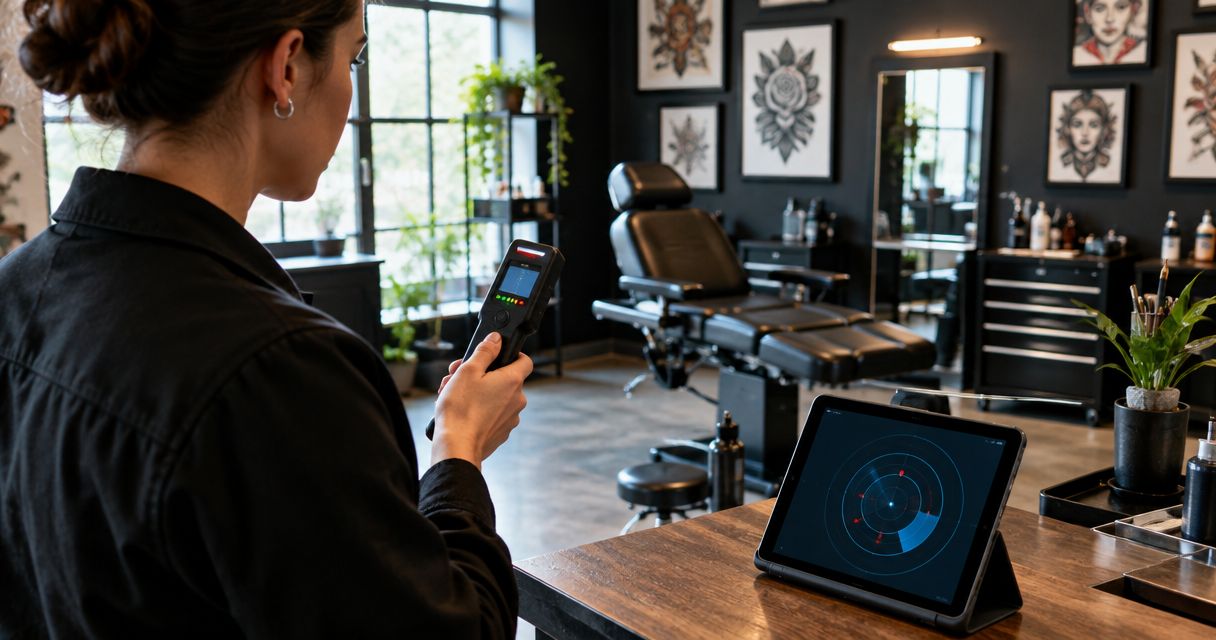
Tattoo and piercing studios need hidden camera detection because private procedure rooms, where clients remove clothing for lower-back tattoos, chest pieces, or genital piercings, are exactly the setting a hidden camera is designed to exploit. A studio's privacy risk is different from a retail shop or office: clients are alone with a single staff member, often partially undressed, in a room with a locked door and no windows — the ideal condition for a pinhole camera to go unnoticed for months.
- Hidden camera detection for tattoo and piercing studios starts with a visual sweep of private procedure rooms before any RF tools come out.
- Smoke detectors, wall clocks, and USB wall chargers are the three most common camera hosts found in body-privacy businesses in 2026.
- A phone flashlight test catches reflective lenses but misses cameras hidden behind fabric, vents, or opaque plastic.
- USA Bugsweeps runs full TSCM sweeps that combine RF detection, thermal imaging, and network scans for studios that need certainty, not guesswork.
- Guest artists renting a booth for a weekend are a documented blind spot most studio owners never screen.
Why hidden camera detection matters for tattoo and piercing studios
A tattoo or piercing studio has more single-client, closed-door rooms per square foot than almost any other small business. Piercing consultation rooms, private tattoo booths, and aftercare stations all involve a client removing clothing or exposing skin in a space they assume is private and a staff member controls.
That combination — locked door, undressed client, one other person present — is the exact scenario news outlets keep reporting cameras hidden in, from gym locker rooms to medical exam rooms. Studios face the same exposure, and the liability sits with the business owner whether the camera was placed by an employee, a former renter, or someone with brief unsupervised access to the room.
The fix isn't paranoia. It's a documented, repeatable check that becomes part of how the studio operates in 2026, the same way autoclave logs and sterilization checks already are.
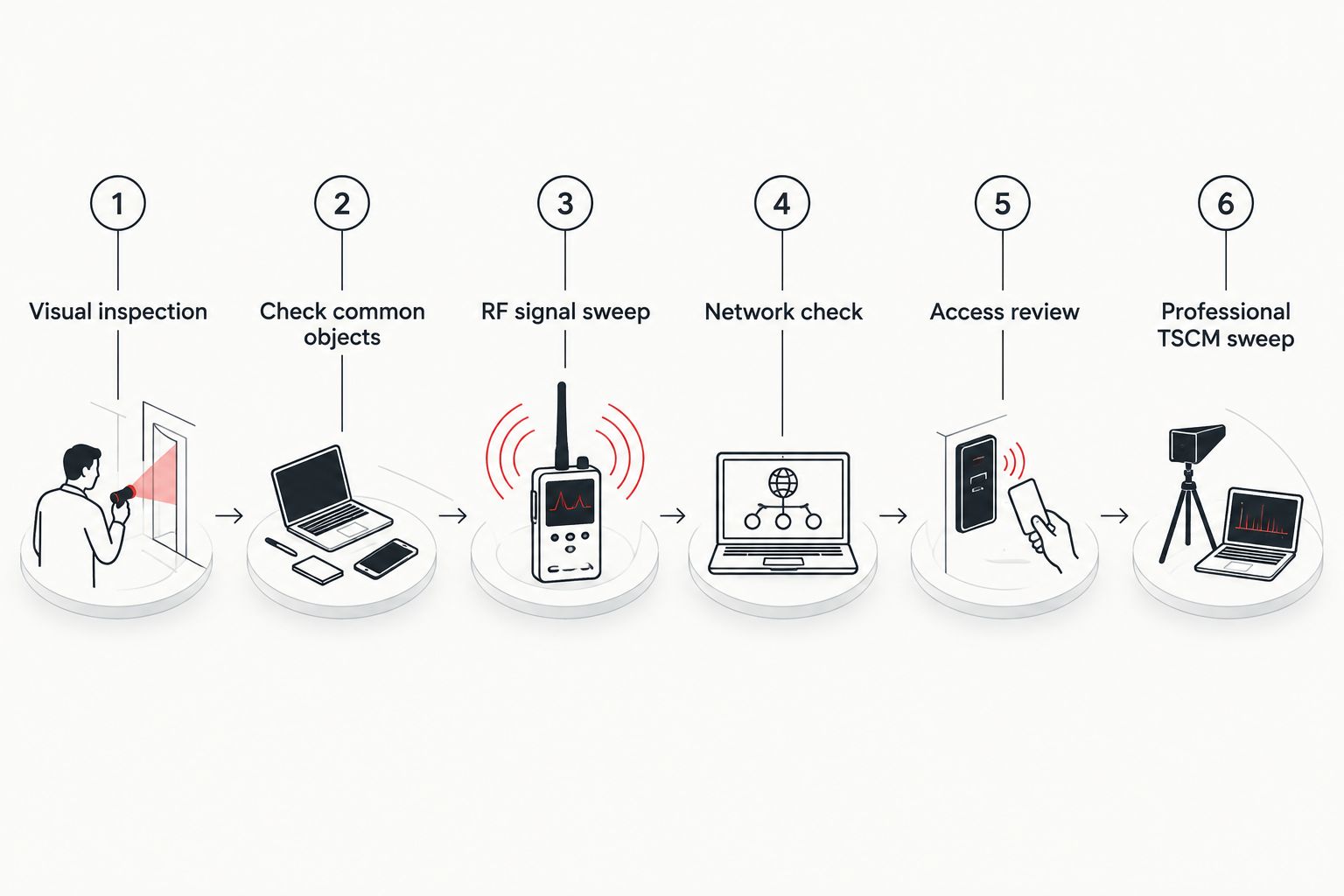
Step 1: Inspect every private room before it opens for the day
A five-minute visual pass at open and close catches the cameras an amateur installs — the ones bought online and pushed into an existing object rather than custom-built into the wall.
- Check smoke detectors and CO2 detectors for a lens dot or an unusual angle on the housing
- Look at wall clocks, especially ones mounted at eye level facing the tattoo chair or piercing table
- Check USB wall chargers and power strips plugged in near the client's position — these are a common host because nobody questions a charger
- Scan air purifiers, humidifiers, and any decorative object added recently by a specific staff member
- Check the mirror for a two-way glass tell: press a fingertip to the surface — a gap between the fingertip and its reflection means real glass, no gap means it could be two-way
Step 2: Check the objects cameras actually get built into
Generic "look around the room" advice misses the point — commercial spy cameras are designed to disappear inside specific everyday objects, and studios have all of them.
- Smoke detectors mounted directly above the tattoo chair or piercing table (see how a camera gets built into a smoke detector)
- Wall-mounted air fresheners or diffusers with an unusual front panel
- Fire alarm units placed lower on the wall than code typically requires
- Picture frames or wall art hung at a height that lines up with the client's undressed area
- Tissue boxes or supply caddies kept on a shelf facing the procedure table
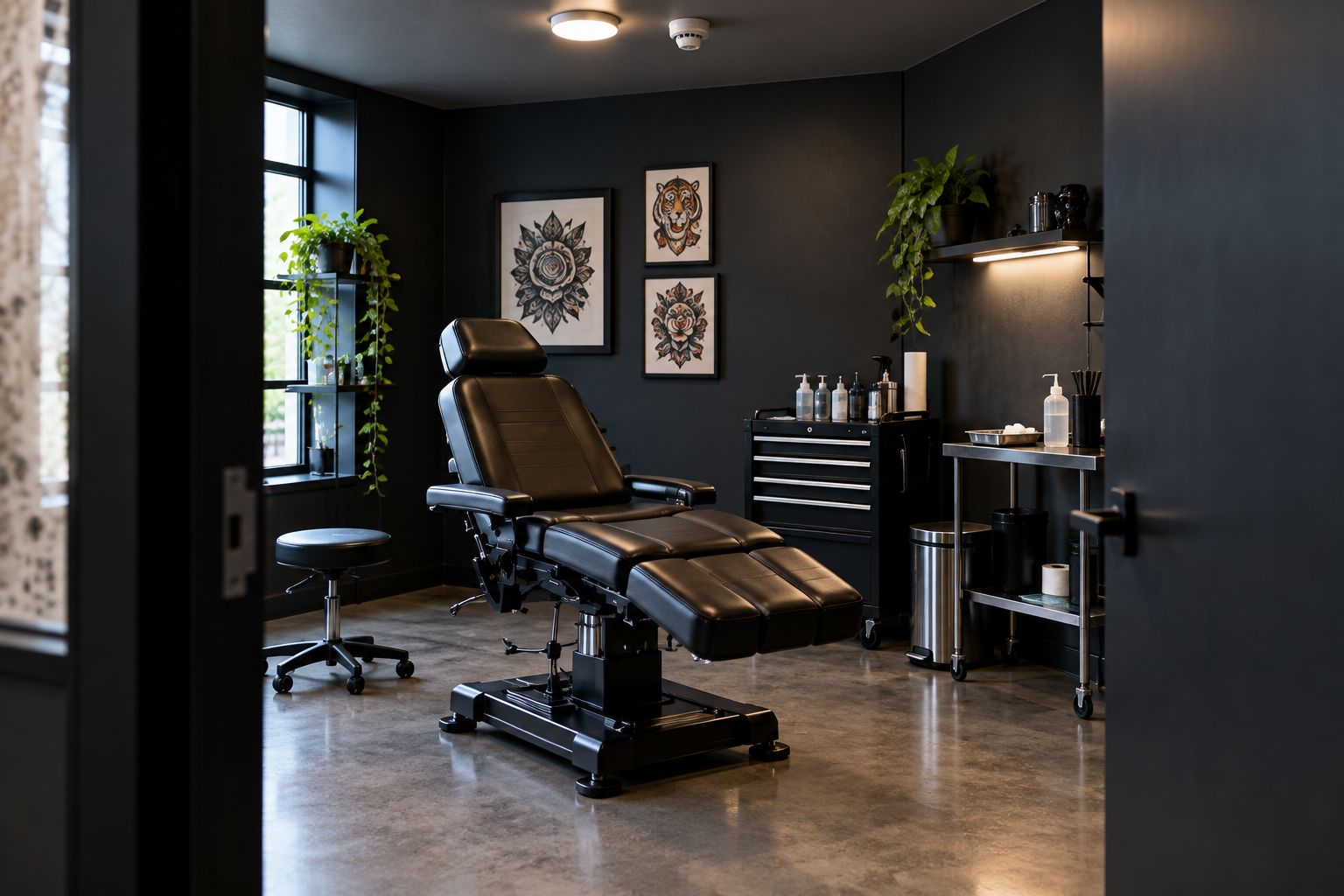
Step 3: Sweep for RF signals from wireless cameras
Most consumer spy cameras transmit over Wi-Fi or a separate 2.4GHz/5.8GHz radio signal, which means a radio frequency (RF) detector can pick them up even when the camera is hidden from view.
- Turn off phones and other Wi-Fi devices in the room before scanning to reduce false positives
- Walk the RF detector slowly along walls, ceiling corners, and any object identified in Step 2
- Pay closest attention to areas within 3-4 feet of the procedure table, where signal strength peaks near the source
- Repeat the sweep with the studio's own Wi-Fi router both on and off to isolate signals that don't belong to the studio's network
- Note any signal spike that doesn't correspond to a known device — that's the one worth investigating with a lens detector next
Step 4: Check the studio's Wi-Fi network for devices that shouldn't be there
Cameras with cloud storage don't just broadcast RF — they connect to Wi-Fi and phone home. A studio's router admin panel lists every connected device, and an unfamiliar one is a red flag.
- Log into the router admin panel and pull the list of connected devices
- Match every device to a known staff phone, POS terminal, or point-of-sale tablet
- Flag anything labeled generically ("ESP-CAM," "IP-Camera," a string of numbers) for immediate investigation
- Change the Wi-Fi password after any sweep, especially if the studio shares login credentials with former employees or booth renters
- Consider a separate guest network for clients so the operational network stays isolated
Step 5: Review who has had unsupervised access to private rooms
Most cameras placed in a business aren't planted by a stranger — they're placed by someone who already had a key or a reason to be in the room alone. Guest artists renting a chair for a weekend, contractors doing repairs, and even a disgruntled former employee all fit that profile.
- Track who has keys or door codes to each private room, and update codes when staff or renters leave
- Require guest artists to bring their own supplies rather than leaving personal equipment installed in the room
- Log maintenance visits (electricians, HVAC techs) with a timestamp and which rooms they accessed
- Do a visual and RF check after any contractor work, before the room is used with a client again
- Rotate access codes at least quarterly, not just after a suspected incident
Step 6: Bring in a professional TSCM sweep for full coverage
DIY checks catch consumer-grade cameras bought off a marketplace app. They miss professional-grade devices with no wireless signature, cameras hardwired into existing electrical, or audio devices that don't transmit at all. What to expect during a professional TSCM bug sweep covers the process in detail, but the short version for a studio owner: a technician brings spectrum analyzers, thermal cameras, and physical inspection tools that go beyond what a $40 RF detector can find.
A professional sweep makes sense before opening a new location, after any staff termination involving access to private rooms, or on a recurring schedule if the studio has had privacy complaints in the past.
Comparison of detection options for tattoo and piercing studios
| Option | Best for | Key limitation |
|---|---|---|
| Visual inspection | Daily open/close routine, catching obvious consumer cameras | Misses cameras with no visible lens or hidden inside sealed housings |
| Phone flashlight test | Quick spot-check between clients | Only catches reflective lenses in direct line of sight |
| RF signal detector | Finding wireless cameras and hidden microphones | Misses devices with no wireless transmission, false positives near routers |
| Wi-Fi network audit | Catching cloud-connected cameras | Doesn't detect devices that store footage locally, no network needed |
| Professional TSCM sweep | Full coverage before opening, after staff turnover, or after a complaint | Requires scheduling a technician rather than doing it yourself |
A studio that only does visual checks is covering the cameras a beginner would use, not the ones a determined person would install. Layering RF and network checks on top closes most of that gap; a professional TSCM sweep closes what's left.
Common mistakes tattoo and piercing studios make
- Checking only the lobby and front desk. Cameras placed for financial fraud target the register; cameras placed for privacy violations target the private rooms, and those get skipped in a general walkthrough.
- Assuming a locked door means privacy. A locked door stops someone from walking in during the appointment — it does nothing about a device already installed before the client arrives.
- Never screening guest artists or booth renters. A weekend renter with unsupervised access to a private room is a documented blind spot most studios never think to check after they leave.
- Skipping the Wi-Fi audit entirely. Studio owners check for visible cameras but never look at what devices are actually connected to their own network.
- Sweeping only after a complaint. By the time a client reports something, footage may already exist. A proactive quarterly check catches devices before they cause damage, not after.
A comparable pattern shows up in other body-privacy businesses — see how hidden camera detection works for massage therapy studios for a close parallel to the piercing-room scenario.
FAQ
What's the best way to detect a hidden camera in a tattoo studio?
Start with a visual inspection of smoke detectors, wall clocks, and USB chargers near the procedure table, then follow with an RF signal sweep. For full coverage, a professional TSCM sweep checks for devices with no wireless signature that a handheld detector would miss.
How often should a piercing studio sweep for hidden cameras?
A daily visual check at open and close catches obvious devices, while a full RF and network sweep on a quarterly basis or after any staff turnover covers what a quick look can't. Studios with a prior privacy complaint should sweep more frequently.
Can a smoke detector really hide a camera in a private piercing room?
Yes. Off-the-shelf smoke detector cameras are sold widely online and are one of the most common hosts found during studio and salon sweeps because nobody questions a smoke detector mounted on the ceiling.
Is a phone flashlight test reliable for finding hidden cameras?
A flashlight test catches reflective camera lenses in direct line of sight but misses anything hidden behind fabric, vents, or opaque housing. It's a useful first pass, not a complete check.
How much does a professional bug sweep cost for a small studio?
Cost depends on the number of rooms and the scope of the sweep. See [how much a professional bug sweep costs](https://usabugsweeps.byryze.com/how-much-does-a-professional-bug-sweep-cost) for the factors that affect pricing.
Do RF detectors catch battery-powered hidden cameras?
Only if the camera transmits wirelessly. A battery-powered camera that records to a local memory card and never connects to Wi-Fi produces no RF signal and won't show up on a handheld detector.
Should new guest artists renting a booth be screened for camera-related risks?
Yes. A guest artist with unsupervised access to a private room for even one weekend is enough time to install a device, so a post-rental visual and RF check should be standard before the room is used with the next client.
What happens during a professional TSCM sweep of a studio?
A technician inspects each private room with spectrum analyzers, thermal imaging, and physical checks of outlets, fixtures, and wiring, then reviews the studio's network for unauthorized connected devices. The process typically covers every room with a locked door, not just the one that raised a concern.
One last thing
The cameras that actually get discovered in body-privacy businesses in 2026 are rarely the sophisticated, professionally-installed kind — they're consumer devices bought off a marketplace app and pushed into a smoke detector or charger because the installer assumed nobody would look closely. A five-minute visual check at open and close stops most of that risk before it ever needs an RF detector or a technician.


