
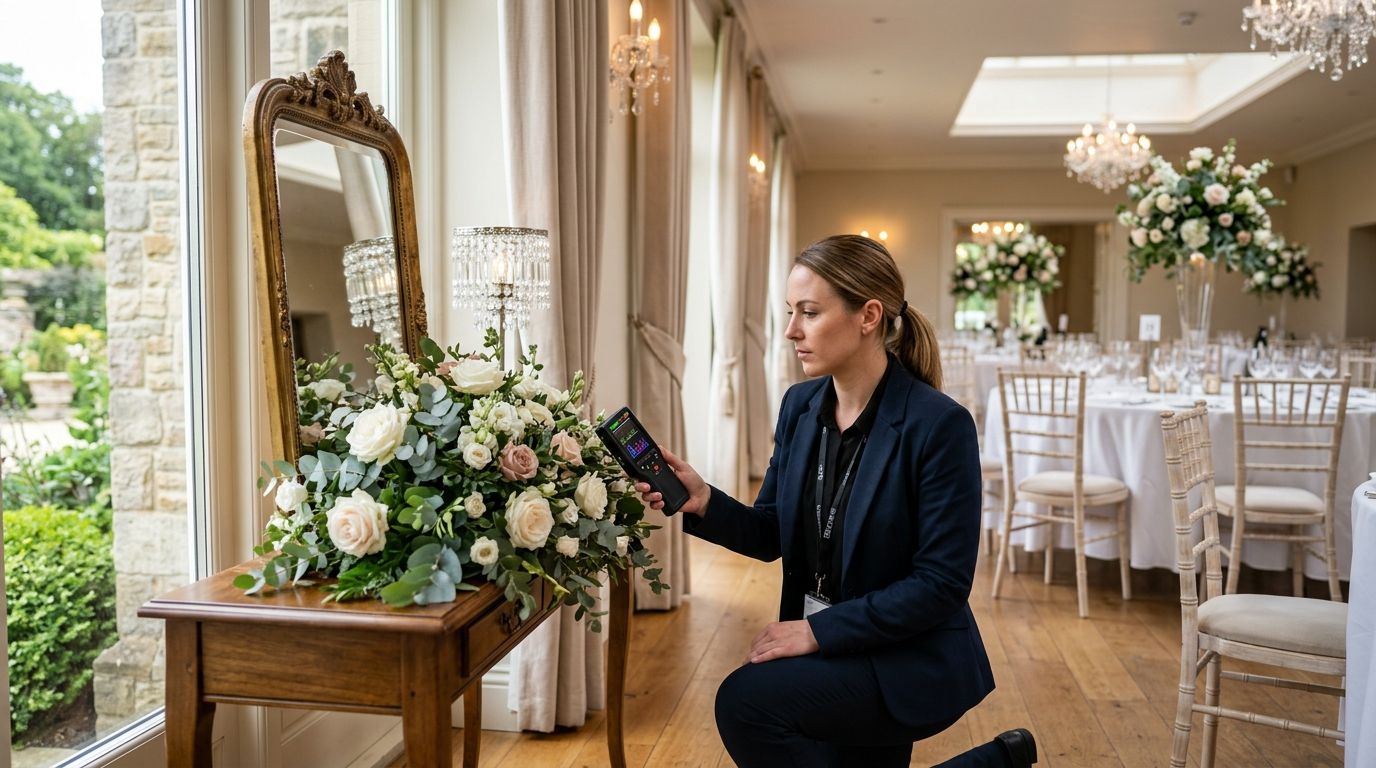
Hidden camera detection for wedding and event venues is the process of screening reception halls, bridal suites, restrooms, and getting-ready rooms for concealed recording devices before guests, vendors, or wedding parties ever walk through the door. Venues host a different guest list every weekend, and the room that held one bride's dress fittings on Saturday hosts a corporate holiday party on Sunday, so the screening has to repeat, not happen once at opening.
- Hidden camera detection for wedding venues means sweeping bridal suites, restrooms, and getting-ready rooms before every single booking, not once a year.
- Smoke detectors, USB chargers, and wall clocks remain the most common hiding spots for pinhole cameras in rented event spaces.
- A phone-camera check catches obvious lenses in a dark room but misses wireless transmitters hidden inside outlets or fixtures.
- USA Bugsweeps runs full RF-spectrum TSCM sweeps for venues before and after high-profile bookings, weddings, and repeat events.
- Sweep again after the event ends, not just before doors open, since vendors and staff have access during teardown too.
Why hidden camera detection matters for wedding and event venues
A wedding venue puts strangers into intimate spaces on a rotating basis: bridal suites where guests change clothes, restrooms, cabanas, and green rooms used for nursing or private moments. Unlike a hotel room booked by one guest, an event space sees dozens of vendors, contractors, and previous renters cycle through in a single week, which multiplies the number of people who had unsupervised access to install something.
News coverage over the past several years has repeatedly turned up hidden cameras in changing rooms, restrooms, and rental properties, planted by staff, ex-partners, or previous occupants rather than strangers off the street. Venue owners carry the liability when a device is found on their property, regardless of who planted it, which is why proactive hidden camera detection for hotel guests practices have become standard at properties that host overnight guests alongside events.
Event venues also deal with a second risk category: outside vendors bringing their own equipment. Photographers, DJs, videographers, and florists all move gear in and out on event day, and any one of them could leave a device behind, intentionally or not.
Walk every private room before guests arrive
Start with a physical walk-through of every space guests will use unsupervised: the bridal suite, groom's room, restrooms, coat check, and any green room or lactation space.
- Look for anything that doesn't match the room's existing decor or fixtures
- Check for new holes, scratches, or tape residue on walls and ceiling tiles
- Inspect items facing the bed, mirror, or changing area directly
- Note any device with a blinking LED, even a faint one
- Move furniture that wasn't there during the last event
This walk-through takes 15-20 minutes for a mid-size venue and costs nothing beyond staff time. It won't catch a well-hidden wireless device, but it eliminates the obvious cases fast.
Check the usual hiding spots room by room
Most pinhole and wireless cameras found in rental spaces sit inside objects that already belong in the room, which is why a surface glance misses them.
- Smoke detectors and CO2 detectors, especially ones mounted lower than code requires
- Wall clocks, especially digital ones with an unusually large lens-sized dot
- USB wall chargers and power strips plugged into unused outlets
- Floral arrangements, centerpieces, or decor items with a small opening
- Exit signs and light fixtures near the ceiling line
- Bathroom vents and towel dispensers
A hidden camera in a smoke detector is one of the most common placements found in short-term rentals and event spaces because the housing already has a hole pattern that hides a lens without modification.
Test for wireless camera signals
Once the visual check is done, test for wireless transmission, since many modern devices send footage over Wi-Fi rather than storing it locally.
- Turn off the venue's own Wi-Fi router and check for any unfamiliar network still broadcasting
- Darken the room and sweep it with a phone flashlight, looking for a lens glint
- Use a phone's camera in night mode to spot infrared LEDs invisible to the naked eye
- Check the router's connected-devices list for anything unnamed or unrecognized
- Note any device warm to the touch with no obvious power source
A phone-camera sweep catches cameras with visible or IR-emitting lenses but misses devices without active transmission at the time of the check, and it can't detect audio-only bugs or GPS trackers left in vendor vehicles. For a bridal suite before a high-profile wedding, or a venue that's hosted a complaint before, a professional TSCM sweep from USA Bugsweeps covers the RF spectrum a phone can't reach, including devices that transmit intermittently to avoid detection.
Schedule a Professional Venue Sweep
TSCM sweeps for wedding and event venues, before and after bookings.
Vet every vendor bringing outside equipment
Photographers, DJs, videographers, and catering staff move their own gear through the venue on event day, and any one of them can leave a device behind, whether accidentally or on purpose.
- Ask vendors for a rough equipment list before load-in
- Require vendors to remove all personal gear during teardown, not the next morning
- Flag any equipment left overnight in restricted areas
- Cross-check vendor badges or contracts against who's actually on-site
Lock down the guest Wi-Fi network
A shared or reused Wi-Fi password from a previous event gives anyone who attended that event ongoing access to the venue's network, including any camera already connected to it.
- Reset the guest Wi-Fi password before every booking
- Set the router to hide the connected-devices list from guests
- Segment guest Wi-Fi from any network tied to venue security cameras or point-of-sale systems
- Check the router logs after the event for unfamiliar device names
Sweep again after the event ends
Most venues only think to check before doors open, but staff, vendors, and contractors keep access through teardown, sometimes for hours after guests leave. A device planted during the reception, or left by a vendor packing up, won't show up in a pre-event sweep.
Treat teardown as its own checkpoint: repeat the visual walk-through of the bridal suite and restrooms once the last vendor has left. This matters just as much for a rented short-term property doubling as an event space, similar to what's covered for Airbnb and vacation rental hosts who deal with turnover between every guest.
Build a recurring sweep schedule for repeat venues
A venue hosting weddings, galas, or corporate events every weekend can't treat detection as a one-time project. Set a schedule that matches booking frequency, not a calendar reminder six months out.
- Log every swept area with a date, so staff know what's current
- Sweep bridal suites and private rooms weekly at minimum during peak season
- Schedule a full professional sweep quarterly, or after any incident report
- Apply the same checklist to any space serving alcohol, since those areas see similar staff and guest turnover, as outlined for restaurants and bars
Comparing detection options for wedding and event venues
| Option | Best for | Key limitation |
|---|---|---|
| Phone-camera visual check | Quick pre-event screening on a budget | Misses non-transmitting or well-hidden devices |
| Consumer RF detector | Venues doing weekly self-checks | Limited frequency range, false positives near Wi-Fi routers |
| Professional TSCM sweep (USA Bugsweeps) | High-profile weddings, repeat venues, post-incident checks | Requires scheduling ahead of the event |
| Vendor equipment audit | Any venue using outside photographers or DJs | Relies on vendor honesty about their own gear |
Verdict: a phone-camera check works as a daily habit, but any venue hosting a high-profile wedding or repeat corporate bookings in 2026 needs a professional TSCM sweep at least once per season.
Common mistakes wedding and event venues make
- Sweeping only the reception hall. The bridal suite and restrooms are higher-risk private spaces and get skipped because they're smaller.
- Treating a grand-opening sweep as permanent. A venue that swept once when it opened has had dozens of turnovers since, each one a new access point.
- Not checking vendor equipment. Photographers and DJs bring gear nobody on staff inspects.
- Ignoring fixtures left by previous tenants. A venue that took over a former hotel banquet hall may inherit devices installed years earlier.
- Relying on guest complaints instead of proactive checks. By the time a guest reports something, the footage or audio may already exist.
FAQ
How much does hidden camera detection for a wedding venue cost in 2026?
Cost depends on venue size and the number of rooms swept, and current rates should be confirmed directly with a TSCM provider. Request a quote based on the specific spaces needing coverage rather than a flat per-square-foot estimate.
Where do hidden cameras usually get placed in event venues?
Smoke detectors, wall clocks, USB chargers, and floral centerpieces are the most commonly reported hiding spots in rented event and hospitality spaces. Bridal suites and restrooms see the highest concentration of reported cases because they are used for changing.
Can a phone camera really find a hidden camera?
A phone camera in night mode can spot infrared LEDs on active cameras and catch visible lens glints in a darkened room. It will not detect devices that are not transmitting at the moment of the check, or audio-only recorders.
Do venues need to sweep before every single event?
Yes, if the venue hosts a different group every booking, since each event introduces new vendor access and guest turnover. A quarterly professional sweep combined with a quick visual check before each event covers most venues.
Is it legal for a venue to sweep for hidden cameras?
Yes, a property owner or manager has the right to inspect their own premises for unauthorized recording devices. The legal question arises around who installed the device and their intent, not around the venue's right to search for it.
What is the difference between an RF detector and a full TSCM sweep?
A consumer RF detector scans a narrow frequency range and often triggers false positives near Wi-Fi routers or Bluetooth devices. A professional TSCM sweep from USA Bugsweeps covers the full RF spectrum plus physical and network inspection, catching devices a consumer tool misses.
Should venues sweep after the event too, not just before?
Yes, since vendors and staff retain access through teardown, sometimes for hours after guests leave. A post-event check of the bridal suite and restrooms catches anything planted during the reception itself.
One last thing
The bridal suite and restrooms get swept last, if at all, because staff assume the reception hall carries the most risk. In practice, those two private rooms are exactly where a concealed device does the most damage and where it is least likely to be noticed until a guest reports something. Put them first on the 2026 checklist, not last.


